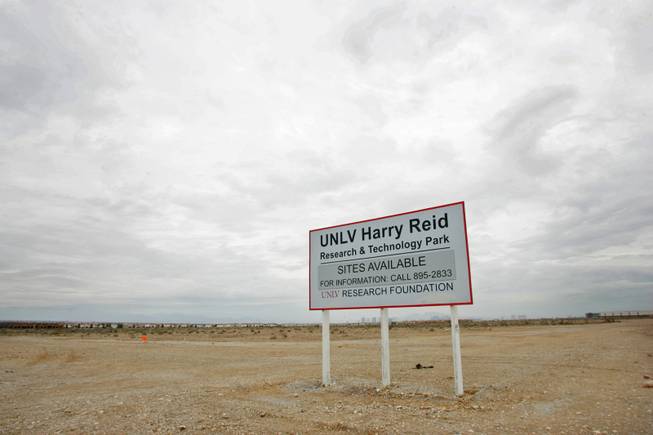
The credit crunch has hurt efforts to recruit developers to the UNLV Harry Reid Research and Technology Park. The park’s goal is to draw companies that will produce practical applications of research at UNLV.
Sunday, Jan. 25, 2009 | 2 a.m.
In Today's Sun
Beyond the Sun
Decade-old dreams of building a university business park that would bring research and technology jobs to Las Vegas could be put on hold.
The UNLV Research Foundation, overseeing development of the 122-acre project, is in danger of running out of money, and the site remains empty desert.
The foundation, funded through federal grants, has enough revenue to pay employees through the end of 2009. The Commercial Development and Management Corp., a nonprofit corporation the foundation has hired to help develop the research park, can afford staffing through June 2010.
But without new sources of income, the project “might go into a dormant period,” said Bud Pittinger, chief executive officer of the nonprofit, which depends on the research foundation for funding.
Across the country, research and technology parks have improved higher education institutions’ research capabilities. At Iowa State University’s research park, for example, businesses employ about 200 students. Companies there spin faculty members’ research into marketable products, such as a nutritional supplement that helps athletes build muscle and strength more quickly.
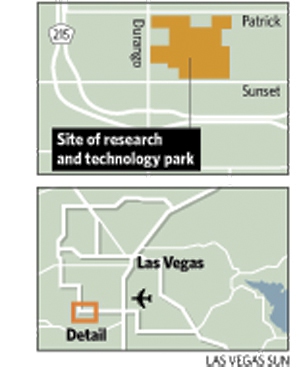
University officials hope the UNLV Harry Reid Research and Technology Park at South Durango Drive and West Sunset Road will yield similar successes with UNLV’s specialties, such as solar energy and water research.
That day, however, could still be far away.
The research foundation’s budget crunch is due in part to a failure to persuade any companies to locate at the park.
Lease money from developers — when it begins coming in — is to provide revenue for the foundation and its development and management corporation. Developers would make money by building office and research facilities to rent to businesses.
The foundation has agreed to allow the first 30 acres of land to be leased to commercial real estate developers who will have the authority to choose tenants that could include companies that do little research, such as professional services firms, Pittinger said.
That disturbs Clark County Commissioner Steve Sisolak, whose district includes the research park. “We’ve got an abundance of office space,” he said of Clark County. “We’re discouraging developers from building more of it until some of it gets absorbed.”
He believes the business park should stick to the mission of bringing research and technology companies to Las Vegas, which would diversify industry in the region.
The amount of time it is taking to build the park frustrates Sisolak, who, prior to taking his seat on the commission this month, was a regent for a decade.
“I’m sometimes not the most patient person when it comes to this stuff,” he said. “They keep saying, ‘We’ve got plans, we’ve got plans, we’ve got plans,’ and I’m not seeing results.”
Though higher education officials and Sen. Harry Reid, D-Nev., have been talking about the park for about 10 years, the research foundation did not receive title to the property until June 2005. The county owned it previously.
The process of securing county approval to develop the site as desired took about 1 1/2 years and was completed in November, Pittinger said.
Several developers interested in the location dropped out of serious talks last summer as the economy dived, he said. He said he does not know when the park might land its first tenants.
“There’s no perceptible financing out there for a builder to get money,” he said.
One bit of bright news is that the park’s groundbreaking will likely take place soon — for the main road running through the site, at least.
Pittinger expects construction of the main entrance, including the road — lined with date palms — to begin in the second quarter of 2009. Sewers are also to be built. A $2 million grant from the federal Economic Development Administration is to pay for that infrastructure, which should help entice private companies.
If none comes, the foundation’s volunteer board members, including top university officials and business leaders, will have tough decisions to make.
Turning to the state for help in staffing the foundation does not appear to be an option. With the governor proposing a 36 percent cut in Nevada’s public higher education system, the system is in no shape to help pay for the business park’s development.
“I don’t know where we would get the money right now,” Michael Wixom, chairman of the system’s Board of Regents, said this month. “I wouldn’t want it to go dormant, but I have no idea where we’d get the funds.”
Pittinger said this month that the research foundation planned to apply for a federal grant to study whether the park could qualify for certification as an environmentally responsible development under the U.S. Green Building Council’s Leadership in Energy and Environmental Design rating system.
That grant would provide money to keep the research foundation and Commercial Development and Management Corp. afloat.
The foundation operates with a small staff, though employee salaries are considerable.
Elizabeth Dickson, the acting executive director, doubles as chief financial officer, making $134,000 a year. She is one of two full-time employees. The other, an accounting manager, draws an annual $83,720. A contract manager has a 10-month, $7,600-per-month contract.
In the past, the foundation received steady funding from federal grants and contracts it managed for UNLV, private companies and other research institutions. Millions of dollars from these grants were earmarked for overhead expenses that included supporting the foundation’s staff, which was once much larger.
However, the foundation stopped managing new research grants and contracts after 2006, when UNLV officials took over management of all federal research dollars in part to avoid competition between the university and the foundation.
Some faculty members had criticized the foundation, created in 2002, for being too quick to steer grants to private companies instead of UNLV researchers.
The foundation’s remaining funding comes from two sources — unspent research grant money, which will dry up by the end of 2009 as the foundation pays its expenses and distributes funds to researchers, and a Department of Energy grant that helped fund the creation of the foundation and its research park.
The foundation had spent all but about $890,000 of that $5 million award by the end of November. Dickson said the remaining money will fund the Commercial Development and Management Corp. through June 2010.
In the past, some regents questioned foundation expenditures, including nearly $165,000 on furniture, a 58-inch plasma television and other items for its office on West Sunset Road.
In early 2007, the foundation took out a $118,000 loan to help pay for the new furnishings.
At the time, Pittinger, the foundation’s executive director from May 2006 to August 2008, said the foundation hoped to pay back the loan from rent it would charge companies at the research park.
Now, Dickson said, the foundation is repaying the loan using federal money.

Join the Discussion:
Check this out for a full explanation of our conversion to the LiveFyre commenting system and instructions on how to sign up for an account.
Full comments policy