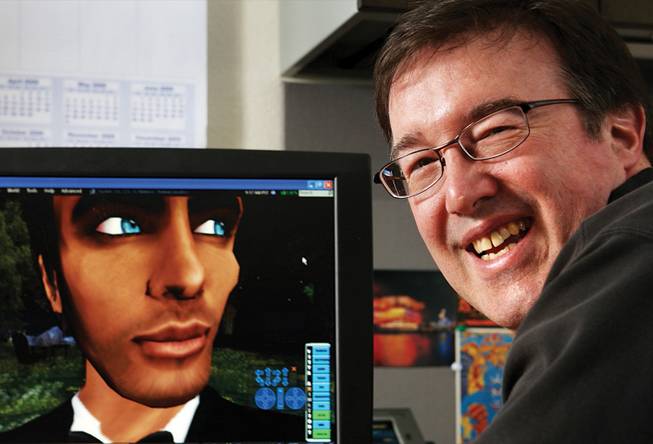
Lawrence Mullen, professor of journalism and media studies at UNLV, says a colleague who had created a classroom in Second Life asked for input on his work. That was the beginning of what has become for Mullen a research project in the creation of virtual communities.
Monday, Feb. 16, 2009 | 2 a.m.
Lawrence Mullen’s digital personas include a woman named Moon and a fur-coated creature called Fergie. The UNLV professor of journalism and media studies has assumed these and other guises while researching communities in Second Life, a virtual world.
This week, he is moderating a panel at an international conference at UNLV on digital communities.
Who cares about virtual worlds?
An increasing number of entities. Universities and businesses recruit in virtual worlds. Teachers hold classes in virtual worlds, so students can log on to attend at home, at a coffee shop, wherever they can access the Internet. The FBI has infiltrated Second Life. There is pedophilia. People create child avatars and do dark things at times.
What sparked your interest in virtual worlds?
A colleague was creating a classroom in Second Life and asked if I would log in, create an avatar and give him feedback on the design of his classroom. He was doing wild things, stacking chairs in the sky for students to sit in. He wanted to know, “Would this work? What do you think?” That’s where it started.
Tell us about your research.
I’m trying to understand how people construct communities in virtual settings, how their sense of togetherness arises and what they’re seeking.
Can you share some findings?
People are recreating what they’re comfortable with, things that are totally useless in the virtual setting but enhance a sense of togetherness. For example, the existence of food. Avatars don’t need to eat, yet you find all sorts of rituals involving food. At weddings, people have wedding cake, a reception with punch. Food — it’s a little thing but intriguing to me.
In March, you’ll be teaching a class on Second Life that will take place, partly, in Second Life ...
Students will explore aspects of Second Life including those dealing with the media, “in-world” newspapers, for example. They’ll learn about real-life advertisers who have located in Second Life. A lot of advertisers fail because they don’t know how to utilize the medium.
How does Second Life affect real life?
There is a dating scene that crosses into real life. People make real-world dollars. A woman became the first Second Life millionaire, making a million U.S. dollars selling virtual real estate. So for some, it’s no longer their second life. It’s their first-life job.

Join the Discussion:
Check this out for a full explanation of our conversion to the LiveFyre commenting system and instructions on how to sign up for an account.
Full comments policy