Higher Education:
A setback for research
After years of gaining on the top research universities, UNLV is losing ground and money — and not just because of the economy
Steve Marcus
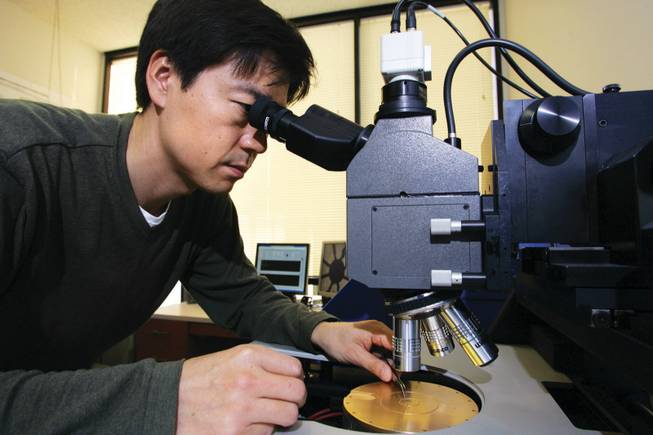
UNLV associate research professor Joon Soo Lee looks through a laboratory microscope in November 2007. The university recently had its first decrease in research activity in years, and the value of research awards from external sources dropped from $74.8 million in fiscal year 2007 to $39.8 million in fiscal year 2008.
Saturday, Feb. 14, 2009 | 2 a.m.
Growth has long defined UNLV. Over the past decade or so, in a quest to become a nationally recognized research institution, the university expanded its faculty, added dozens of graduate programs and secured increasing numbers of federal research grants.
Sun Archives
- Gov. Gibbons strikes back – with a podcast (2-11-2009)
- Rogers highlights ways universities have saved money (2-9-2009)
- As budget cuts loom, UNLV lacks requested program rankings (2-8-2009)
- Funding inequities have no simple fix (2-6-2009)
- UNLV must scramble to save $25 million gift, hotel building (2-2-2009)
- Administrators says proposed cuts too much to withstand (1-26-2009)
- Research park running through cash, still empty (1-25-2009)
Beyond the Sun
Now, UNLV is slipping backward. Budget cuts are reversing some of the expansion, no shock given the depth of the state’s financial crisis.
More surprising is that one aspect of the slide is unrelated to the economic downturn.
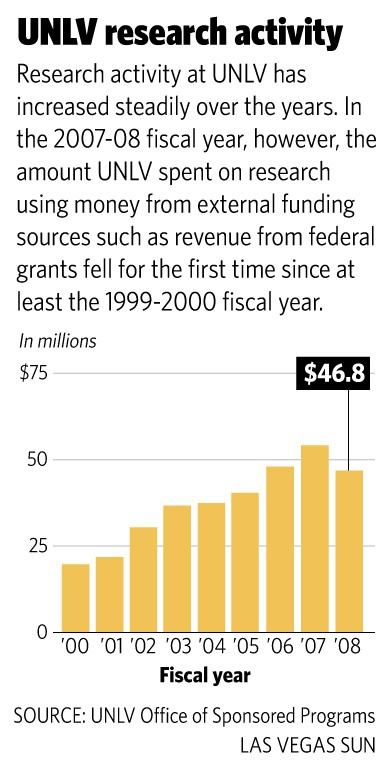
In the fiscal year ending in June 2008, the amount UNLV spent on research using external revenue, such as money from federal grants, dropped to $46.8 million from $54.1 million the previous year. That was the first decrease in research activity since at least fiscal 2000.
The value of new research awards the university received from external sources fell too, plummeting from $74.8 million in fiscal 2007 to $39.8 million in fiscal 2008.
Rochelle Athey, executive director of sponsored programs at UNLV, attributes the declines in large part to a one-year moratorium on most federal research earmarks in fiscal 2007. Because it takes time for these appropriations to reach universities, UNLV did not feel the brunt of the moratorium until the following year.
How could suspending earmarks — derided by opponents as “pork” — put such a dent in UNLV’s research funding? Though research activity at the school, as measured in dollars, has more than doubled since 2000, earmarks still account for the majority of external money the school spends on research. The nation’s top universities reap federal appropriations, too, but the most prestigious ones support their research primarily through federal grants and other awards for which faculty members compete.
When it comes to funding research, “You may not want to depend on having a well-connected member of Congress,” says Kei Koizumi, the American Association for the Advancement of Science’s director of research and development budget and policy program. “It’s certainly more sustainable to have enduring capabilities that are recognized in competitive programs. To put it simply, Sen. (Harry) Reid may not be around forever as majority leader.”
In fiscal 2008, UNLV received $9.6 million in earmarks for sponsored activities, compared with $41 million the previous year. Though research makes up just a portion of sponsored activities — those activities include projects such as cultural conservation studies on public lands, which are not considered research — almost all earmarks the university receives for sponsored activities go to research.
Over the years, this money has helped UNLV build the laboratories and buy the pricey equipment necessary to compete for external funding. A radiochemistry education and research center that earmarks helped establish over the past five years, for instance, has received more than $1 million from industry and sources that require researchers to compete for the funding.
With budget cuts forcing the university to downsize, the return of earmarks does not guarantee that UNLV will be able to resume growing its research capabilities.
“Two or three years ago, it looked like we were really going to go places,” Athey said. “Of course, with the crash in the economy and the declining revenues here due to gaming being down, we’ve had to revise our viewpoint and cut back and find ways we can maintain where we are now.”
To save money, the school has left about 100 faculty positions vacant, about a tenth of the total roster. Because faculty members drive research, applying for grants and mentoring students, those cuts will be a major blow to the university’s research capabilities.
Reductions in the number of staff members available to help professors prepare funding proposals and keep track of research-related expenditures will also set UNLV back. Even before the financial crisis, faculty members complained that the university lacked proper administrative support for researchers.
Losses the university has incurred could snowball. Dan Cook, coordinator of UNLV’s entertainment engineering and design program, says, “Anyone who has a brain is looking for another job. Any untenured faculty member at UNLV who tells you they are not looking for a job is lying.”
Budget cuts are also disrupting the university’s efforts to bring in more non-earmark research money. In fiscal 2008, UNLV devoted about $1.4 million in “seed money” to help faculty members work toward securing competitive funding. Through the President’s Research Awards program, for example, the university distributed a total of $400,000 to help faculty members launch projects that could later win awards from agencies such as the National Science Foundation. The school could not afford to continue the program this year.
To improve new faculty members’ chances of landing competitive funding, UNLV has, in the past, provided them with start-up money for purchasing equipment, paying graduate student researchers and renovating laboratory space. These dollars, now limited, made UNLV attractive to promising young researchers who might have had to wait several years before establishing laboratories at other institutions.
“If this budget crisis had happened five years or more into the future, UNLV may have been on a better footing because the initial investment in research infrastructure ... may have produced increased competitive research funding,” Athey said. “Now, however, UNLV may have to spend long years rebuilding that infrastructure support.”

Discussion: 31 comments so far…
Post a comment
- Most Read
- Discussed
- Most E-mailed
- Corrections officer with Metro killed in U.S. 95 crash
- System fails to catch contractor’s family tie with county
- Fontainebleau contractors say sales process is flawed
- Where to watch UFC 106
- UNLV and Southern Illinois will be guarded tonight
- Findlay guard Joseph scores 33, talks about UNLV
- The pull of a drug, a push to the brink
- Bishop Gorman takes Sunset Region title in win over Cimarron
- Fighters make weight, Dana White talks Rampage/Rashad
- Reid clears major health care hurdle, daunting weeks ahead
Blogs
Culture and Entertainment
UFC 106 walk-in music: Griffin changes his tune, secures win over Ortiz
The Kats Report
For props, Lewis Black needs only his manic delivery and torrid material (6 Comments)
Elsewhere
Sands China raises $2.5 billion in Hong Kong IPO (1 Comment)
Marquardt v. Sonnen scheduled for UFC 109
Bloggity, Bloggity, Bloggity
Will a fourth consecutive title by Jimmie Johnson be good or bad for NASCAR? (4 Comments)
Top Chef: Las Vegas
The Jet Stream: And then there were four
Top Chef Episode 12: On keeping it simple
- Live chat
- Tuesday, noon PST
- Chat with Krista Creelman
- Problem Gambling Center executive director Krista Creelman will answer questions about gambling addiction from Las Vegas Sun readers from noon to 1 p.m. Tuesday, Nov. ... Submit question
Calendar »
- 22 Sun
- 23 Mon
- 24 Tue
- 25 Wed
- 26 Thu
-
The Four Tops at The Orleans Showroom
Orleans Hotel-Casino
-
The Chase at Downtown Cocktail Room
Downtown Cocktail Room | 10 p.m. to 11:59 p.m.
-
Lady Gaga album release party at Revolution Lounge
Beatles Revolution Lounge | 10 p.m. to 11:59 p.m.
-
Food drive at Christian Audigier
Christian Audigier The Nightclub | 10 p.m. to 11:59 p.m.
-
Above & Beyond at Moon
Moon Nightclub | 10 p.m. to 11:59 p.m.
The Sun
Locally owned and independent for more than 50 years.
Technorati


Are you kidding me that this article claims that UNLV was moving into the top research tier because they had lots of earmarks???!!! In my opinion, earmarks are like welfare since you don't have to do much to earn the funds.
In my opinion, when a professor can receive earmark funds for research for 10, 15, and even 20 years straight .... they are not going to try for competitive funds. They are just going to become lazy and out of date with reality because they can take the freebie earmarks.
I can't believe that my tax dollars went towards the $41 million in earmarks to UNLV in a single year! I even think that $9.6 million last year is too much.
I also wonder, if earmarks are supposed to help them to become "competitive" eventually, at what point did they plan on ending the earmarks because they reached that competitive point?
I found the salaries of UNLV faculty and staff. I need to get a job there because I think that the salaries are above national average:
http://hrfs.nevada.edu/hrweb/EEList.aspx...
I have been an educator in higher education. I do not like the way UNLV faculty are conducting themselves. Everytime they are asked to participate in belt-tightening, they complain LOUDLY that they are looking for another job. That is not only childish, but counter to your professional choice to educate the public. If you got into higher education because you wantted to be rich, then you are a fool. The bottom line is this:
1. UNLV is ranked in the BOTTOM quartile of comperhensive public universities (UNR is the third quartile)
2. Faculty salaries at UNLV are not only above average, but way above average.
I know all sorts of folks will post and tell you that I have my facts wrong, but I've got 15 years in the trenches in higher education, and I don't like to see "professionals" thinking just about their wallet, and not enough about the students.
I agree with you. I also can't believe that an Assistant Professor in this articleis stating to the public that they are looking for other jobs. Good - Go and find another job. We don't need professors that publicly state this and make the students feel that their professors don't want to be at UNLV.
Personally, I think that UNR is ranked higher and should be given as much support as possible and that UNLV should be shut down. The state could get a ton of money for the land that UNLV occupies. If the state is broke, they might as well support the strongest university instead of spreading the money too thin.
Thank you nevadaappleslices for the link to the salaries of these higher education employees.
FUN FACT: On the salary list just the people's names that start with S and W have an average salary of $73,000.00 with a total payroll of about 37 MILLION DOLLARS. That is just two letters of the alphabet. With the salaries as high as $184,000, not including benefits, it is absolutely ridiculous.
The State needs to go and cap the salaries just like the President of the United States has with the bankers.
Just another example of UNLV's bloated behavior. The tiny light in the tunnel is that in a few short months Rogers will be out. Then the house cleaning needs to start and ALL of management needs to go and bring in new people with fresh ideas and give them more reasonable salaries. UNLV needs to come into the current century. How many years have they said they want to be a top research university? How many millions of dollars have they wasted on this? What do they have to show for it-ABSOLUTELY NOTHING!!!
I understand the topic at hand is this article on research dollars to UNLV. That said, as someone relatively new to Nevada (three years) and that has lived in many other states, I cannot help but feel how anti-education the populace of this state is.
Everyone becomes indignant when it comes to talk of higher education. I'm not arguing it's a perfect system, and that there isn't mismanagement and waste, but name me one other area, both public and private, where there isn't?
I think it's a scam how the casinos pay nothing, the mining industries are raping our natural resources and making money hand over fist, and yet, you people are worried about the universities in Nevada??
This state will NEVER (never) have legitimate higher education because its citizens are so quick to just throw the baby out with the bath water. What I find comical is all the other waste everywhere else and yet mention higher education and the pitchforks and torches come out.
We as a state simply have a profound mistrust and antipathy for higher education. Shame.
Elizabeth,
If the goal is to become more respected research-wise, much ground has been gained in the last decade. Read
http://research.unlv.edu/innovation/issu...
To OG:
As far as faculty salaries, full professors are 2% above national average while assistant professors are below national average. Hardly what I would call "way above average"
For $41 million in gifts of tax payer earmarks (and millions in other years), I don't feel that UNLV has a good excuse for not becoming nationally ranked. Why should tax payers continue to give millions of NON-COMPETITIVE research dollars to a university, especially when we are in a recession?
I looked up the salaries for a field that I am familiar with. Some UNLV full professors are paid about $40,000 MORE than full professors that I know at a couple of higher ranked schools and some Assistant Professors are at about $20,000+ MORE than those that I know at other schools.
Personally, I don't see how someone came up with the figure that they only make 2% above the national average. More details please! Even so, I wonder why they pay above average when they aren't ranked in the top of universities. The above average salaries are a cost to tax payers and students.
I must say that I am a bit puzzled reading most of the previous comments. Just a few questions to try and balance the debate here. They will be addressed to a hypothetical guy who happens to drive a pick-up truck! You'll agree with me that almost anyone is capable to drive a pick-up truck. won't you? Maybe not as well as you do but with a bit of practice, that should be achievable. Now how many people are capable of conceiving the engine that will power your beautiful beast? I believe I would not be overstating my case if I were to claim that I would not find many of those among your friends. Am I wrong? Where do you think we find them? I am going to let you figure out that hard one! Genius! Let me just give you a hint: "Education" (the higher one!).
Now one last thingie: Have you heard about market economy? Why in Nevada a jolly fellow capable of driving a truck will always be paid less than a product of higher education is very easy to understand. Let me give you another hint: The number!!! There a plenty of truck-driving jolly fellows out there (and I am stating that fact with the utter respect for all of them but you) but you do not find many products of a good higher education in Nevada so you do have to attract them with some incentives. Thanks heaven some people do understand what a good education means: Jobs, power, innovations, development....
But I guess this is already too sophisticated an argument for you, my pick-up-truck-driving friend.
With all my love
I think that all of us agree that higher education is important and people that graduates from college usually have better jobs. (Well, sometimes, depending on the major.) However, it is reasonable to question whether our tax dollars are spent wisely and whether UNLV is doing that. It is reasonable as a student to question how my tuition dollars are spent. (I am paying for a service!) The bottom line is that we are in a recession and there is not enough tax dollars to pay for everything that we desire.
If we shouldn't cut higher ed at UNLV, what should be cut? People can go to UNR (they are ranked higher), or even out-of-state for higher ed and let other states subsidize their education for a few years before coming home to Las Vegas. However, there is no substitution for money when it comes to uninsured children that need healthcare, police that we need to protect us from crime, homeless people that need shelter and food so that they don't feel that they need to resort to crime, K-12 schools, the lack of medical facilities in rural Nevada .... I disagree that subsidizing a low ranked university is a priority when you look at the big scheme of things and how little money we have.
BTW - not all truck drivers stupid and unsophisticated. I wouldn't be surprised if many of them have higher salaries than some of your UNLV graduates. We should be grateful to everyone that contributes positively to our society.
A small addition:
Some commentators are claiming that they are knowledgeable about how overpaid faculty are at UNLV. They ask from another commentator to provide proof of what she claims (that faculty are 2% about average etc.). Though the salaries are available online, that commentator is asked to justify her claim. I believe again that this should go the other way around.
"Some UNLV full professors are paid about $40,000 MORE than full professors that I know at a couple of higher ranked schools and some Assistant Professors are at about $20,000+ MORE than those that I know at other schools". To me this seems pretty vague. And I would ask from you that you justify your claim here.
"Faculty salaries at UNLV are not only above average, but way above average". Very vague claim. Could you please elaborate?
Remember 2 things before responding though:
1.you do not attract people of value (sorely needed to jump start a complex dynamic) with peanuts (do not forget the highly competitive academic market, hundreds of applicants, one elected, the best ones get several offers and you want them!)
2.you do not achieve excellence in a day. It is a process (look at San Diego, for instance) that has to be sustained for a long period (you have to quick start many phenomena of feedback loops to achieve a self-sustain institution of the size UNLV is, an institution that acquire a name and becomes attractive among the competitive universities of the South West, an institution that gets recognized as being a place of research that attracts new funding, private or public...)
Cheers
BTW I am driving a big car too. So not to worry, I get your point.The prupose of my example was edification!
On another front now: so if many of them have higher salaries (which I am fully ready to accept as I will claim here again that UNLV faculties, most of them, are paid quite low salaries for the work they are accomplishing), why is the salary of faculty so unacceptable to you? That to me is a wonder. This seems to indicate as one of the previous commentators has said, that higher ed is the privileged target in Nevada. Why is that when indeed many other matters are sooo wrong?
Cheers
Okay, you can go to http://chronicle.com/stats/aaup/ and look up averages for salaries.
Of 211 PhD granting institutions, Full Professors average $112,000 per year while Assistant Professors average $68,100.
Averages at UNLV are $114,500 and $66,200 (at UNR they are $116,000 and $67,600). This puts UNLV Full Professors 2.2% above average and Assistant Professors 2.8% below.
I hear also a lot of talk about closing down UNLV as Reno appears to be ranked higher (well! first you might want to have a good look at the different ranking process, what is taken into consideration etc.). But let's put that aside for now. Do you know that UNLV has more student than Reno? But let's also put that aside. Think of the logistic nightmare, if you were to close down UNLV and tell all its students to go enroll somewhere else. Many of those students have jobs here in Las Vegas that allow them to study at the same time. You would not find any of those jobs in Reno, which would mean suppressing access to education to a whole lot of hard-working people who are trying to better their life. But let's put that aside too. Imagine there is enough job avaialable i Reno for them all. Do you know that many of UNLV students commute to come study, that is, they benefit from the fact that they have family members around town. Imagine the added expenses if they had to relocate themselves to Reno (cost of living, actual relaocation away from family etc.). But let's forget about that for now. Do you think that Reno has enough space for accommodating circa 30,000 students. Does the university would have enough space for that? Does the city would have enough affordable housing for them? But again let's put that aside. How would you attract new professor over there in order for the university to provide a decent training (given the explosion of the number of students, even if you think that they would have enough room, you would need to hire 'some' more faculties. Search, relocation cost etc. are very important cost. But again let's imagine you let the candidate pay for that. Well and this will be my last question, whom do you think you are going to attract? What will be the quality of your teaching, training, research?
Best
Thank you, Killebrew! I knew you knew what you were talking about. I was wondering if some of the other ones, harshly criticizing knew what they were talking about.
Thanks
Oops! Sorry for the grammatical mistakes above. I was getting too enthusiastic and did not re-read myself. Apologies to all! I need a good education indeed!
Cheers
So, those of you that defend the above average salaries, I still ask, what should be cut when there is not enough tax dollars?! I think that you want above average salaries, non-competitive earmarks, and who knows what else. Who cares about health care, K-12, police, and other social services? Who cares that the highest ranked university in the state (UNR) needs funds to continue their high quality services?
I feel bad for people that can't empathize for the less fortunate around them. Visit a state hospital, visit a homeless shelter, visit some of the local schools where teachers spend their own money on school supplies, and see my opinion that there are serious needs for tax dollars and that professors don't really need to make above average salaries at a below average university.
The point is not either/or. The point is to have a decent tax system that understands the fact that you have increasing problems that are not taken care of now. Nevada does not have 300,000 people anymore. It has a whole lot more and the cost of services is going up (as is always the case when you start having a complex civil society). Taxing middle size business would be an immediate way out. No need to tax at the level of what they do in California or Ohio. Just a tinny bit. Maybe taxing the mining industry (Nevada is one if the biggest producer of gold, and mining companies operate almost free of tax). Here I am not claiming that this would solve all the problems but it would do some good, especially that those business are using extensively the infrastructure of the state (among which higher ed, K12... provided for families of skilled workers attracted to Nevada among others) and do so at no cost.
So part of the solution will be to cut costs, YES! To increase "productivity" and accountability" Yes but certainly not by cutting again 37% of an institution (altogether with the pre-existing cuts, 50%). What institution would sustain such drastic decrease in budget. I do not believe it is achievable (especially if the cuts are aimed at the working force of the institution, which, lets be fair is not overpaid already). The dreaded reality has to be faced; Nevada need a sane tax structure on which to rely. You cannot stay a frontier state for ever, using a predatory type of economical structure to sustain a complex civil society. So some reforms will have to be made. Nevada did not have a significant population of retirees 30 years ago, or even 20 years ago, now it has and this has consequences for the budget of the state. Nevada did not have a high unemployment rate (not in percentage but in absolute numbers), now it does (and it will have increasingly at each economical readjustment). Nevada did not have a significant population of handicapped, homeless before, now it has... etc.
This needs to be tackled with a perspective on the future. Cutting may be solving some of the problems but if you think that growth is going to resolve the matter in a more or less distant future, I believe you got it all wrong. Nevada had a boom (housing etc.) as it was starting from scratch. Now that you have a complex society that has emerged, it is going to be harder to have a new boom at the level of what Nevada has known previously. it is just basic economy. Doubling the size of an economy when it is small, is easier than doubling its size when it is quite large. The flows of money there used to have around here is clearly not going to happen at such an extent as they used to.
Best
the conversation seems to be drying up. Ah! Well! One more point: Structural problems should be responded with structural solutions. You cannot use what seems to be non-structural ad hoc solutions for resolving those problems as you probably will introduce many more problems than the one you think you are going to resolve. In essence that is what i meant right from the start. You just cannot delete a university the size of UNLV just because it would make sense just now. It would not tomorrow.
Cheers
This economy is tough on everyone and while it is difficult for me to feel sympathy for UNLV in comparison to people in need of healthcare, underfunded school children, and issues that I consider more serious ........ I wish you luck in your quest to rationalize and keep those above average salaries and non-competitive earmarks. I just hope that you realize what you are arguing for and the impact that it has on people that are less fortunate.
Do you know where the State gets the vast majority of research dollars??? The Federal Department of Energy. If Harry Reid gets his way with Yucca that source will dry up soon. Way to go. How does the Sun write a lenghty article on reseach at the university and not mention the fact that DOE is the main funding source.
Okay nevadaapplesslices,
I am very disappointed that you would equate my correcting of yours (and others) complete misrepresentation of UNLV professors' salaries with my not caring about Nevada. I have chosen Las Vegas as a home and want nothing but the best for my community. I have children in public schools and my wife and I have donated countless hours and money to their schools.
As for earmarks - I would agree that they are not the best for science. Again however I would like to point out that UNLV received significantly less then UNR in 2008 (and MUCH less than for example the $50M+ that went to North Dakota schools).
http://chronicle.com/free/v54/i29/4529no...
Finally, one last thing. Growth at a research university is a very difficult, slow process (especially one without a med school generating a lot of research$$). I would again point out that UNLV is moving up VERY quickly on all measures of research productivity. As I mentioned previously, one measure, the number of scientific publications, doubled at UNLV in a decade in a time where the total U.S. number was flat. I also direct you to the Center for Measuring University Performance http://mup.asu.edu/ which tracks many different indicators for around 200 universities (which make up over 90% of Federal Research$$). Between 1997 and 2006, UNLV has MOVED UP 48 places in Total Research $ (even including inflation, the amount at UNV has almost tripled) while UNR has DROPPED 8 spots.
I really hope that I can convince at least someone that UNLV has dramatically increased its research effectiveness over the past 10-15 years. This has come by hiring many very good faculty members who really want nothing more than to see the continued growth of UNLV as a research university.
The feeling of entitlement to earmarks is a problem and it scares me if this has trickled down to new faculty!
If the university has increased research effectiveness for 10-15 years, why isn't the university nationally ranked? Have I missed this ranking somewhere? About 10 years ago, I could run a mile in 50 minutes. Today, I can run it in 40 minutes. I've made progress, but nothing to brag about since other people can run a mile in 5 minutes.
I don't understand how you can even try to compare to UNR. They are nationally ranked and can run a mile in 5 minutes, so the investments to UNR show results.
To the new faculty that are enthusiastic about wanting to see nothing more than the growth of UNLV as a research university: My opinion is to get out there and obtain competitive external funding. I don't think that arguing for the case of non-competitive earmarks is productive for a long, successful career.
To move up 48 spots in 10 years requires a LARGE number of competitive grants to be won. I know of at last 4 faculty members who won prestigious CAREER awards (these are very hard to get peer-reviewed grants) for young faculty in the last 10 years. The last point I will make is that on the total funding side UNLV is now ranked 166 and UNR is 135 - not that much of a gap when you consider where things were a decade ago.
Four out of hundreds of professors have CAREER grants. Let's just hope that there are enough earmarks in the future to cover those without competitive funding. Let's hope that the DOE funding doesn't dry up either! Hey, maybe we can tax truck drivers to give everyone a raise.
Let's not forget the title of the article here: "A setback for research". UNLV professors are not bringing in the big competitive research dollars this year. It's tough for me to have sympathy for people making above average salaries that try to make the case for non-competitive earmarks.
I don't know if this is true, but I've heard that the tenure rate at UNLV has been as high as 90% for those that apply. Faculty have received tenure without any competitive funding and less than 1 journal paper a year. It makes me wonder how many of the superstar junior faculty stick around or find new jobs? Any insight? Have they had a high turnover, or do they stay?
I just wanted to point out that the Professor's aren't the only people who work at UNLV. Some of you have mentioned, why don't we shut down UNLV and just keep UNR. That is not a solution. Not only would many students be at a loss for a higher education (because they cannot get to UNR), there is also all the Classified staff who would be jobless. Since I am one of them, I can relate to this. We are the ones who help these Professor's get the funding they want in addition to the Sponsored Programs Office mentioned in the article.
I don't believe that the faculty would exist without the classified staff assisting them. And we don't make even a third of what they do but, in some cases, we do much more work. While I agree that we need to have some fiscal responsibility in regards to faculty salaries, we also want to keep the ones producing growth in Nevada because we must think about our future as well as our present.
But if the Governor gets his way and UNLV has to make a total of 50% in cuts, how will we survive that? I'll tell you...we won't and everyone will lose - the students, the staff, the high-priced professors, as well as the community, vendors who survive off of UNLV, etc. And what about the venues at the Cox Pavilion and the Thomas & Mack center? Those bring in thousands of dollars to Nevada with every event. That revenue would be gone too.
I agree with the fact that there are many things at stake here. I agree that we should tighten our belts in regards to salaries like everyone else is in this state. Classified staff have been told that Step raises (or any raise for that matter) will be at a stand-still for at least 2 years starting the new fiscal year. I can accept this though it doesn't make it any easier to live. I hope that something will be done about those Professor's making outrageous amounts of money as well.
From what I have read from you all, what I see around me, and what I have learned working here at UNLV is that research is very important for the growth of Nevada. Closing UNLV is not the solution. MAJOR fund cutting in all of the Nevada System of Higher Education (UNLV, UNR,Nevada State College, the 4 Community Colleges and the Desert Research Institute) is not going to save our economy but make it so much worse. Our graduates are the future. Research is a huge way to bring in a lot of money for them and for Nevada's future. But we also need to deal with our present and issues like the homeless, jobless and healthcare. There has got to be a compromise somewhere (and Governor Gibbons ain't it...). Cutting off the nose to spite the face is not the answer.
jadeeyes, you make a good point about some staff being underpaid/overworked and then again some staff overpaid. there are staff that make in the $90's/100,000k/year that could be possibly be replaced with people that would take the job for half the salary and then there are employees that make $30k/year that work so hard and should probably make more. How do you solve the problem? it's tough because I don't know that the little guys have a way to speak up about these situations.