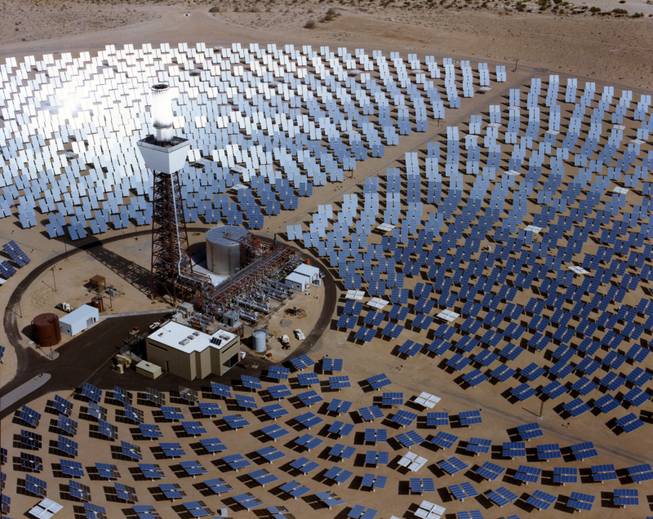
Photo courtesy of Nevada Renewable Energy Laboratory
Solar Two in Barstow, Calif., showed that molten salt could be stored at high temperatures for days without losing more than a couple degrees of heat. This allows solar plants to create energy virtually on demand, even after the sun sets.
Thursday, Dec. 31, 2009 | 2 a.m.
Sun Archives
- NV Energy agrees to purchase Crescent Dunes solar power (12-22-2009)
- Amargosa Valley solar plant to use less water (11-17-2009)
- Vision for desert solar power plant expands (9-23-2009)
- Dirty detail: Solar panels need water (9-18-09)
- Latest obstacle to rural solar plants a tiny toad (9-11-2009)
- The cost of building a solar powered economy (8-16-2009)
- Small town making hay (3-8-2009)
- Another solar power plant in the works for Boulder City (1-19-2009)
- Solar power plant opens in Boulder City (1-5-2009)
- Solar firms seek land (12-24-2008)
The U.S. solar energy industry is poised for a major technological breakthrough, and Nevada is in a race with Arizona to be the first to take advantage of it.
The nation’s first commercial solar electricity generator using the holy grail of solar technology, particularly for the Southwest, will either be in Gila Bend, Ariz., or near Tonopah.
This is about more than a new source of electricity; it’s an economically viable heat storage capability that enables solar plants to produce power at night. If the Silver State wins the race to premiere a commercial solar heat storage plant, it would be another renewable energy “first” to crow about. It could help cement Nevada’s place as a world leader in the increasingly important industry.
The state is home to the nation’s first modern solar thermal plant, Nevada Solar One outside Boulder City, and the nation’s largest commercial-scale photovoltaic plant, Nellis Air Force Base’s 14-megawatt array. By the end of 2010, the state is expected to be home to the largest photovoltaic “thin film” array, Sempra’s Copper Mountain solar power plant outside Boulder City.
But competition for the next wave of solar plants is fierce, and every state wants its projects to outshine the rest. That’s because a reputation as a solar leader is expected to attract not only new large-scale solar development for a state, but also the more economically beneficial solar manufacturing sector. Manufacturing for the renewable energy industry has the potential to provide many more long-term jobs than construction and operation of renewable energy plants do. Most of the manufacturing is in California and Arizona.
The Crescent Dunes plant outside Tonopah would be another step toward more manufacturers setting up shop in Southern Nevada.
The introduction of the technology to be used at Crescent Dunes has the added significance of being more likely to produce energy that actually stays in Nevada. Exporting electricity from solar plants is controversial in a state that has little to gain from the industry other than short-term construction jobs.
Crescent Dunes is to be a cutting-edge operation, making electricity with Nevada’s solar resources for Nevadans. The plant is planned by California-based developer SolarReserve, which announced a deal this month to sell its 100 megawatts to NV Energy.
It will use giant mirrors to boil a saline mixture. The saline then turns to gas, turning a steam turbine that creates electricity. Excess molten saline is stored in heavily insulated tanks to generate more electricity later.
Thermal heat storage for solar plants was first tested in 1996 at an Energy Department and Southern California Edison project, Solar Two, in Barstow, Calif.
Solar Two showed that molten salt could be stored at high temperatures for days without losing more than a couple of degrees of heat. This allows solar plants to create energy virtually on demand, even after the sun sets, making them more attractive to utilities such as NV Energy that need reliable, consistent power through peak energy demand periods.
Most power from renewable energy is off and on. Wind turbines need wind, and solar power needs sunshine, with little to no clouds.
“You never know when they’re going to provide power,” says Tom Fair, renewable energy executive for NV Energy. “With storage you can run consistently at a certain level. For planning and working it into the grid, that’s important. Demand and supply for energy have to be balanced. With this technology, we won’t have to bring in another power supply as soon as the sun goes down.”
The technology is more useful to NV Energy and other Southwestern power companies than it is to those in other parts of the nation.
“Take California’s Pacific Gas & Electric — their customers have cooling breezes in the evening and may not need electrical cooling at night,” says Fred Morse, the Solar Energy Industry Association’s Concentrating Solar Power Division chairman, who also serves as the U.S. senior policy adviser to Abengoa Solar, the company that has a 280-megawatt solar heat storage project, Solana, planned for Gila Bend.
In parts of Arizona, as is true in Southern Nevada, air conditioners run through the hot summer nights. The peak energy use times are midday through late evening in summer and late evening through early morning in winter, making the areas well suited for the heat storage technology.
Like Crescent Dunes, Solana is scheduled for completion in 2013. Which plant will be finished first is hard to say.
The Crescent Dunes plant just completed the scoping process with the Bureau of Land Management, and plans for the plant are undergoing environmental evaluation. The plant is one of three solar projects in the state that the BLM granted “fast track” processing this week, but it could still take several months to complete the environmental impact statement.
Once that is completed, the environmental report must be made available to the public for 30 days for comment before the BLM decides whether to allow it. It would then take several months to build.
The Arizona plant is larger and expected to take longer to build, but the developers have permits. Construction could have begun, but the recession affected the developers’ ability to get financing.
“Everything is moving forward with Solana,” said Jenna Henry, spokeswoman for Arizona Power Service, a partner with Abengoa on the Solana project. “We expect to break ground in the first half of 2010. We’re just finalizing the financing, and we’ll get the ball rolling.”
NV Energy still has a few hurdles to clear before it could use Crescent Dunes power in Southern Nevada. The power purchase agreement with NV Energy has yet to be approved by the Public Utilities Commission, but the company will submit the contract for PUC review soon, Fair said.
There’s also the issue of actually getting the power from Crescent Dunes to Southern Nevada homes and businesses. The plant will be at the southern end of the Northern Nevada electrical grid. The state’s southern and northern grids don’t touch, so the only way to get the power between the two is to run it hundreds of miles through either California or Utah.
NV Energy’s vision of lighting the Strip with solar energy may hinge on the PUC signing off on the utility’s controversial plan to build a cross-state transmission line.
The OneNevada transmission line would allow renewable energy from the north’s geothermal, wind and solar plants to flow south to Las Vegas when demand is highest. And solar and natural gas-fired power can be sent north in winter, when Reno experiences higher demand.
The line is only controversial because a second privately funded line is planned for the same route. NV Energy’s line would cost more than $500 million and be funded by ratepayers.
If the PUC OKs it, NV Energy expects construction to be completed by the end of 2012, ahead of the anticipated completion of the Crescent Dunes plant.



AZ is way ahead. they have water as well, which is needed to clean them off. The idea of blighting the desert with arrays of solar panels vs. local use of solar panels is an issue not being addressed.
It seems like an improvement in technology but they refused to disclose the cost of the plant.
Hmmmm......I wonder what they are hiding.
It still will not be a reliable 24/7 operation that can produce a quarantee X amount of energy over a period of time because weather can disrupt the ability to gather energy.
That means it can only provide supplemental energy and will still need to build duplicate reliable 24/7 energy plants that use either coal, natural gas or nuclear.
Also storing the energy for later use reduces the amount of energy that feed into system during the day which impacts it financial efficiency.
On a cost factor it does not make sense.
It will only save money on fuel cost but we will duplicate capital and general operational cost.
It would be nice to know how much it cost to build the plant.
Oh, I am sure Nevada will get this because we have such a fighter in Harry Reid (he used to be a boxer in his youth you know). The great and powerful Harry will make sure NV finishes on top. And if Nevada doesn't win, I guess he can always blame Bush.
Why is it that anything new or improved is just an Obama plot to subvert the oil burning, war mongering, bible thumping republikan soreheads? WAKE UP! Clean energy will create jobs.
What is the Cost Per Kilowatt Hour compared to natural gas generation or nuclear generation?
Rock, the tech they're using is designed to create/store energy, not just produce it and send it. Nevada is far drying than AZ, so we have less to worry about in terms of weather conditions. As for water, my understanding with this project is that it's already settled with the region (underwater stores?). I might be wrong on that, but I thought I read it a few months ago.
I'd like to know the cost per kilowatt too, but I don't think you can claim they "refused" to disclose the cost. It just wasn't reported. Or are you looking for a conspiracy, and that's why you phrased it that way?
In any event, I'm glad to see us using the natural resources. There's been a boon in the technology associated with this type of power (and all "clean" power) recently. This model seems like a winner. Apart from cleaning the mirrors/panels, sounds like a winner that will produce jobs too!
A few years ago, they built the largest solar plant in the world southeast of Vegas.
It created about hundred jobs in construction for about a year.
After it was finished they have a total of 9 full-time employees all of which were brought in from out of state and a couple out came from off shore.
I think there is a lot of over-hyping about green jobs.
Similar amount of jobs can be created by building reliable 24/7 energy plants like coal, natural gas and nuclear that would deliever energy much cheaper than these solar non-reliable plants.
They reason why they did not disclose the cost of the plant is most likely it was an very expensive plant to build.
"It could help cement Nevada's place as a world leader in the increasingly important industry."
Great to have it - but siting somebody's technology does not make you a leader.
Fossil fuels (natural gas and oil) as well as nuclear all have hidden costs that should be taken into account to determine cost of a delivered Btu or kW to the consumer. Yes, solar plants are expensive, but they do not have these same types of hidden costs. For example, oil requires us to have a huge defense budget to be able to project power into the middle east. Natural gas drilling results in significant amounts of ground water that must be disposed of properly according to the EPA. Nuclear requires proper storage of waste materials for thousands of years.
We need to consider the life cycle costs of all energy sources in an honest way.
I see your points. But the tech suggested that the energy can be gleaned from the solar system for DAYS without sun. In the photo, the power is generated by heating molten salt. Sounds pretty 24/7 to me. But I think you're right that it was likely a very expensive plant to build. But I'll add that people can't complain about education and make cuts to school and university budgets, and then expect that local people have the education and skills for high tech jobs! I'm not suggesting that you're complaining (or even brought education into it), but it IS the overall disposition I get from the sun forums.
And the issues that remain are huge: clean, renewable, sustainable, reliable, cost effective. No one solution addresses all the issues and depending upon the factors at the time... one makes more sense than another. Global fuel costs change ALL THE TIME. That drives cost crazy. When you try to clean up coal, the costs go up too. I won't even comment on the risks of nuclear power. But anything relying on a fixed-resource is a temporary fix, imo. We get into the same situation eventually. Limited resource, an obsolete plant, and heavy reliance on an over-priced commodity.
I'm guessing that the reason they don't disclose the price is for competitive reasons. I'm sure the Nevada Public Utilities Commission sees all of the details before they approve such a deal -- in our behalf.
We'll put far more money into the system than we will ever get out. Let Arizona subsidize solar energy. One day it will be viable and economically efficient and we can reap all the benefits then without having to pay any subsidies today.
Peegee, the risks of nuclear energy are very, very low. Furthermore, we can recycle nuclear waste already, making it a very very powerful renewable energy source. Had environmentalists not gotten their way in the 1970s we could have at least 200 nuke plants online today and have 1/3rd less the carbon emissions.
And yes, nuclear plants receive large subsidies. We shouldn't subsidize any form of energy.
And no, energy prices do not always have to rise. Prices for any good rises when demand outstrips supply. People work on creating alternatives or making existing production more efficient. Cost may rise in the short term but in the long term it is almost always down - except when government steps in and starts messing with the economy.
*We'd also have clean burning diesel cars like they have in Europe that make 40-50mpg if the crazy environmentalists hadn't of gotten their way in the 1970s too.
Coal is by far the cheapest source of household electricity on the planet I believe.
Natural gas probably isn't that far behind.
The rest of it solar, wind, water, biomass (which may actually be dirtier than coal)and nuclear requires tons of subsidies to operate. The most energy efficient after coal and gas would probably be nuclear because nuclear power plants can create a great deal of energy for sustained periods of time. Most of the waste can also be recycled with today's technology.
One day nuclear power won't require subsidies because we will be technologically advanced enough to make it economically efficient as well. Nuclear power is the ONLY way, currently known, that will create clean energy to power the homes of 6+ billion people and growing.
One thing that nobody seems to want to talk about is that the delicate glass and mirrors that they are building for the Crescent project are adjacent to a wind based source of sand. The Crescent Dunes are tall dunes. Now, the sand does tend to erode glass. Have you ever walked around some of those big sand dunes out here? Any old bottle you find that is 5 or more years old is sandblasted dramatacally. Other than plowing the whole dune away, there is really no way to stop that. I'm sure they will want to try to move the whole dune, but that sand will return!
Another thing is that heat storage will work far better in Gila Bend than it would in Tonopah. This year anyway, overnight lows in Tonopah have been single digit. Heat storage will be far less efficient in those kind of winter temperatures. I guess if global warming continues to heat up the Tonopah region, solar heat storage will have a future up there. Looks like Nevada will need climate change to jump start the economy :)
nevada and swg will fight this they hate competition
Harry Reid saved City Center and he'll get this for Nevada. Get ready for some phone calls!!
Just a quick clarification for all those wondering about why SolarReserve didn't disclose the cost.
The Crescent Dunes project, like most in the state, is privately funded, owned and operated. Because it is not a publicly funded project, the cost of development is considered proprietary information and does not have to be disclosed to the public. Developers generally don't disclose this information for fear it could give their competition an advantage.
However, NV Energy will be required to disclose the price per kilowatt hour it has agreed to pay for the electricity from Crescent Dunes in the upcoming PUC filing mentioned in the story.
-- Stephanie Tavares
Ever wonder why Solar Two near Barstow is just standing there in the sun doing nothing and disabled?
They won't tell you, because that would be politically incorrect.
Some experts question the molten salt as a reliable working fluid. It has corrosive properties.
But politicians like Reid and Obama will force these unreliable plants to be built, regardless.
Atlas shrugged.
SgtRock - "A few years ago, they built the largest solar plant in the world southeast of Vegas."
Truth: Nevada Solar One is not even the largest solar plant in the United States (SEGS 8 & 9 in California).
"After it was finished they have a total of 9 full-time employees all of which were brought in from out of state and a couple out came from off shore."
Truth: Nevada Solar One has at least 27 full time employees. I'm sure most of them live in Boulder City or Las Vegas/Henderson.
Also, storing energy does make economic sense because the plant is able to reliably produce power during peak operating periods, when power is most costly.
Solar One is the largest concentrated solar plant in the world. SEGS 8 & 9 are not solar plants. SEGS 8 and 9 are energy distribution systems that get energy from various solar plants.
The unions were upset with the Solar One plant because so much of the labor was from out-of-state.
Thanks for confirming my main point which is (whether it is 9 vs. 27) that solar plants do not hire a lot of full-time employees to run them.
Also, you are confirming my other point which is the plants could be used to supplement energy output but can not be used to replace the needed reliable systems that produce 24/7 energy.
Just a FYI, solar mega-watt cost is much higher than natural gas or coal. So the economics of building a plant that produces higher cost energy that can't be relied on to produce 24/7 power makes no sense what so ever.
There are just feel-good projects that will bring pain later for coal and natural gas plants are not being built at the rate needed to fulfill future power needs.
We are digging a big hole.
It's well known that solar is more expensive, but we're building them because the fuel is free and there are no emissions.
The job argument you have is correct if only look at power plants. Still, you have 27 jobs for a 64 MW solar plant, how many jobs do you have at a 500 MW natural gas plant? Probably not many more. A larger number of green jobs would be from manufacturing.
Google or Wikipedia SEGS 8 and 9, these Harper Lake CSP plants are both 80 MW, with larger solar field areas and turbines than Nevada Solar One.
Again, SEGS 8 and SEGS 9 are not solar plants.
They are energy distribution falicities that receive power form solar plants and then push it down the line.
I did not say that building any type of power plants are big job creators but I wager that building an average coal plant at around 700 megawatts probably has around 80 to 100 fulltime perm jobs as oppose to the 27 jobs at the "big" solar 65 MW plant.
My main point is not to believe all the hype about green jobs.
It is true that manfacturing the parts for solar plants will create jobs. Most of those manfacturing jobs will be spread over the USA and probably the majority of those jobs will be in China and India or other low labor cost markets.
Also comparing MW from a coal plant vs the Solar One plant is comparing steak to pop tarts.
A 700 megawatt coal plant could produce nearly 600 to 700 megawatts of power nearly 24/7.
The 64 MW solar plant produces probably peaks around 60 MW about 6 hours during the day and drops off to around 30 MW for about another four or so hours.
I am sure that this new plant has the same issues. During the peak sun hours it can generate peak MW but the rest of the time the MW drop of radically.
The coal plant as well as natural gas and nuclear can spread capital cost and labor cost over more MW as oppose to a solar plant. It is one of the reasons why solar plants per MW cost are higher.
Do you use the same amount of electricity 24/7?
We all know that the sun only shines for part of the day, but the purpose of the article is to describe new technologies that are helping to make solar more dispatchable. We can stick with coal, or we can look forward.
http://www.nrel.gov/csp/troughnet/power_...
Let's say solar is double the cost of natural gas or coal or nuclear. And we shut down building coal, natural gas or nuclear plants and go down this feel-good path.
That could mean you pay more for everything.
That could mean more jobs go to places where stuff can be made cheaper.
That could mean less money to spend on eating out or going to the movie or buying clothes.
That could mean higher unemployment.
Are you OK with having inefficient economy?
Perhaps, the libs should just volunteer and be the ones to lose out. Perhaps, we should have a sign-up sheet for those willing to lose their jobs if energy grid can no longer provide the energy needed at a cost effective manner.
Perhaps one day solar technology will advance to make it a great cost effective source of energy. The government is spending billions on trying to improve it. We are not there yet even though solar power is like a 50 year technology. We should not be going down the yellow brick road until we see the payoff.
"Some experts question the molten salt as a reliable working fluid. It has corrosive properties."
Very, very good point. There really has never been a molten salt project that has ever been bigger than this Barstow project (which failed). This is untested technology and the burden of failure will no doubt be passed on to the rate payers. Nobody wants to hear it, but the technology is not complete and we are just not ready to do this.
Then there was the solar facility in Daggett, CA that used heat transfer fluid and ended up in a fireworks display that rivals any Vegas New Years Eve celebration.
Renewable energy needs to be placed near the point of use. That is better for the rate payer and the environment.
Sgt Rock, the plant will not cost rate payers anything. An NV Energy PPA from NV Energy's semi-annual RFP for interconnection establishes how much an electrical generator will accept for the electricity generated. I suspect it is less than 5 cent per KWh, a wholesale rate. Developers get federal tax credits and accelerated depreciation. However the tax breaks are on development that otherwise would not have occured. So, it's a wash. Developers are hedging the market for RECs, Renewable Energy Certificates, which go for 3 cents a KWh on voluntary markets will improve. Back east the market conditions and demand has established a 20 to 66 cents per KWh purchase prices in utility markets.
I see what you are saying.....it is the Federal taxpayers picking up the bill....most likely via deficit spending.
Excellent....excellent....excellent.
Also, your post does not make any sense.
Solar producer is going to sell it a lost.
I guess you are the taxpayer is picking up the tab so it is not a lost to the producer.
It stills makes an inefficient economy whether the consumner is paying it directly or via deficits.
Developers are very eager to construct solar plants at their cost for an ROI that includes RECs and wholesale payments for the electricity they generate. There are over 96,000MWs of solar plant right-of-way applications on file at BLM. That's steady construction work for decades. Not one of them will cost consumers a dime to build. So, cost to rate payers is not an issue.
The issue to be discussed is that Nevada pays almost $12 Billion annually to buy coal, natural gas and 38% of needed electricity from the grid. That's all money that's spent outside the state. Instead of paying for coal and natural gas to burn for steaming thermoelectric generators, let's construct concentrated solar powered plants for steaming thermoelectric generators. Solar power is free and free of pollution. The cost of equipment to capture and make solar useful is the only cost of solar and that money is being offered by eager investors that believe once the solar plant is built they will make money selling the wholesale electricity and RECs.
Sgt Rock, you and SunLizard are contributing a steady stream of mismatched facts that establish a position of ignorance.
Here are more facts that establish a need to replace coal as the heat source for steaming thermoelectric generators:
1) Coal contributes 2/3 of the Earth's air pollution. Twice as much as the pollution of all vehicles. That's gross pollution versus no pollution for solar power.
2) On any given peak capacity HOUR Nevada's coal-fired plants burn 2500 tons of coal and use 120,000,000 gallons of water. Every hour!
3) Coal-fired plants use more water than irrigration. Adding the number of coal-fired plants needed to provide the additional electricity that our growing population needs will compete for the water needed to grow crops and feed us.
Solar is far more expensive than coal or natural gas.
There is this thing called natural gas and nuclear power.
Even Obama and other libs know that renewables can't fill the gap. They are only using a target of 20% which is probably a reach at this point in time.
Solar and wind are not 24/7 reliable sources of energy. Mother nature says so. They can't be used to remove other sources of power off the grid. They can only be used to supplement power and if they are cost effective save fuel cost at the other sources.
"I see what you are saying.....it is the Federal taxpayers picking up the bill....most likely via deficit spending."
He just said your taxes will raise and he was right. In California, every transmission line upgrade as well as subsidized renewable energy project will cost rate payers 5 to ten cents per upgrade per power bill. Now this would not be a large issue if we were talking about one or two power plants. The problem with renewable on an industrial, centralized scale, is that wind, photovoltaic and even molten salt can not produce 24/7 energy. Molten salt CSP can get good effiency in theory, during the summer when days are long and ambient temps can actually provide an environment where heat is not lost. The topography of Nevada does just not allow for very long days. The young geology is what provides the long shadows. Solar radiation needed on an industrial output just won't be as abundant in deep mountain basins as it would on the coast. The point is, you need a lot of space and you need a lot of resources to produce energy from a source with limited output. So you need to construct hundreds of these new types of power plants. Economically, that can't sustain itself. Even if Nevada can deflect your rate costs to your county, state and federal taxes, it is still your money that will be needed to pay for these boondoggles. No free lunches unless we are willing to change our lifestyle for renewable energy. We should be less wasteful, but the impression I get from this news source is that we can have our cake and eat it and I just can't see this working. It is a dissapointment that the path we have chosen for renewable energy will be as wasteful as it is and so devistating to the natural environment.
Like I said, facts that don't add up to squat Mr. Rock.
Credibility for the "parade of postponers" is eroded with each of your contributions.
This information is from: Manuel Romero-Alvarez and Eduardo Zarza. 2007. Concentrating Solar Thermal Power. In, Frank Kreith and D. Yogi Goswami (eds.), Handbook of Energy Efficiency and Renewable Energy. CRC Press: Boca Raton, London, New York.
SEGS 8 and 9 are parabolic trough solar thermal power plants, built at Harper Lake, California, the last solar plants built by LUZ before it went bankrupt. SEGS 8 was built in 1989 at a cost of $231 million (it does not have thermal storage). Due to technical improvements, SEGS 9 was able to bring the cost of electricity down to 9 cents per kW-hour; Daggett SEGS 2 was 16 cents/kWh--it had thermal storage.
None of the SEGS plants are competitive with conventional energy, and were not profitable (LUZ went bankrupt in 1991). Capital cost is 3 times that of fossil fuel plants. With thermal storage the investment costs are very high- $4000 per kW. So Cresent Dunes will be absolutely dependent on federal grants and tax breaks from the US Treasury (our tax dollars at work)to keep it going.
I talked with the project manager of Solar Millennium's Amargosa Valley parabolic trough solar plant proposal, which will use molten salt thermal storage. He said it will be able to store heat 3 hours after sunset (NOT all night). It also helps buffer the heat collection during cloudy days (yes the desert does get cloudy even in Nevada--look outside). He told me the thermal storage tanks are very expensive. This is not 24/7 electricity like coal or natural gas.
BrightSource's Ivanpah SEGS power tower project will cost AT LEAST $1 billion. It is much larger than Crescent Dunes, but it does not have thermal storage in the plan.
Could we get a few million Chinese slaves to work on these projects? It will help to keep costs down!
All the SEGS plants in California are still operating today, SEGS 3 - 9 operated by Florida Power & Light, and I'm pretty sure they're still doing it for a profit. I was an operator at the Kramer Juntion solar power plants (Segs 3 - 7) for 18 years and am now operating at Nevada Solar One. Concentrated solar power plants are more expensive to build because the cost of the fuel (the solar field) is paid for up front, unlike coal or natural gas, who don't know what they're fuel costs will be for the next 30 years. Nevada Solar One has 27 employees, which is more than the 500 megawatt Sempra combined cycle natural gas power plant across the street from it. SEGS 8 & 9 ARE solar power plants, NOT energy distribution facilities. They are 80 megawatt parabolic trough solar power plants with natural gas fired heaters to supplement output during poor weather conditions or for operation at night. It's funny to read all the misinformation about these proposed and existing solar power projects on here.
How about we do without any of it and then it will be cost effective... The prices of axes will go up,, but look at shape you will be in... Then what would that health care bs be to anybody then...Nothing...Also you wont have to think you know everything about energy since the internet wouldnt be any good...See now,, all kinds of ways to save energy.....
we have had the space,and we have had the sun,and we have had the workers,and we have had technology about boiling off a liquid property,converting it to gas,BUT the project is still not done,or even advanced much in discussionary meetings
the reason is simple COST per kW
peace out
Bottom line.....we should just build nuclear power plants. I don't know why we don't do this......all of this renewable energy stuff is a waste of time and money. Until we can get the costs significantly down, we should just move forward with the best option, which is nuclear.
Forget about job creation....none of these options are going to make an impact to jobs. Even if it created 200 new jobs....that's not a big deal in the overall scope of things. Let's get the power bill for millions of people in the Las Vegas Valley lower so they can spend it locally rather than the money going somewhere else.
S711
Seriously? common sence says RE would create many times more jobs because of the diffuse nature. Common sence also says it is the nature of humanity's evolution to robotically exponentiate the (best form of) solar energy collection and storage.
Nuclear is better if closed cycle and ridden of fears. Open cycle is "safer" from the terrorist point of view but is FAR worse from the supply issue and radiation for millions of years point of view.
Why even bother with nuclear when advanced PV (and mirrors in this case) automation is just around the corner. The solar dish (SES) is better as it is post mounted and thus can not piss off any enviro's (no grading required!). It is also twice as efficient as PV (4 X thinfilm). The mass automation of the LiFePO4 battery on utility scale are also just around the corner IF greed and stupidity does not get in the way. We need to slow down on fossils and rapidly accelerate the "invention" of AUTOMATED PV and LiFePO4 (or better) battery factories. Then, will humanity break the solar price barrier, only then will we have achieved the ability to generate UNLIMITED clean power!
Who cares about clean power? I want cheap power.....whatever power source will lower my bills and cost of living, then I am in favor of it. I don't care if it is coal, gas, nuclear, solar, bananas, wood, or moonlight.....as long as I pay less for stuff.
S711
Looks like the desert tortoise is going to stop the project anyway.
The equivalent 10 nuclear power plants take only a few hundred acres, not hundreds of square miles.
Also, as others have pointed out, what happens when global warming or the ice age, whichever is coming, changes the southwest climate to be more cloudy - these things won't produce squat for days on end. So the consumer and industry users are supposed to stop consuming electricity?
Renewable energy power plants are only supplements for mass energy production and are only economically even close to feasible with huge federal subsidies that citizens pay for one way or the other. The Nevada Legislature passed a feel good law in 2001 requiring 15% renewable energy by 2013, but didn't include any cap on its cost. Nevada's economy is already suffering with 13 cent/kwhr power which 10 years ago was 8 cents. Where will it stop? Probably when everyone has left the state live in cheaper places that have economists running things. Unless the Nevada Legislature revises an outdated and expensive law, and does it soon.
FWIW:
NV Energy has provided a real-time status of grid load conditions (Green/Yellow/Red) at the web-link provided below for their power consuming customers.
GREEN: During Condition Green (known inside the industry as Alert Level 0) Sufficient resources are available to serve all Company electric loads.
YELLOW: A Condition Yellow (Known inside the industry as Alert Level 2) Energy Emergency exists where:
1. Reserve Deficiency: All available generating capacity is loaded and all operating reserves are utilized,
2. Insufficient generation/transmission resources are available, for delivery to the power company transmission grid, to serve all customers. The expected energy delivery shortfall is substantial.
RED: A Condition Red Alert (known inside the industry as Alert Level 3) is An Energy Emergency exists where:
1. Reserve Deficiency: All available generating capacity is loaded and all operating reserves are utilized,
2. Insufficient generation/transmission resources are available, for delivery to the power company transmission grid, to serve all customers. The expected energy delivery shortfall is substantial.
3. Condition RED is the most serious condition alert and can bring about controlled, rotating power outages. Although we will try to provide as much advance warning as possible, at times, only a few minutes may be available until customers are notified of the alert. Such outages prevent more severe consequences such as a total collapse of the electric system.
http://headsup.nevadapower.com/
It is my opinion that electrical grid status conditions of YELLOW and RED should be mediated to the public, such information could/should be incorporated into local daily weather reports which already include air-quality and pollen status alerts for example.
By informing consumers of abnormal electrical grid conditions, consumers can take actions to minimize their electrical usage in an effort to help assure grid stability until conditions return to normal.
It is also my opinion that America desperately needs to address its aging nuclear power generation fleet (base loading source) by removing political and governmental encumbrances which currently inhibit new plant constructions.
With regard to alternative electrical power production -- although it can be advantageous for electrical power production methods to be diverse, the economic viability of solar/wind production remains questionable at best.
: {
There are some good posts in here dispelling the naive enthusiasm about solar power we see in many other posts and indeed in the article itself.
"Alternative energy" enthusiasts, who more often than not oppose clean energy sources such as nuclear power, are notorious for ignoring or refusing to disclose certain "inconvenient truths" when promoting solar or wind.
However, many studies have been done on the subject and the numbers are there for people willing to do some investigating. (The alternative energy lobby, and a good number of so-called "green" politicians discourage such activity.)
For example, I recently read an analysis of the state-of-the-art Andosol solar plant in Spain, which like the plant discussed in the article uses the molten-salt scheme for storage. What becomes clear, even when you assume an unrealistically high reliability factor, is that these facilities cannot compete with nuclear power -- not even close. I notice, for instance, that no one seems to be talking about footprint issues, or the indirect generation of CO2 from construction or fabrication.
The "diffuse" and frankly embarrassing difference in terms of capacity is well known. But even if someone were crazy enough to want to scale one of these solar installations up to the capacity of a typical nuclear generating station (approximately 1000 MW), the consequences would be staggering.
The land use ratio, for starters, is about 2530 to one. So if a typical nuclear plant occupies about a single square mile, you would have to build 2530 square miles worth of solar panels to generate the same amount of power.
Also, such installations require concrete and steel -- two materials that generate massive amounts of CO2 just to produce.
As it happens, the ratio (using Spain's Andosol solar plant as an example) for these materials is equally lopsided. To construct a solar plant with the same capacity as a nuclear plant, you would require 75 times more steel and 15 times more concrete.
Welcome to the Brave New World of alternative energy, in which vast stretches of our planet have been bulldozed flat to accommodate thousands of square miles of solar panels.
Here's another way to look at it:
The Palo Verde nuclear generating station, about 40 miles outside of Phoenix, is situated on about 4,000 acres (6.25 square miles) and generates an average of 3,200 megawatts (MW) of BASELOAD power.
That means it generates about 0.8 MW per acre of land use.
By contrast, the Sempra plant mentioned by the author would produce what she laughingly calls a "massive" 48 MW. Based on the stats for the existing El Dorado solar array (which produces 10 MW and occupies 80 acres), the ratio of megawatts produced to land use is about 0.12, which means that the installation will need to be about 384 acres in size (that's 0.6 square miles).
The proposed Crescent Dunes solar plant, by comparison, would produce an alleged 100 MW and require about 1,600 acres of land use to do so. That converts to a ratio of 0.11 MW per acre.
So let's scale these solar projects up to the capacity of the Palo Verde plant.
In order to generate the 3,200 MW produced by Palo Verde, the Crescent Dunes solar plant would have to be roughly 30,000 acres in size, or about 37 square miles, or six times the footprint of the Palo Verde plant.
Now, bear in mind that this back-of-the-napkin calculation of mine DOES NOT adjust for capacity factor. It assumes, in other words, that the different installations produce at the rated capacity all the time. In truth, nuclear plants have recently been averaging 90% capacity, whereas solar installations on paper (very optimistic estimates) average about 30-40% capacity because they remain INTERMITTENT energy sources even with storage schemes like the molten salt. (The land use ratio of 2,530 to 1 is based on adjusted capacity factor using the Andasol 1 solar plant as the example.)
So all this enthusiasm for "alternative energy" needs to be seriously tempered by the reality of numbers. It's one thing to cheer for a "massive" 48 MW from a proposed solar installation, but another thing entirely to extrapolate the consequences in terms of land use, cost, etc.
And Ms. Tavares should know that the molten salt for this proposed solar plant in all likelihood does not "turn to gas" when heated to drive a turbine. Rather, the salt is probably used with a standard heat exchanger, steam-loop rig.
Out of all these posts, GrandmaCrabby hit the nail right on the head. The argument for renewables is not to win a battle with the republicans, promote green sensible jobs, keep costs down or for the ego sake...who wins the argument. The simple reason for the fight is that our generation is spending down its inheritance faster than any generation before us, and any other country on the planet. Americans are wasteful and do not want to be inconvenienced with high energy costs that will deny them the right to spend money on stuff they don't need. Wake up folks. Two hundred years down the road, our home called earth will be so polluted, energy resources used up and every living space filled with our waste that we will need to move to another planet. But what the hell ... let's spend it all! We'll be dead so who cares...right?