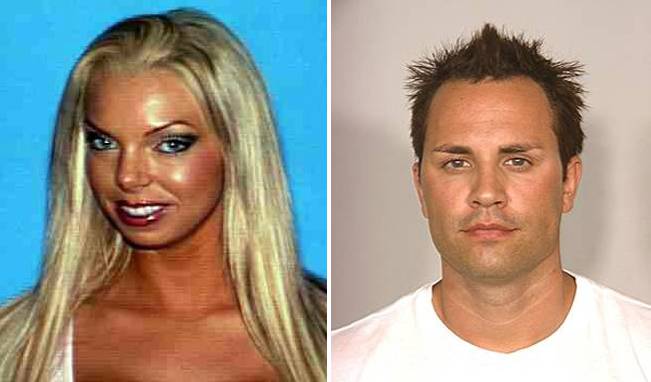
Jasmine Fiore and Ryan Jenkins.
Friday, Aug. 28, 2009 | 2 a.m.
AP Coverage
AP video: Police: Former Model's Body Mutilated
Sun Coverage
Here’s the script synopsis: A woman is found dead in a suitcase, her fingers and teeth removed, leaving investigators to identity her by breast implant serial number.
If the early August murder of Las Vegas resident Jasmine Fiore reads like a prime-time plot, it’s in part because her mutilation seems like the work of someone worried about fingerprints, dental records and bite marks, the kind of evidence TV investigators collect nightly for audiences of millions.
The cultural effect of TV crime dramas has long troubled prosecutors, who find themselves fighting the “CSI effect” — jurors with unrealistic expectations of forensic evidence; 12 armchair investigators with science degrees from CBS.
Academics study the phenomenon, and prospective jurors are quizzed about their TV viewing habits, but what’s seldom considered is the effect shows like “CSI” have on criminals.
It’s all pretty circular: TV viewers, informed by TV crime shows, committing murders and obstructing evidence so that their crimes, in turn, sound like TV shows.
The circle works backward, too: How long will it be until we see a “Law & Order” episode featuring breast implant identification?
Of course, criminals have always tried to cover their tracks. And nobody’s counting the number of crime scenes doctored by criminals, or whether it has become more common as shows like “CSI” grow in popularity. But anecdotally, police do see more people trying to bleach away blood, picking up bullet casings, using latex gloves and burning evidence.
In England, car thieves were reportedly dropping cigarette butts retrieved from public ashtrays inside abandoned stolen cars so police would be tied up trying to figure which cigarette, if any, contained the DNA of the thief.
As the media detail every development in the Fiore case (another reflection of our appetite for all things true crime), Clark County prosecutors are preparing to take a similar case to trial.
Nichole Yegge was buried in a shallow desert grave last year — the teen’s teeth were knocked out and a fairy tattoo on her hip had been sliced off.
Local police, like their TV counterparts, often use tattoos to make identifications.
Yegge’s case bears another similarity with Fiore’s: The grim butchering didn’t work. One suspect in Yegge’s killing was trailed to the grave site on a police tip — less forensically thrilling than a breast implant identification, but effective nonetheless.
And on the subject of implant identification: Using breast implants is uncommon, particularly since some companies stopped tagging implants with serial numbers years ago, in the wake of defect litigation, Metro homicide Sgt. Rocky Alby said. (A cynic might suggest that’s an example of corporate efforts to obscure evidence and impede investigation.) It’s much more common to see the serial numbers on knee and hip implants used for identification.
Of course, the risk in circulating that information, in this story or on tonight’s true-crime TV show, is that removing implants will become more common. This is why Alby, when pressed for other examples of post-mortem modifications, won’t budge — why give anybody ideas?
Even if the “CSI” effect had nothing to do with Fiore’s mutilation, TV has still complicated the case. Fiore’s former husband, Ryan Jenkins, was a reality show contestant when her body was discovered in a trash bin. The show was pulled, and Jenkins found himself in a new reality role — prime suspect — before committing suicide several days later.
That Fiore was identified despite her killer’s efforts shows another side of the “CSI” effect. Crime dramas are also credited with motivating more students to pursue forensic careers, inspiring future investigators to stay, hopefully, a step ahead.

Join the Discussion:
Check this out for a full explanation of our conversion to the LiveFyre commenting system and instructions on how to sign up for an account.
Full comments policy