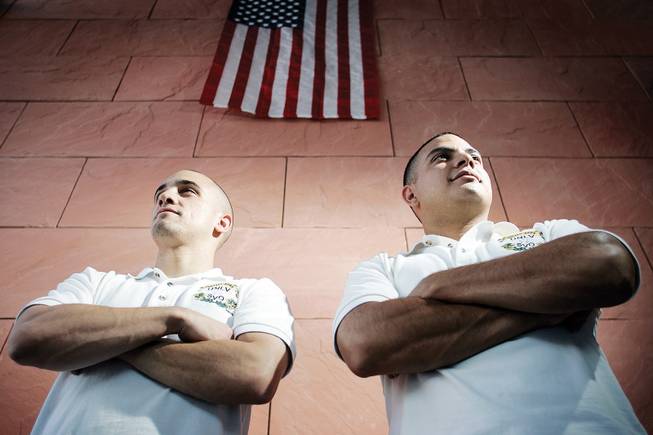
Antonio Montenegro III, right, president of the UNLV Student Veterans Organization, and Michael Dakduk, vice president of Student Veterans of America, are among the hundreds of veterans who will attend classes at UNLV in the fall. Their groups are instrumental in helping former servicemen adjust to campus life.
Friday, Aug. 14, 2009 | 2 a.m.
Sun Archives
- Reid backs G.I. Bill (4-29-2008)
- Letter to the Editor: G.I. Bill a smarter way to repay troops (2-24-2008)
- Editorial: Go Army, go cash (2-21-2008)
Sun Coverage
For the better part of his college life — at a two-year college and now at UNLV — the only times anyone acknowledged Marine Corps veteran Michael Dakduk’s military service was in classroom debates about the wars in Iraq and Afghanistan or when teenage classmates wanted to hear war stories.
Dakduk, a senior, says he didn’t always feel comfortable, let alone welcomed, on campus.
That complaint is shared by vets at colleges across the country: They feel invisible, ignored.
And that’s why the new GI Bill, which took effect this month, may force campuses nationwide to ramp up their services for veterans. The bill is expected to increase by 25 percent the number of vets enrolling in college, and the question is whether colleges are ready for them.
“The GI Bill brings people to the campus, but we need to work on graduating them,” says Bob Ackerman, a UNLV associate professor of education who researches the transition from combat to classroom.
UNLV thinks it is up to the challenge, and Dakduk agrees, thanks to the progress vets have made on campus in recent years in reaching out to one another and building relationships with the university.
Colleges are competing for veterans because they come with federal funding for tuition, books and living expenses. Post-9/11 veterans no longer have to get jobs or rack up hefty student loans to complete their degrees.
The new GI Bill expands previous educational benefits for anyone, including National Guardsmen and reservists, who served at least three months since Sept. 11, 2001, on a scale that brings the most benefits to those who have served three years or more. The new bill provides more money for tuition — which for the first time is paid directly to colleges — and up to $1,000 for books, as well as living expenses and fees. It also includes partnerships with private colleges that have agreed to lower tuition for veterans.
The new program also allows service members to transfer their education benefits to their spouses or children.
And under the VA’s new Yellow Ribbon Program, post-9/11 vets who qualify academically can attend top-flight private schools, such as Stanford and Yale, that have agreed to cut tuition costs for them.
UNLV is seeing the effects of the new GI Bill. Like most colleges, it does not track the number of student veterans it admits. But the school’s financial aid office had about 470 people apply for benefits this spring under the old GI Bill. Fewer than that may actually attend UNLV, but it’s the closest measure the school can provide. This summer another 40 applications were filed for benefits under the new GI Bill, said UNLV Veteran Services Coordinator Gail Reese, who manages the GI Bill paperwork.
With their growing numbers, veterans are now flexing their muscles, organizing groups for both socializing and activism. They’re lobbying Congress for more improvements to the new GI Bill. And they’re pushing college administrators for better access to on-campus services and the respect they feel they’ve been denied.
In spring 2008, with the support of a handful of faculty and staff, UNLV’s first student veterans group was formed. This year Dakduk was elected vice president of the national Student Veterans of America.
Senate Majority Leader Harry Reid credits both groups for lobbying Congress to adopt the new GI Bill and, since then, pushing for amendments to it.
Millions of veterans have gotten college degrees under the GI Bill since World War II. But as its benefits diminished and wearing one’s uniform on campus went out of vogue, veteran students have largely blended in to university populations — and their needs got less attention.
In a recent study by the American Council on Education, nearly half of the 723 colleges that responded said they had no special services available to veterans.
That’s not to say services and programs are not available. Most colleges offer services for disabled students in addition to academic and psychological counseling, health services, tutoring and financial aid — all of which are disproportionately sought by veterans.
But veterans coming from Iraq and Afghanistan need additional support in their transition to academic life, Ackerman says.
Ackerman is working with researchers across the country to develop ways to make campuses more veteran-friendly.
The most common suggestions are sensitivity training for faculty and staff, opportunities for veterans to get involved in campus life and improved communication with student veterans about the campus services they may need, Ackerman and others say.
UNLV and other campuses started looking seriously at ways to implement these suggestions after Wal-Mart announced in 2007 it would be offering millions of dollars in grants to colleges and nonprofit organizations for work aimed at bettering veterans’ educational opportunities. A small group of UNLV staff and faculty hurled itself into the grant-writing process.
UNLV didn’t get any of the grant money, but the group members, and student services providers they consulted on campus, were inspired. It grew to include financial aid staff members, a campus psychologist with Veterans Affairs experience, the office of disability services and more, operating under the radar of the university’s top administrators. It’s still an informal group — there’s no cabinet-level representation and none of the members of the veterans support committee was appointed by the university. But it’s having an impact, nonetheless.
As public attention to student veterans has increased in recent months, UNLV has been criticized for not investing enough in veterans services or dedicating money to open a veterans center.
But those involved, including students, say that at a commuter school with dire financial problems such as UNLV, what they really need is a student organization and a good Web site — not a building and staff.
Much of what veterans need is available on campus. Ackerman, Dakduk and UNLV Student Veterans Organization President Antonio Montenegro III say the university doesn’t have to spend a bundle to make UNLV more attractive and welcoming to veterans. Most of the post-9/11 veterans expected on campus belong to a generation that’s more comfortable browsing the Web and text-messaging than sitting in an office talking to a liaison. They’re getting much of the information they need informally from other veterans, so improving that communication network is the best place to start.
“We’re not creating anything new and at this point we don’t really need to,” Ackerman says. “We’re trying to make sure that existing things operate as efficiently as they can, that they understand the sensitivity to vets and that it’s all communicated to veterans.”
UNLV’s student group is central to the campus’ efforts to reach out to students with military experience.
The UNLV Student Veterans Organization had 100 members last year and is expecting to add 40 to 50 in the next year. They want to be the first point of contact for veteran students on campus so the level of service won’t ebb and flow with budget cuts. They’ve built a Web site with links to all the most pertinent campus services, they hold meetings and social events so veterans can make friends on campus and they’re trying to raise money for an on-campus veterans memorial that would be the first in the city. In a nutshell, they want to make UNLV a place where veterans feel welcomed.
“You don’t understand how big a deal all that is until you understand that we’re different,” says Montenegro, an Army veteran. “Our life experiences are different, we’re older, we often look different. And we don’t always want to be answering questions about what we did over there. We just want to feel comfortable.”

Join the Discussion:
Check this out for a full explanation of our conversion to the LiveFyre commenting system and instructions on how to sign up for an account.
Full comments policy