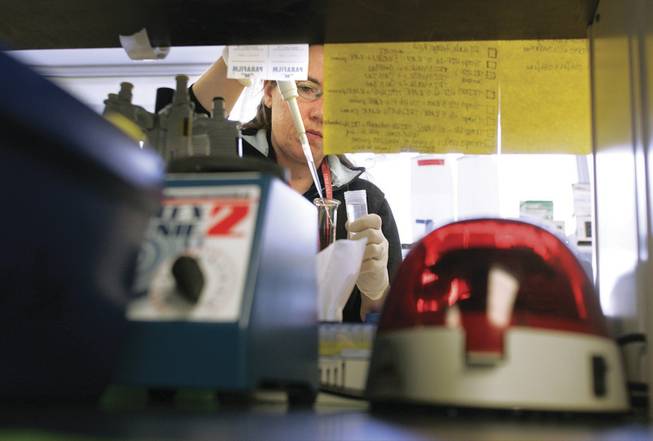
Post-doctoral scholar Jennifer Head prepares a solution to isolate DNA in the UNLV genomics lab. The cost of such facilities and number of post-graduate programs UNLV has started in recent years concern some officials, who say the university needs to focus now on the quality of its four-year degrees.
Sunday, April 5, 2009 | 2 a.m.
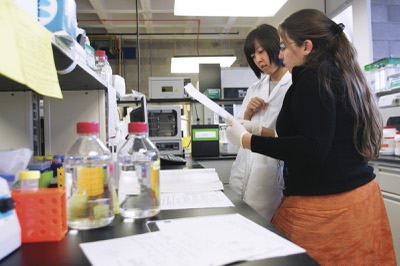
Undergrad assistant Anna Huh and post-doctoral scholar Jennifer Head discuss steps in an experiment in the UNLV genomics lab. Low per-student funding and stipends for graduate students are among obstacles to expanding research at UNLV.
Sun Archives
- Higher education system outlines 'doomsday' budget effects (3-25-2009)
- A setback for research (2-14-2009)
- Gov. Gibbons strikes back – with a podcast (2-11-2009)
- Rogers highlights ways universities have saved money (2-9-2009)
- As budget cuts loom, UNLV lacks requested program rankings (2-8-2009)
- Funding inequities have no simple fix (2-6-2009)
- UNLV must scramble to save $25 million gift, hotel building (2-2-2009)
- Administrators says proposed cuts too much to withstand (1-26-2009)
- Research park running through cash, still empty (1-25-2009)
Beyond the Sun
Above a bookshelf in Carol Harter’s office sits a photograph of her and writer Wole Soyinka, a Nobel laureate she recruited to UNLV.
On her computer, a screen saver trumpeting the university’s $500 million fundraising campaign runs through a parade of snapshots depicting campus life. A quote from scientist Alan Kay overlays a photograph of a researcher in a white lab coat hunched over an open flame: “The best way to predict the future is to invent it.”
The trappings of the former UNLV president’s office convey an optimism and can-do attitude that now seem out of place. In Harter’s 11 years as president, which ended in 2006, the university added dozens of graduate programs and courted legions of researchers to catalyze its planned transformation into a nationally-recognized research institution.
Today, budget cuts are driving dreams of prestige to the wayside and bringing to the fore questions about whether UNLV should scale back its research aspirations.
As president, Harter’s vision was for UNLV to be the UCLA of Southern Nevada: “An urban institution at the heart of a major city that offers everything from great athletics to great culture and art to graduate degrees to professional programs.”
Her successor, David Ashley, has also pushed a strong research agenda.
Jim Rogers, chancellor of Nevada’s higher education system, has expressed strong support for UNLV’s research mission, saying expansion of its research capabilities is essential.
But skeptics say the school’s ambitions exceed what the state can manage financially, a reality made salient by the budget crisis.
Cuts in higher education over the next couple of years could be deep. To get a portion of the federal economic stimulus, states must fund education at the levels they did in fiscal 2006. But the governor, with some Democrats’ backing, recently asked the U.S. government to waive that requirement, saying Nevada could not afford to meet the mandate for higher education.
“At a time like this, your main mission — this is just my opinion — what the taxpayers in the state of Nevada are looking for, is a place they can send their children and get a quality four-year degree,” says Steve Sisolak, a UNLV alumnus and Clark County commissioner who served on the higher education system’s Board of Regents for a decade.
Patrick Callan, president of the National Center for Public Policy and Higher Education, says although research is valuable, “protecting undergraduate education and protecting access has to be the first priority” for states in today’s recession.
As Sisolak points out, research is extremely expensive. A more than 200,000-square-foot science and engineering building that UNLV is opening this year came with a $113 million price tag. State-funded stipends for graduate students who teach and conduct research total millions of dollars a year. Some of the most active researchers on the faculty teach less than their colleagues.
In many fields, the university lacks infrastructure such as specialized laboratories that could help it win grants from the National Institutes of Health and other federal sources. The typical $12,000 stipend UNLV offers Ph.D. students who work for the school falls below what many others institutions provide. UNLV’s standard teaching load — three classes per semester — is high for a research university.
Officials’ contention that UNLV is underfunded only highlights how far it is from reaching its goals. The school gets about as much state money per student as Western Nevada College, Carson City’s community college. One oft-cited statistic is that UNLV receives about half as many state dollars per student as University of California campuses get for each new student.
The vision of UNLV that emerges, then, from administrators’ own testimony, is that of a famished, bare-bones institution — not exactly the type positioned to launch itself into the top tiers of academia.
The university excels in some fields, with the hotel college, law school and creative writing programs gaining national recognition.
But critics like to point out that fewer than half of UNLV’s freshmen complete a degree within six years. They wonder why the university is obsessing over research when it is struggling with basics. Part-time instructors and graduate students teach about 40 percent of undergraduate classes, said Executive Vice President and Provost Neal Smatresk.
In some fields, students complain that they have trouble getting into courses they need to graduate.
•••
UNLV’s leaders say the notion that the university’s teaching and research missions are at odds is erroneous. Engineering Dean Eric Sandgren says researchers possess cutting-edge knowledge that they pass along to students.
As Ashley says, “What we want are faculty members who are engaged in their own disciplines, engaged in their own scholarship, because every discipline is evolving and advancing.”
In a memo in July, Chancellor Rogers called research institutions “important prestige centers.”
Rogers wrote, “It is clearly the case that excellent students are most likely to apply to those universities that have excellent faculty and research driven graduate programs and that the best research faculty teach at those universities with the research programs that attract excellent students.”
Defenders of the research mission say the state cannot afford not to support research. In explaining the university’s impact on Las Vegas, Harter points to a study by UNLV’s Center for Business and Economic Research showing that for every dollar the state invested in the school in 2006, the institution generated another $4.50 in economic activity that year.
Research faculty bring money to Southern Nevada, winning grants and contracts that create jobs for lab technicians and other specialized personnel. Professors study subjects relevant to the region such as the levels of secondhand smoke in casino restaurants and ways to reduce energy consumption in the desert. Businesses such as pharmaceutical and technology companies, which offer high-paying jobs, often locate near universities, which help train skilled workers.
Harter, now executive director of an on-campus literary institute, says establishing a research university means more than just staffing laboratories. In the arts, for instance, professors produce creative work such as novels and screenplays and mentor rising stars in their fields.
In Harter’s view, a research university can be a city’s cultural hub. Harter’s Black Mountain Institute has hosted public events featuring speakers such as Nobel laureate Toni Morrison and Pulitzer Prize-winning author Michael Chabon — the type of activities that could help Las Vegas shed its image as a place with little to offer beyond strip clubs and slot machines.
Harter admits UNLV needs a lot more state support if it is to compete in the academic equivalent of the major leagues. And she thinks Nevada has the money.
“Even smaller states with less per-capita income support more research university activity, if not more institutions,” Harter says. While acknowledging that she’s not an expert in economics, she pitches a broad-based business tax and higher levies on mining as potential sources of revenue.
As she talks, her computer screen saver is running, and a quote from Walt Disney pops onto the monitor: “If you can dream it, you can do it.”
•••
The more important question might not be whether UNLV should focus on research, but how quickly the university should expand in that area and whether it has reached beyond its means.
From 1998 to 2007, UNLV launched more than 60 degree programs, mostly at the graduate level. One reason for the additions was to ensure that Southern Nevada’s growing population had access to a wide array of education opportunities.
But Sisolak contends that instead of concentrating on building “a few centers of excellence,” the school has developed an “abundance of centers of mediocrity.”
Bryan Spangelo, a former faculty senate chairman and a ferocious supporter of UNLV’s research mission, agrees that the university started too many programs in too many areas. Like many of his colleagues, he thinks UNLV’s resources are spread too thinly.
Callan of the National Center for Public Policy and Higher Education, says in a time of cutbacks, institutions looking to establish a reputation for research will be more likely to succeed if they push for improvement in “a limited number of areas where you have a real shot at making an impact.”
“The places that will be most successful ... are the ones that have a very strategic focus, the ones that say, ‘In these 10 fields, we’re going to try to get into the top 10 or top 30,’ ” Callan says. “The places that are going to get hurt the most are the ones that are trying to do it across the board.”
UNLV administrators say they are thinking strategically. To save money, the school has left about 100 full-time faculty jobs open. Ashley says when the time comes to fill those positions, “rather than spread them across the campus, I would hope that we would be deliberate and invest those in places that make strategic sense, that create areas of real prestige and real reputation.”
That day, however, could still be far off.
Though administrators insist that UNLV should not abandon its aspirations, another of the quotes on Harter’s screen saver seems to sum up the school’s present condition. The words are those of philosopher Jean-Jacques Rousseau, and they assert that the world of imagination is boundless. But the quotation begins with: “The world of reality has its limits.”

Join the Discussion:
Check this out for a full explanation of our conversion to the LiveFyre commenting system and instructions on how to sign up for an account.
Full comments policy