Las Vegas Sun

November 8, 2009

Currently: 57° | Complete forecast | Log in

ECONOMY:

What we can expect — and whom to blame: In Las Vegas

Less spending, fewer new resorts, slower growth — get used to it

Sunday, Sept. 28, 2008 | 2 a.m.
Image

Chris Morris

If there was any lingering doubt among bankers and investors about a years-long hiatus of resort construction on the Strip, the recent meltdown on Wall Street — highlighted by the Lehman Brothers bankruptcy, bank consolidations and thousands of layoffs — has cemented that outlook.

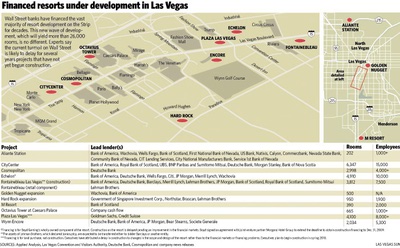
Like the strong aftershocks of an earthquake, the latest shaking won’t necessarily topple projects under way. But it will mean a longer wait before others, such as Boyd Gaming’s Echelon resort, the proposed Plaza Las Vegas resort and land intended for the now-scrapped Crown Las Vegas resort, can get in the game, analysts say.

It’s the corporate version of what’s playing out in the housing market, only with casinos instead of homes: Banks are reluctant to take on new loans because they can’t resell them, and they are taking losses on existing ones.

What it will mean for Southern Nevada’s economic landscape, experts say, is fewer job-creating casinos will be built. When lenders do put cash down in Las Vegas, they will be more cautious, sticking with established companies.

“The financial community needs to clean their balance sheets before they can begin to lend to corporate America,” bond analyst Dennis Farrell Jr. of Wachovia Capital Markets said. “Banks are lending money, but the standards have tightened dramatically.”

Banks have more reason to be cautious about Las Vegas resorts than your average home lender, even in the nation’s home foreclosure capital. Although many industries, such as retail, have suffered more than casinos, the effect of the economic downturn on Las Vegas has been more dramatic than expected. Gambling was once believed to be resistant to recessions, but that theory has been disproved on an unprecedented scale, with the latest Nevada figures showing slot machine play off by more than a billion dollars from a year ago.

In many cases tourists are spending less on everything else, including rooms, entertainment and food. It has also become more expensive for visitors to get here.

Investment banks — from Wall Street giants to smaller, regional banks — have financed every major resort in Las Vegas for decades. In this post-meltdown world, the investment banks that remain are converting into traditional bank companies anchored by cash deposits rather than corporate loans.

Banks will eventually lend to new projects but likely at higher interest rates, Deutsche Bank stock analyst Bill Lerner said. Their overall tolerance for risk will be low “for some time,” especially now that other avenues for financing major resorts — selling off condo units and retail centers, for example — aren’t working right now.

Also dampening Wall Street’s appetite for Las Vegas: disappointing early results from the Palazzo, which opened in January as the newest Strip resort. The Palazzo has an impressive customer list from its neighboring Venetian resort and sister properties in Macau as well as one of the top management teams in the business. With the Palazzo’s challenges, bankers are questioning the prospects for new resorts without those advantages.

Meanwhile, other unknowns loom large for the state’s primary economic engine, especially in 2009, which is expected to be another difficult year. Will the airline industry recover, bringing new flights at lower rates to Las Vegas? Will consumers loosen their purse strings?

Some executives and financial experts are pinning their hope on a turnaround in 2010, in time for several new resort openings.

Officials of Boyd and Plaza’s El Ad Group are responding differently. Boyd is hoping banks will rebound next year so it can resume construction on Echelon, and El Ad executives say they are delaying construction at the Plaza site until spring 2010 to retool their plans for the resort rather than because of market instability.

It’s not all bad news in the fallout on Wall Street. Removing additional competitors from the pipeline will cushion the blow for casinos combating this downturn, such as MGM Mirage, Harrah’s Entertainment, Wynn Resorts and Las Vegas Sands. These companies had once contemplated an epic battle to fill more than 40,000 new hotel rooms in the next few years. They will now have more time to generate demand for about 26,000 new rooms.

The giants won’t escape this retrenchment on Wall Street without a scratch or two. Gaming companies emerged from the credit boom more leveraged than ever. Some have violated loan agreements as their cash-to-debt ratios have soared. Some companies will need to refinance their debt, most likely at higher interest rates. MGM Mirage faces higher rates as it attempts to secure the final piece of its CityCenter financing.

Projects that might have made sense a couple of years ago, Farrell said, aren’t going to fly. “How is someone supposed to pay more than $10 million an acre for land, borrow the money they need (to build a resort) and then compete with a $9 billion destination resort like CityCenter?”

This wave of conservatism on Wall Street will hurt speculative projects the most.

In a town where questionable designs such as the Stratosphere and the Aladdin lured millions from Wall Street, “speculative” used to mean eccentric ideas from entrepreneurs lacking a background in casino management. Today, analysts say, it more likely means projects that aren’t backed by companies with established track records.

With the primary source of Las Vegas’ casino financing running dry, more insiders are looking for cash in the Middle East, and specifically, the business-friendly, tourism-driven emirate of Dubai. Wealthy from oil and real estate, Dubai has made multiple investments in Las Vegas companies, the largest being Dubai World’s half interest in the $9.2 billion CityCenter.

Dubai’s interest in Las Vegas — its unofficial sister city in desert megaresort development — is clear. Yet, even a part of the world little affected by the U.S. downturn won’t be rash with money during an uncertain time in Las Vegas, analysts say.

Dubai World is raising money for CityCenter, after which the government-controlled conglomerate may acquire more shares in its CityCenter partner MGM Mirage, Farrell said. “As oil continues to trade higher, their purchasing power only increases,” Farrell said.

Largely lost in the news about project cancellations is the long list of under-construction megaresorts financed just before the blowup on Wall Street. They represent, in cost and scope, the most formidable competition to hit the Strip. The money stakes have never been higher.

Easy money from Wall Street made possible the biggest building boom on the Strip. Now, Wall Street conservatism could make the gaming industry more like the movie industry, with fewer experiments by newcomers and more variations on a theme from the usual suspects.

That, some say, could be bad for a town that was built on entrepreneurial visions.

During these leaner times, Farrell says, investors may choose to renovate existing properties rather than build new ones. This has happened in turbulent markets such as Miami, where developers have bought and refurbished older hotels.

All this will likely mean fewer jobs.

Each Las Vegas hotel room generates about two jobs directly, according to research firm Applied Analysis. When the broader economic effect of resort building is considered, as many as seven jobs across the Las Vegas Valley can be traced back to construction of a single hotel room.

But it will take time before the state’s gaming engine has enough momentum to pull off another growth spurt, Applied Analysis partner Jeremy Aguero said.

Until then, banks will be “hunkering down, building their reserves.”

Discussion: 20 comments so far…

  1. Clinton getting praised for the explosion of the sub-prime and minorities getting housing before the mortgage crash.

    http://articles.latimes.com/1999/may/31/...

    Democrats were still pushing for more and more and more sub-prime for minorities as of Feb 2008.

    http://www.marketwatch.com/news/story/de...

  2. Nevada, how can continue to vote Harry Reid into office? It's transparent that the little wimp was beat up on the playground, got his lunch stolen and his ears boxed everyday...however, he is a man now, get over it. Quit being a spineless, wimpy, immature weakling. He is an embarrassment to Nevada and to the Nation. I'll be amazed if the dude doesn't cry on camera sometime.

  3. Nance: There is a big difference between lowering credit standards (Clinton) and eliminating credit standards (Bush). There are democrat fingerprints on the mess, but the majority of fingerprints are republican. Republicans focused on deregulation and no oversight.

    One example of no oversight, blind short selling has always been illegal, but was not enforced until last week. There are many regulations on the books that were simply not enforced by the Bush administration. Why do you think McCain wants to fire Cox, the SEC chairman.

  4. What proof that you have that Bush eliminated credit standards?

    There is none because the last degregulation bill that was passed was signed into law by Clinton.

  5. Not enforcing regulations is the underhanded way of eliminating regulations. The explosion of subprime occured from 2003 forward see chart here http://bigpicture.typepad.com/.shared/im... .

    The vast majority of foreclosures are from loans given in 2003-2006. Subprime loans have fallen since 2007 when democrats seized control of congress.

  6. Can you name any source that says the Bush admin were not enforcing mortgage regulations?

    Please do not post an opinion piece or something from DailyKos.

  7. http://www.usatoday.com/money/economy/ho...

    "A top Federal Reserve official admitted Thursday that the central bank could have done more to prevent the escalating crisis in the subprime mortgage sector, as lawmakers told the Fed to use its broad power to clamp down on abusive lending."

    Committee Chairman Chris Dodd, D-Conn., said the Fed had evidence by spring 2004 that lenders were easing standards but did not take strong action. He reiterated his desire to move legislation on predatory lending and use a variety of means to help borrowers now stuck with loans they can't repay.

    "Our nation's financial regulators were supposed to be the cops on the beat," Dodd said. "Yet, they were spectators for far too long."

  8. Federal Reserve is an independent quais-private/government organization.

    The President can not remove a governor of the FRB even if he wanted to.

    Only Congress can impeach a governor.

  9. Well Nance the same as you argue that Clinton 'pushed' for lowering the credit standards, Bush 'pushed' for not enforcing the standards/regulations.

    Also note the date of the article 3/22/07 http://www.usatoday.com/money/economy/ho... . Democrats won control of the 110th congress that was seated 1/3/07. You can see Democrats were 'pushing' the federal regulators to clamp down on predatory subprime loans, shortly after they won control of congress.

    3/22/07- "Dodd prodded regulators to speed up recently proposed standards that, among other things, require lenders to ensure that borrowers can repay at the highest potential future interest rate under an adjustable loan, not just an initial, teaser rate."

    "Given what we know now, yes, we could have done more sooner," said Roger Cole, director of the Fed's Division of Banking Supervision and Regulation. He added that the worst of the problems in the subprime sector -- high-cost loans to consumers with impaired credit -- didn't emerge until last year, when lenders stepped up use of risky adjustable-rate products.

    Also, Just as McCain found out he could not fire the SEC Chairman, the president can ask for their resignations.

  10. Clinton sign a law that deregulated the finance industry.

    Bush did not.

    Clinton and Democrats pushed Fannie Mae and Freddie Mac to go hard into the sub-prime market.

    Bush did not.

    If fact Bush asked Congress to pass a law to put the brakes on Fannie Mae and Freedie Mac.

    As of Feb 2008, Democrats were still pushing hard for the sub-prime market.

  11. Nance: "Clinton and Democrats pushed Fannie Mae and Freddie Mac to go hard into the sub-prime market." Post a source, I've already shown you the difference in subprime and predatory subprime, and the difference in lowering credit standards and eliminating credit standards. I've also shown you how democrats were trying to correct these problems. How do you explain the explosion in subprime in 2003 on this chart http://bigpicture.typepad.com/.shared/im...

    Fannie Mae and Freddie Mac did not 'originate' the loans. Crooked banks and lenders marketed predatory subprime loans during Bush's watch. Then hid the risk from investors including Fannie Mae and Freddie Mac. Predatory loans did not exist until Bush's administration lacked oversight. If proper oversight existed proper loan payment to income ratios (plus many other 'regulations') would have been applied and this crisis could have been avoided.

    The legislation that deregulated banking 'rules' was the Commodity Futures Modernization Act. This is the legislation that included the 'Enron Loophole' and banned regulation of credit default swaps and derivatives. http://www.cftc.gov/stellent/groups/publ...

    Read the story of how the republican senator Phil Gramm (also McCains economic advisor until he said our current economy is "a mental recession") inserted the legislation in an underhanded way, as an amendment, into a 384 billion omnibus spending bill here http://www.motherjones.com/news/feature/...

    Democrats have made several attempts to repeal the Commodity Futures Modernization Act ( http://pqasb.pqarchiver.com/washingtonpo... ), but were blocked by Republican control of congress until 2006. Since 2007 Bush has vetoed attempts at repealing this law.

    McCain defends the Commodity Futures Modernization Act http://www.baltimorechronicle.com/2008/0...

  12. It makes sense that sub-primes became a larger percentage of all over loans in 2003 because the interest rates were getting jack up at that time which cause more borrowers to be in the sub-prime category then then the regular prime category.

    There is no proof that sub-primes became a larger percentage of over all loans in 2003 because regulations were getting lax which is your root argument.

    Here is an article praising Clinton on busting open the sub-prime market for minorities to own homes. It was written in 1999 with this scary prediction: " argues that a higher target would only produce more loan defaults by pressuring banks to accept unsafe borrowers."

    http://articles.latimes.com/1999/may/31/...

    As of Feb 2008, Democrats where still trying to increase the sub-prime market:

    "Democrats sought to expand the role of Fannie Mae and Freddie Mac in affordable housing and the subprime market on Thursday as a proposed increase in the companies' conforming loan limit ignited some protest from Republicans. "

    http://www.marketwatch.com/news/story/de...

    Below is part of McCain's speech in 2005 on the Senate floor. Too bad, they did not listen to him.

    "For years I have been concerned about the regulatory structure that governs Fannie Mae and Freddie Mac--known as Government-sponsored entities or GSEs--and the sheer magnitude of these companies and the role they play in the housing market."

    "I join as a cosponsor of the Federal Housing Enterprise Regulatory Reform Act of 2005, S. 190, to underscore my support for quick passage of GSE regulatory reform legislation. If Congress does not act, American taxpayers will continue to be exposed to the enormous risk that Fannie Mae and Freddie Mac pose to the housing market, the overall financial system, and the economy as a whole."

  13. The prime rate was at historical lows in 2003 http://www.moneycafe.com/library/prime.h... becasue Reagans republican appointee, Alan Greenspan cut interest rates too far and for too long.

    Also subprime loans made prior to 2002 are not the problem; these loans had proper underwriting and proper credit ratings. The old (prior to Bush) subprime loans are within normal default range. The subprime loans issued since Bush are defaulting at a WELL ABOVE NORMAL RATE.

    During the 6 years when republicans controlled government, subprime loans evolved into a predatory subprime loan. Prior to Bush, subprime wasn't an 'evil' thing, there was transparency, proper ratings, and fair borrowing conditions. They were simply a higher interest rate for the borrower and a higher return for the investor with higher risk. Prior to Bush subprime was always identified properly to all parties.

    During Bush's watch subprime loans turned predatory; 2/28's, 3/27's, teaser introductory interest rates that shoot up 10% or more on their resets. When these loans started resetting, doubling homeowners' payments, then foreclosures started rising (again these predatory loans did not exist prior to Bush, subprime loans prior to 2002 have a normal default rate).

    Another part of the problem was banks/lenders were packaging this new predatory subprime with AAA paper and hiding the risk (Another item that never occurred prior to Bush). After investors started getting burned with what they thought were AAA investments, they sold ALL mortgage backed investments because they had no idea what they contained (here again, prior to bush investors knew what they were getting, since bush it's more like 'yeah there's AAA in there mixed with some other junk, but it's all good, trust me).

    Now credit markets started seizing because nobody was buying ANY mortgage backed securities due to UNKNOWN risk. The seizing of the mortgage markets cascaded to other credit markets turning the financial markets into chaos. This occurred because of republicans deregulation and lack of oversight during King George's 6 year rule of America.

    Any bailout should help owner occupied homes that were hurt by the predatory lending. The speculators (flippers) should receive NO help whatsoever, they are another chapter in this mess.

  14. Our ill conceived consumer based economy will have to be replaced, and that will take quite some time as we've exported many of the essentials necessary to sustain ourselves.

  15. Gordon, I appreciate reading your input as you do provide a very well balanced picture - I do not exonerate either Party - both have had their hands in this mess - There are some who will not see the forest thru the trees no matter how many facts you present if the facts put 'their party' in a bad light. Keep presenting the facts as they pertain to BOTH Parties because it's enlightening and just strenghtens my belief that neither Party is God Supreme and neither Party has ALL the RIGHT answers - the idea is to figure out which Party has the Best Solution because now that we have a problem we need to focus more of fixing the problem than pointing fingers at whoever we think started it all - what's done is done - we need to get on with it. Thanks again.

  16. good post azsk8. Let's get past the Blame Game, because quite frankly BOTH parties lost it. One could have stopped the other or hedged it better, but neither did. The fact is when you are at the bottom of a hole, you shouldn't waste time on who got you into the hole. We just need as many ideas as possible to get out ot the hole. Besides I'm tired of making plans on how my family will survive in breadlines or if I'm cut out to be in the Civilian Conservation Corps.

  17. Gordon wrote: Reagans republican appointee, Alan Greenspan cut interest rates too far and for too long.

    Greenspan was appointed Chairman of the Fed in 1987 by Reagan for a four year term. He was then reappointed by George H.W. Bush in '91 and Bill Clinton in '95 and '99 as well as George W. Bush in '03 before leaving the post in early 2006. Calling him "Reagans republican appointee" isn't exactly accurate.

  18. Excellent posts Gordon. You didn't mention the short sellers role in all this. It was the short sellers who managed to create doubt about all securities not just the iffy ones. With the market on the run the shorts have used every financial tactic and rumor mongering at their disposal to crash the markets. With the SEC asleep on the job, the shorts went wild and crashed bank after bank. Lehman, Bear Stearns, Indy Mac, and WaMu all went under after depositors were convinced to get their money out and made a run on the bank.

    For those of you not in the know, huge fortunes are made when markets crash, and short selling is one way to do that. Credit Default Swaps is another. We have people on main street who want the markets to crash in the mistaken belief that only the rich will suffer. I guarantee you that if the markets go belly up, the rich will get richer.

  19. Phoebe, so what, who cares, get over it! Maybe he just stayed too long at the party but in any case the damage is done and it's time to work on solutions instead of continuing the blame game.

  20. The plan I am laying out is modeled after the depression era HOME OWNERS LOAN CORPORATION set up as an agency of the US GOVERNMENT...During the depression the corporation saved 1 million homes and actually turned a profit back to the US Treasury... This should work even better since the government will buy at a discount and charge a slightly higher than market based interest rate.

    Loans could even be purchased at a 20-25% discount from the lenders holding the bad debt...Yes they would take a beating but it would give these companies a type of penalty for the predatory lending practices...

    Loans need to be rewritten keeping the balances the same and any late payments (and fees to process the loans) will simply be rolled into principle so now one receives a free ride. You could even make the loans with the first 3 payments rolled into principle as well so that these people can get back on their feet...Loans would be a .25% premium and possible option of a 40 or 50 year loan term......

    Since the beginning of a loan is all interest, the government would be receiving interest payments for a minimum of 10 years...

    We do not want this to be permanent government takeover of the financial sector, there should be a 10 to 15 year limit that the government can hold the loan. As soon as the loan becomes viable after 10 years the loan could be sold to the private sector for full face value plus a premium...Thus the government would get all of its money back on the loan from the interest payments, then it would sell it for a premium making money on that sale as well....

    Finally to guarantee taxpayer money, the bankruptcy laws would be changed to prevent discharge of the debt....

    Any bank that sells their loans to the government should be required to agree that their current CEO, President or Board of Directors do not get the infamous golden parachute...

    Finally the IRS and FBI need to be used to investigate all problematic banks...and CEO's that walked away with millions....For fraud and breach of fiduciary duty...Criminal Charges should be leveled as in the savings and loan scandals of the 1990's.....

    This plan would not only provide profits for the taxpayer but ultimately provide retribution on businesses that tried to prey on underprivileged people and it would provide personal accountability for the individuals as well..No one would get a free ride and anyone that broke the law would go to jail....

Post a comment

Commenting requires registration.

Comments are moderated by Las Vegas Sun editors. Our goal is not to limit the discussion, but rather to elevate it. Comments should be relevant and contain no abusive language. Full comments policy.

Username:
Password: (Forgotten your password?)

OR Create an account (It's free)

  • Most Read
  • Discussed
  • Most E-mailed

Calendar »

  • 8 Sun
  • 9 Mon
  • 10 Tue
  • 11 Wed
  • 12 Thu