Friday, Sept. 12, 2008 | 1:27 p.m.
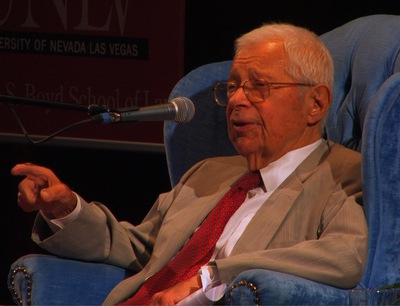
Ninety-four-year-old Daniel Schorr, longtime journalist and National Public Radio's senior news analyst, spoke Thursday, Sept. 11, 2008, at UNLV on the topic "Forgive Us Our Press Passes," as part of the "Peace in the Desert" lecture series sponsored by UNLV's Saltman Center for Conflict Resolution.
After 70 years in journalism covering major events such as the Cold War, Watergate and President Bill Clinton’s impeachment hearings, Daniel Schorr is thought of more as an oracle than a journalist.
“I haven’t saved the world; what I’ve tried to do is describe the world,” Schorr told a gathering Thursday night at UNLV, after receiving a standing ovation on the stage of UNLV's Artemus Ham Hall.
The 94-year-old National Public Radio senior news analyst went on to speak on the topic “Forgive Us Our Press Passes,” a talk that was part of the “Peace in the Desert” lecture series sponsored by UNLV's Saltman Center for Conflict Resolution. The series offers a glimpse into how experts in various fields have handled conflicts and what type of tools they used to solve those conflicts.
Besides conflict and resolution, a third theme wove itself into Schorr's talk: Answers.
From the rise of the Internet to the fall of newspapers across the nation and the publicly perceived lax role that the media has taken in covering politics, those attending wanted answers from Schorr about a changing journalism landscape.
However, instead of answers, Schorr shared some of the conflicts – some serious and some not so serious - that have peppered his career in professional storytelling.
A “Journalist has a role he can play in prolonging conflicts or simplifying conflicts,” Schorr said.
After a long pause – one of many he took throughout the night, which he blamed on his advanced age – Schorr began to tell two separate anecdotes.
“Twice in a very long career I killed my own story,” he said.
The first time, he said, was while working as a foreign correspondent in the Netherlands.
After writing a story for LIFE Magazine about the queen of the Netherlands inviting a faith healer into the palace to help cure her youngest daughter’s blindness, a member of the monarchy’s staff pleaded with him not to publish the story.
The staff member reminded Schorr of the trust that he had cultivated with the people of the Netherlands who had gotten him the interview and the unrest that it would cause for the people of the Netherlands to learn about the queen’s fanatic-like religious practices.
Schorr said the second time he backed off a story was while putting together a documentary for CBS about post World War II Poland.
While doing research he came across a group of Polish Jews from the Soviet Union who told him they were moving to Israel.
“At the time, the Soviet Union wasn’t permitting Jews to go to Israel because they wanted to be on good terms with the Arabs,” Schorr said.
He inquired about his encounter with the Polish Jews to the Israeli minister in Poland, who then revealed to Schorr that the Soviet Union had agreed to let the group of Polish Jews flee to Israel, with the condition that the move be secret.
Schorr noted that both instances where he held back on reporting what he knew were decisions in which telling the story would do more harm than good — but he questioned the ethics of journalism and his own ethics.
“If you’re a journalist, and you’re job is to tell the facts, who are you to interfere in that process?” he asked, rhetorically.
Schorr digressed though, “You don’t live in a world that’s journalism alone, you live in a community and you have your duties (to that community).”
As for the future of journalism, Schorr didn’t offer any fortunes or predictions.
In the question and answer period following Schorr’s lecture, a young woman asked him what he thought about the onset of the Internet in journalism and what its effects would be on reporting.
Schorr replied, “I have no idea.”

Join the Discussion:
Check this out for a full explanation of our conversion to the LiveFyre commenting system and instructions on how to sign up for an account.
Full comments policy