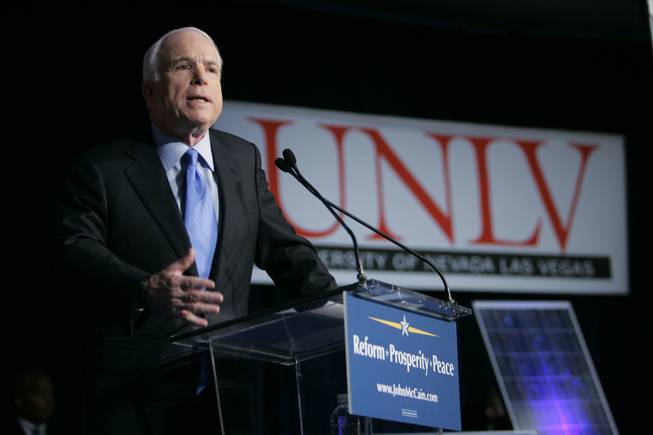
Steve Marcus / FILE
Republican presidential candidate John McCain speaks on energy policy during a June campaign visit to UNLV. McCain, like his Democratic rival, Barack Obama, supports a cap and trade system for regulating carbon emissions, but would set the eventual cap higher than Obama.
Sunday, Oct. 26, 2008 | 2 a.m.
Sun Topics
Beyond the Sun
Before all the talk turned to the economic crisis, the energy crisis had our attention.
Remember rising electricity prices, global warming, stranded polar bears?
Here’s a breakdown of the presidential contenders’ energy policies, and how they might affect the environment and Nevadans’ wallets.
Nuclear power
The main thrust of John McCain’s energy policy is a call for 45 new nuclear power plants by 2030.
Although the plants produce no carbon emissions, making them an attractive power source in a carbon-constrained world, there are serious environmental and safety concerns with uranium mining and disposal of nuclear waste.
Barack Obama has said there must be solutions to the waste storage and safety problems before he would support new nuclear power plants.
Nevada is unlikely to see a nuclear plant built within its borders even if McCain is elected because the plants require large amounts of water. Still, local environmentalists are concerned that more nuclear plants mean more radioactive waste, which could wind up dumped at Yucca Mountain, 90 miles northwest of Las Vegas.
McCain supports the Yucca project; Obama has said he would kill plans for a repository there.
There are also concerns about the cost of nuclear plants, which would receive billions in federal subsidies under McCain’s plan.
“The real concern with nuclear power is it’s so expensive,” said Lydia Ball, a local representative of the Sierra Club.
Coal-fired power
Both candidates advocate researching how to capture the carbon emissions from coal-fired power plants, because experts say coal will continue to provide a significant amount of the nation’s electricity. Fifty percent of America’s electric power comes from coal.
There are three coal-fired power plants in various stages of the approval process in Nevada, but environmentalists shouldn’t expect the next president to step in to stop those plants, according to William Becker, executive director of the Presidential Climate Action Project.
“They’re going to wait and see. New coal plants have been on the decline in the last year or so — not because of any federal action, but because of the price of coal, how (plants) will be affected by carbon pricing, by lawsuits, by states’ refusal to issue permits,” Becker said.
Still, it’s the federal legislation putting a price tag on carbon emissions, which both candidates support, that would have the greatest effect on the price of energy from new coal plants and be most likely to stall plans for more.
Renewable energy
Both candidates say they support renewable energy, although environmentalists question McCain’s dedication to the technology.
“McCain used to be one of the few Republican voices ... calling for action on global warming,” said Anna Aurilio, director of Environment America’s Washington office. But she says McCain skipped out on many important environmental votes from June 2005 to February 2008, earning him a 27 percent grade to Obama’s 86 percent from the environmental group.
And his choice of Alaska Gov. Sarah Palin as his running mate — and possible point-person on energy — hasn’t helped him in environmentalists’ eyes.
“McCain putting Palin in charge is not going to lead us to the kind of clean energy policies we need,” Aurilio said.
Among McCain’s promises are a $5,000 tax credit to consumers who buy zero-emissions cars (which are not now available in the market); a $300 million prize to the inventor of a better battery for plug-in hybrids or electric cars; and a tax rebate equal to 10 percent of what companies spend on wages for employees doing research and development.
What he hasn’t called for, and what environmentalists and renewable energy industry insiders say will be the real driver of clean energy development, is a requirement that the nation get a percentage of its energy from renewable sources, such as wind or solar power plants. Obama has called for 10 percent of America’s energy to come from renewable sources by 2012. Last year, less than 1 percent of the nation’s power came from solar, geothermal and wind combined.
Nevada business leaders and politicians of both parties have said the state could benefit from a strong national standard for renewable energy, because it has rich solar and geothermal resources and could export clean energy to power-hungry Southern California.
Obama is also calling for $15 billion in federal funding for renewable research and development.
Carbon caps
Both candidates favor setting a national cap on the carbon emissions that contribute to global warming, but they differ on how low that cap should be and how to trim emissions to reach it.
McCain wants to cut carbon emissions to their level in 1990, or by 40 percent from today’s level, by 2020. By 2050 his plan would cut emissions by an additional 60 percent from 1990 levels.
Obama’s caps are initially on par with McCain’s, but over the longer term they are more aggressive. Obama would cut emissions to 1990 levels by 2020, but then by an additional 80 percent by 2050.
Climate scientists have agreed that emissions must be trimmed to the levels Obama is calling for to prevent the most severe effects of climate change, although some scientists now say even that might be too little.
‘Trade’ in cap and trade
A cap and trade system would set a carbon emissions limit that would grow more strict each year. The government would distribute pollution permits, and as the cap becomes more strict it would create a market for those permits. Power plants, factories and other businesses that emit carbon could either spend money installing pollution control devices to meet the cap, or buy pollution permits from other companies that have gone below it. Companies that cut their pollution to get it below the cap could sell their permits for the difference to other emitters.
The candidates differ, however, on how to regulate the market for these pollution permits.
McCain wants to give away at least a portion of the permits, called allowances. He would auction the rest.
Obama wants to auction 100 percent of the permits.
In either case, the system is likely to be incredibly complicated — with the price of permits and the cost of all kinds of energy varying based on everything from whether the utility where you live is regulated (as in Nevada) to what kind of fuel the utility uses to generate its electricity.
Utilities such as NV Energy that get the majority of their power from fossil-fuel-burning coal and natural gas plants would pay more; utilities generating hydroelectric or nuclear power would pay less.
Michael Yackira, president of NV Energy, said the rules that govern a cap and trade system will also matter more to utilities that serve growing populations such as that of Las Vegas, because their carbon emissions are growing, too.
NV Energy also buys a portion of the energy it sells to customers from the energy market. That electricity will certainly be more expensive under a cap and trade system.
Yackira said his company favors at least a partial giveaway of allocations, because an auction would push up energy prices in Nevada.
“An auction is the equivalent of a tax,” Yackira said.
The candidates also disagree over what to do with the revenue from auctions.
McCain would spend the money from the auction portion of his plan on research and development of clean energy technology and energy assistance for the poor.
Estimates are that Obama’s 100 percent auction program would bring in $100 billion to $200 billion, and he says he would spend $15 billion of that on research and development. The rest would go back to taxpayers and to fund energy assistance programs.

Join the Discussion:
Check this out for a full explanation of our conversion to the LiveFyre commenting system and instructions on how to sign up for an account.
Full comments policy