HIGHER EDUCATION:
Graduates’ burden: Student-loan payments
Debt accrued over years of study often surprises, and straps, borrowers
Tiffany Brown
Eric Jones, 24, who graduated two years ago from The Art Institute of Las Vegas, will likely be paying on his student loans until 2032. Jones, a graphic artist, says he would have considered less expensive college options had he known the eventual cost of his payments.
Sun, Nov 30, 2008 (2 a.m.)
Beyond the Sun
Why are students borrowing so much today? And what relief is there for students struggling to repay their loans? To learn more about these subjects, visit the following Web sites:
MEETING COSTS
A pair of College Board reports show how the cost of attending college has escalated over the years and how students are financing their educations.
Trends in college pricing:
http://professionals.collegeboard.com/data-reports-research/trends/college-pricing-2006
Trends in student aid:
http://professionals.collegeboard.com/data-reports-research/trends/student-aid-2006
DEFAULT RATES
The "cohort default rate" the U.S. Department of Education releases annually measures the percentage of federal student loan borrowers who begin repaying their debt in one fiscal year and default before the end of the next. The Department maintains a database that allows anyone to search for schools' default rates.
http://wdcrobcolp01.ed.gov/CFAPPS/COHORT/search_cohort.cfm
REPAYMENT
In the midst of an economic downturn, more borrowers are having trouble repaying loans.
The nonprofit Project on Student Debt has information on an income-based repayment plan set to roll out in July 2009 that will cap monthly payments for many federal student loan borrowers:
http://www.ibrinfo.org
USA Funds, a student loan guarantor, has information on repayment options for borrowers struggling to repay loans in the federal program:
https://www.usafunds.org/about_usa_funds/news_archive/2008_news_releases/pr110408.htm
THINKING ABOUT BORROWING?
Learn more about federal student aid programs including loans and grants:
http://studentaid.ed.gov/PORTALSWebApp/students/english/index.jsp
The nonprofit Project on Student Debt has advice for borrowers, along with reports on financial aid:
http://projectonstudentdebt.org/advice.vp.html
“Why would they give some kid $60,000? What gave me the privileges to take out loans like that?”
These are the questions Eric Jones, 24, has been asking, to no one in particular, since he graduated two years ago from The Art Institute of Las Vegas with a bachelor’s degree in graphic design — and a heap of debt.
A graphic artist for a national firm headquartered in Las Vegas, Jones earns about $33,000 a year before taxes.
His monthly student loan payments total more than $700.
In all, Jones owes more than $80,000, including loans he took out to pay tuition, and interest that has accumulated.
The amount of Jones’ student loan debt is unusual, but the fundamentals of his story are not. In a bleak economy, students are leaving school carrying growing amounts of debt that force them to put other dreams — homeownership, marriage, raising children — on hold.
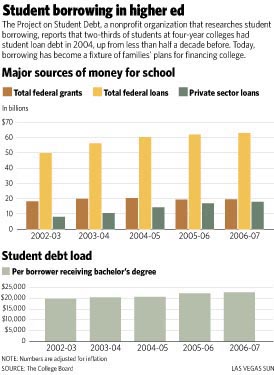
A College Board report on trends in student aid shows that the average borrower who graduated with a four-year degree in the 2006-07 school year had $22,700 in loans, up 15 percent, after adjusting for inflation, from 2002-03.
The struggle to find money for college has some education and political leaders calling for greater emphasis on grants and other aid students don’t have to pay back. President-elect Barack Obama, for instance, pledged in his campaign to give students a $4,000 tax credit for 100 hours of public service.
Borrowing, however, is likely to remain central to the way families finance college for years to come.
For many students, loans are a blessing, making higher education possible.
But others say the money is too easy to obtain, fueling decisions they later regret. Some, like Jones, wish they had chosen cheaper schools once the reality of how much they borrowed hits in the form of steep monthly payments.
•••
“You don’t look at it as a corporation because it’s a school. But they just want your money.”
With that statement, Jones answers his own question. That, in part, is what enabled someone in his 20s with a skimpy credit history to borrow tens of thousands of dollars.
It’s just the way the system works.
Students’ willingness to take out loans provides colleges with steady income. With record numbers of applicants looking to enroll, even expensive schools can afford to keep raising fees.
Financial aid offices are set up to ensure students can get money — not to discourage them from attending their dream schools, even if that means racking up decades worth of debt.
To be fair, colleges typically suggest loans only after students have exhausted alternatives.
And The Art Institute even offers bachelor’s degree students up to $10,000 in tuition credit to match scholarships they could have received had they attended a public school.
Still, 87 percent of Art Institute students borrowed in the 2006-07 school year.
Under the federal Education Department’s loan program, students and parents borrow from the government or from lenders whose loans the government backs. Congress sets maximum interest rates.
To give lenders incentives to lend, the program limits their risk to encourage profits. When borrowers default, lenders receive 97 percent of the amount owed from guaranty agencies that get similar reimbursements from the government.
Until recently, investors’ hunger for securities backed by student loans made it easy to finance lending. But in the midst of the credit crunch, the Education Department is buying up to $6.5 billion in federally backed loans lenders made in the 2007-08 school year, along with loans made this year and next.
In recent years, surging college costs and caps on how much students can borrow from the federal program have expanded the market for private student loans, which are not guaranteed by the government and often carry double-digit interest rates.
When Jones was in school, money flowed readily, but newly wary lenders have begun tightening restrictions on who can borrow. Many have pulled out of the private student loan market — some say that’s good.
Of the $80,000 Jones owes, about three-quarters is on private student loans, some co-signed by his mother. The new difficulty in securing such funding could force students to consider what Jones wishes he had done — attend a less expensive school.
“There are some colleges that think of private loans as financial aid. We strongly disagree,” says Lauren Asher, vice president of The Institute for College Access and Success, a nonprofit group dedicated to improving access to higher education.
“Do you think of credit cards as financial aid?” Asher says. “Or home equity loans as financial aid? (Private loans) are just an expensive way of getting cash.”
But Justin Draeger, vice president of planning for the National Association of Student Financial Aid Administrators, calls private loans “a necessary evil.” Families, he says, have come to depend on them.
•••
“Had I known I had to pay over $700 a month, I wouldn’t have ever agreed to go to that school in the first place.”
Jones knows he shouldn’t have signed up for loans without understanding how long it would take to pay them back. “When it’s all said and done,” he says, “it’s my fault.”
Still, he adds, companies are “offering these crazy loans and qualifying these kids that are clearly not educated about what they’re really going to have to go through.”
Financial aid advisers, he says, did not caution him against taking on too much debt.
At all schools, students must complete counseling to learn about borrowers’ responsibilities and repayment plans before getting federally-backed loans.
In Jones’ case, The Art Institute provided him with documents explaining loans, and he signed acknowledgments stating he understood their terms.
But, “being 18, I didn’t care what the interest rate was,” he says. “I didn’t think about it.”
Nancy Rapoport, a UNLV law professor and bankruptcy expert who sat on an American Bar Association commission examining student debt, says students deciding whether to borrow for college should ask themselves, “Does my choice of career match my ability to repay my loans?”
This, says Rapoport, is an issue lenders and financial aid officers should broach to give students a “reality check.” Like subprime mortgage borrowers, she says, young people eager to go to school often don’t pause to consider their ability to pay later.
Some financial aid officers say they avoid discussing salaries because each person’s background affects job prospects. Students might change their field of study. And data about earnings is widely available.
At The Art Institute, Jones received financial plans showing how much debt he could expect to accrue over the course of his studies. Students there must meet with financial aid staff before borrowing, which isn’t the case at other schools.
At the College of Southern Nevada and UNLV, loan counseling is available online. Students who want to sit down with an adviser can get an appointment. But not everyone wants or needs in-person attention, says Peter Hurley, director of student financial services for CSN.
CSN does not include loans in financial aid packages unless students request them, and of more than 57,000 who studied there in the previous fiscal year, just 2,088 borrowed.
Melise Leech, 51, says the only debt counseling she attended before accumulating more than $100,000 in federal loans and interest over seven years at UNLV was a group session with fellow students. She doesn’t recall what she learned there.
“There’s nobody sitting down with you and saying, ‘Look, if you’re not careful, you could find yourself looking at $100,000 of loans in the next few years,’ ” says Leech, who earned a master’s degree in history from UNLV but dropped out of her doctoral program there in 2007.
Of the yearly financial aid process, she says, “They sent me a letter and said, ‘This is how much you’re eligible for,’ and they said, ‘Check off what you want. Do you want this? Do you want that?’ So you look at it and you say, ‘OK,’ and I checked them off. And that’s it.”
Harrison Wadsworth, special counsel to the Consumer Bankers Association, says prospective borrowers can call lenders to inquire about loans. Banks disclose interest rates and repayment plans, he says, and students need to invest time into understanding the debt they’re taking on.
“They need to know they’re getting the education that they want, they need to think about how much money they’re borrowing and if they’re going to be able to pay it back given the field of study they’re pursuing,” Wadsworth says. “I am amazed at the amounts that some students borrow, and it seems like it’s too much.”
•••
“I don’t think I’ll ever go into default. ... It’s not going to get me anywhere — just a deeper hole.”
Jones knows defaulting on his loans could ruin his credit and leave him with a bigger debt. The government charges defaulters in the federal program for the cost of collection and can garnish a portion of their wages.
Bankruptcy laws that allow people to discharge most medical and credit card bills make it difficult — some say nearly impossible — to write off student loans, including private ones.
Under Jones’ repayment plan, he is strapped to his student debt until 2032. By that time, he will have shelled out more than $137,000. He will be 48.
He could reduce his monthly bill by choosing a longer repayment plan, but the total he would ultimately pay would balloon. “To me, that’s just getting screwed over even more,” he says.
His mother covers some of his loan payments. But he is responsible for most, along with a monthly car payment, insurance, groceries, gas, his portion of the rent on a house he shares with his girlfriend. Buying a home is little more than a pipe dream. Starting a retirement account? Out of the question.
Jones’ mother had declined to pursue federal loans parents can take out to fund students’ education. She says she would not have let her son borrow so much had she known how long it would take to repay the loans.
“I was naive myself,” says Alicia Pontbriant, 46, a respiratory therapist. “I’d never taken student loans out. You always hear student loans are the best thing on the planet because they’re really cheap ... I just had no idea.”

Discussion: 21 comments so far…
Post a comment
Email Edition
- Most Read
- Discussed
- Most E-mailed
- Harmon inspector lacked experience
- 15-year-old charged in hit-and-run death of motorcyclist
- Venetian, Palazzo lay off workers amid downturn
- Feds sue Forum Shops over alleged discrimination
- UMC has collected less than 1 percent of $459 million in past-due debt
- RE/MAX accuses real estate agent of ‘cybersquatting’
- Las Vegas guide to the Fourth of July
- NLV fire captain indicted for felony arson
- How state furloughs will work, for now
- Metro officer fatally shoots man in northwest valley
Blogs
The Bull's-Eye
Dramatic darts victory sealed with a kiss, or two (UPDATED)
Sports: Upon Further Review
Timberwolves release summer league roster; Rubio not included
Bloggity, Bloggity, Bloggity
When it comes to Mayfield, I don't know what to believe (1 Comment)
Punchy Points: UFC 100
No. 9: The Voice: Buffer offers unique entertainment to UFC events
Elsewhere
Jackson, Evans could headline Memphis event in Dec.
Four grappling superfights set for UFC Fan Expo
UFL eyes overseas expansion
Calendar
- Doyle Brunson hosts at Blush (11 p.m. to 11:59 p.m.)
- Bill Maher at the Orleans Showroom (8 p.m. to 10 p.m.)
- The Lon Bronson All Star Band at Green Valley Ranch (9 p.m. to 11 p.m.)
- Black Camaro CD release show at The Gypsy Den (9 p.m. to 11:59 p.m.)
The Sun
Locally owned and independent for more than 50 years.
Technorati

Nevada students who plan on entering health professions have loan assistance available from the state in the Nevada WICHE program. But students in other fields do not get much help from the state of Nevada.
http://www.collegeloanconsultant.com/Nev...
My co-worker is signing her son up for the Art Institute and the cost is $90k!!! Wow, the price you pay for instant gratification of career related education that will just focus on that one specific profession. I'm still paying on my loan from my medical assistant education in 2001. I'm no longer a participant of the health care industry. I think the whole thing is a crock.
I would be proud to have a son like Eric based on two comments he made: "I don't think I'll ever go into default" and "it's my fault." He appears to be a person who will always do the right thing. Now, if he could only find a way to double that monthly payment (a hobby that earns him money, perhaps?) and double those loan payments to pay it off in less than half the time. Good job, Eric!
I found myself in a position like Eric a few years ago after I graduated from college. It helped me to learn more about debt negotiation (http://www.debtmatch.com/debt-negotiatio...) and I worked alongside my debt collection companies to come up with a solution.
$700 a month wow thats a lot for sure! But he did get the money so he should pay it back. He needs to learn how to pay this debt down with extra payments. So how much does he spend getting all those tatoos? Looks like thousands of money wasted on ink to me. And why would an employer give a guy with all those tats a raise? I say if they cant look professional you pay them less. I mean half the pay is for representing the company in a professional way and arms covered with what looks like "prison ink" is gonna keep your pay low forever. What are all these kids getting all this ink for? Its a lifetime choice. I bet hes got at least $10,000 in ink!!!
They should limit loans to tutition only.
Many people use their loans for other stuff like cars, TV's and partying.
to lasvegas2009, why dont you take your 1940's ideals and stuff em. seriously, I have an engineering degree from Penn State and my cousin has her masters from PSU as well, we both have tattoo's on our arms. Which can be easily hidden with a long sleeve shirt so that we may be "respectable/professional". Then again, what do those terms mean in todays world? The same tattooless people who run companies into the ground and embezzle your 401K's are respectable right? Really, get a clue, dont judge a book by its cover, we may be the people helping you out one day.
Financial Education needs to be a mandatory High School Class for all US High School Students. It should be given the same priority as math, writing, and reading. All too often I hear stories like Eric's about trusting college students taking thousands in loans. Schools need to stop getting bonuses or kick backs for signing up as many students as they can with loans from preferred providers. Frankly schemes like that are ridiculous and border on criminal. Best of luck to you Eric and the others who are forced to pay back thousands in student loans.
"Financial Education needs to be a mandatory High School Class for all US High School Students."
I totally agree with that. And perhaps Ethics.
@lasvegas2009: I'm Eric -- the one featured in this story. Just wanted to answer a few of your questions; first of all, my best friend does all of my tattoo and has been since he was an apprentice, and I haven't paid for any "ink" in almost 5 years. I agreed and plan to pay these loans back, and do believe loans are made between two consenting and responsible adults. However, I was taken advantage of in many ways that AREN'T explained in this story, but I won't get into that right now. My employer should make their decision on my raises based on my work performance. Considering I'm a graphic artist/illustrator, I don't meet with clients, and I work behind the scenes...My artwork speaks for itself. I don't think i need to defend myself, just wanted to make that clear. You are obviously ignorant in your prejudices, and may want to rethink your social outlook. Thanks to everyone else for the kind words, and good luck to anyone else in my position. -- Just know things will always work themselves out.
The job you have now is not the job you want in the future. You have already made choices (tats)that will affect you for the rest of your life. There will always be people like me who see this as an issue. Unlucky for you most of us well never tell you why you didnt get the job. We will just say "we will call you" when we make a decision. Remember the people who own and manage the companies you want to work for dont have tats and some of us will always judge you because you chose to get them. When I was your age only thugs, rapists, and prison people had selves of tats. Like it or not each one of us are judged by our appearance. I would never seek health advise from a Fat person and would never consider a person with selves of tats professional. I just being honest! Hey and good luck with paying down those loans.
Eric, I saw your pic and was wondering how fast someone would comment against your tattoos. My wife has "several", and she knows to just cover up. Would you show up to a job interview in a beater to rep all your tats? Probably not. In any case, it is what it is, and I hope the best for you financially.
BTW, judging from your pic, you seem smart enough to avoid tats to the hands and face/neck. Those are the tats that employers notice. Hell, I was a teacher with seven tattoos, and when I wore a short sleeved shirt, no one was the wiser.
Well, let me re-phrase that for you - "the job you have now MAY not be the job you want in the future." You don't know me, and you jumping to your own conclusions regarding my personal career choices is only furthering the catalyst that induces your stereotyping. I rather resent your condescending cordiality, so don't patronize me please. For one thing, privileged people in your superior position might not know if I have tattoos if I have long sleeves on. Hell, I could be a tattoo artist right now, and make double what I make, but I have goals of becoming a creative director, and using advertising alongside my talent to help charitable organizations. I understand that prejudice is a naturally occurring psychological behavior in almost all species of life. Except, we as humans have the choice, to understand that things aren't always what they seem. That piece-of-advice can get you a lot further in life; your introverted and isolated view of the world is just bleak. I guess you're just gonna have to kick those old-fashioned values, and understand that tattoo shops in themselves are becoming a larger sector in this country's economy. Still trying to figure out what selves of tats are too, by the way. LOL
Ok poor little guy got taken advantage of? What ever, if every idiot who made bad decisions got an article we would have all you whiners in every article. The whole point of my post was that life is not fair, never will be and quit whining about it. "Oh that business took advantage of me by paying for me to go to school and now they expect me to pay it back"..boohoo, boo hoo. If you can make double then your a fool for not doing it. If you dont like the attention then stay out of the news! My spelling may not be great but I dont cry to the world every time I have to face up to MY bad choices.
As if it wasn't already obvious, 'LasVegas2009' completely misses the point of the article and ascribes an attitude to Mr. Jones which he clearly does not espouse.
The backward and outdated ideas being spouted by 'LasVegas2009' display an irrelevance that I haven't seen for quite some time. Tattoos equal poor judgment? Ok, Gramps.
Mr. Jones has shown a level of maturity in his actions and attitudes that dwarfs the childish bickering offered by LasVegas2009.
Well that is sad. I was asked to do this piece as a cautionary tale to students that are taking on huge loads of debt. Many people were originally part of this story, but eventually backed-out due to not wanting their names and personal information in the public eye. I stuck my neck out, and feel I did a noble thing - I am not proud of how much I make, I am embarrassed that I was young and dumb and didn't know or care about interest rates and loans. I have to deal with this on a day-to-day basis. I did not go out and look for a reporter to do a story on me; I was contacted. I think I know first-hand that life isn't fair, but thanks for making that brilliant observation, what an amazing and refreshing slice of philosophy you've introduced. If I was to quit my job and become a tattoo artist to make twice as much money it would just be an immediate financial gratification decision, but it's not what I want to do. Yet I have confidence in my position, this is my career and I feel I can capitalize on my education. The sky is the limit in my field when it comes to salary. Unfortunately tattoo artist reach a ceiling when it comes to pay. I think you're making a bad decision every time you attempt to write a complete, clear and concise sentence.
I am reading this story and I am not sure why this is a story of interest? Everyone pays to go to school. A higher education degree will cost anyone 10k, 50k, 120K etc. It is also a fact that most people do not have enough cash on hand to pay for school and will need to take out a loan be it federal or private to cover the cost of the education. I would be proud of the fact that a degree has been earned and that a job has been gained at "a national firm" and at a salary that is above average for an entry level employee. Mr. Jones you should be proud of what you have accomplished. Maybe this is a lesson learned to ask more questions in regards to financial decisions.
Poor babies
Welcome to the real world
It is happy to see your posting. Yes really informative article. I will tell this information again to my friend, oh yes I suggest you to check my blog on http://top-studentloans.blogspot.com/ , I hope the article on my blog will be usefull for you" and we can share each other. thank you" ;-)
(Removed by the site staff)
I have to agree about The Art Institute. I graduated in the 90's. At that time, my debt was 25-30K. After graduation, I couldn't find a job in the field..too many out there applying. The school. I had 1 job for 6 months and the company closed. I went back to the Art Institute( as they offer job placement for graduates ) and was told the in school students come first and whatever they don't choose I can pick from !!???There was nothing left !! I had to take a job with a convenience store...my bills skyrocketed...I had to do several forebearances and now my debt is 59K. I am about to give up on the loan because they keep raising the payment. Now at 192.00 a month. I make 10.50 an hour and can't find a higher paying job. My suggestion for all artist wannabes...STAY AWAY FROM THE ART INSTITUTE !!!Go to your local college and get the same education for a 1/4 of the price.