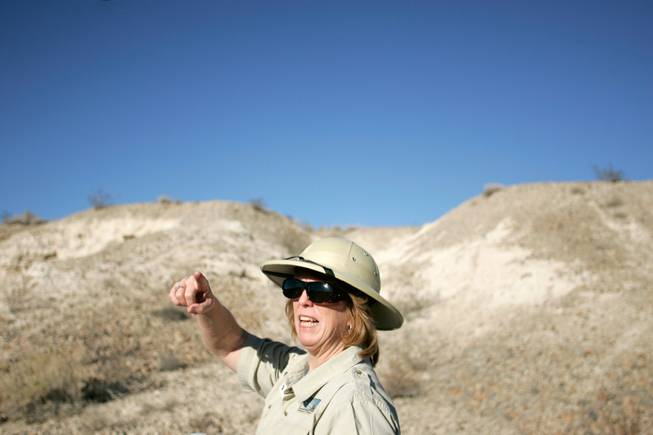
Jill DeStefano, founder of the preservation group Protectors of Tule Springs, leads a tour last week of the Upper Las Vegas Wash.
Monday, Nov. 17, 2008 | 2 a.m.
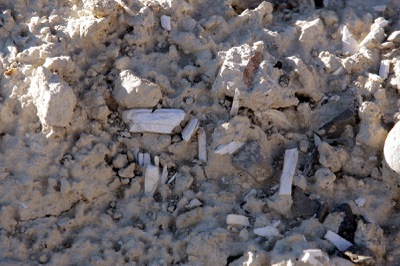
Mammoth tusk bones are among fossils that lie on the 13,000-acre swath of desert.
For 30 months preservationists have been waiting for the findings of a Utah State University study on the potential effects of developing the Upper Las Vegas Wash, a broad swath of archaeologically rich land that may determine how far Las Vegas and North Las Vegas grow into the desert.
The findings will help the federal government decide whether to allow some of the land to be auctioned to developers, or whether it should be preserved.
The study has now been released. And a lot of people are trying to make sense of it.
Hanging in the balance of how the study’s findings are interpreted is nothing less than the potential growth of two cities, or the partial eradication of archeological history.
The 13,000 acres in question form a virtual development stopper, sandwiched between the Paiute Reservation to the southwest and the Desert National Wildlife Range to the northeast.
North Las Vegas and Las Vegas say they want to preserve the land — but in a way that leaves room for urban development.
Las Vegas favors saving 2,300 of the 13,000 acres. With limited preservation, a corridor of tens of thousands of acres further northwest would remain open for future city growth. If larger swathes of land are preserved, the city argues, the cost to move development into those northwest acres would skyrocket.
City leaders say preserving a big chunk would lead to “leapfrog” development and costly measures to carefully lay down utility lines needed to spur and maintain growth.
Preservationists argue the land is too valuable to alter for the sake of development. With the preservation of 13,000 acres, they see the area turning into something akin to Red Rock Canyon, complete with a museum and education complex.
Four Utah State professors involved in the study repeatedly refused to say whether the land should be freed for development.
Instead, they only cite what exists at the edge of the mountains — using terms such as “thermic typic hapolacids” at a meeting Friday called by the Bureau of Land Management to receive the study.
“I’m really good at cocktail parties,” said Janis Boetinger, a Utah State soil science professor poking fun at the lexicon of her discipline.
The crux of her research shows there is no difference between the soil found underneath the rare bear poppies and soil elsewhere. Preservationists say that means the entire area needs to be preserved to protect the plant life.
Thomas Edwards, a research ecologist with the U.S. Geological Survey and a Utah State wildlife resources professor, noted that he used “abiotic, topographic and bioclimatic variables to model likely locations of plants of concern.”
In other words, he tried to pinpoint where bear poppies live. His research shows they live in 53 of the 307 places he looked.
But the concern in the environmentalist-filled audience was more about what wasn’t included in the study: information about the region’s water and paleontology. A study on water movement is ongoing, said Gayle Marrs-Smith, a BLM project manager.
She said the BLM is relying on data from the San Bernardino County museum that shows more than 430 paleontology sites in the wash.
For more than 40 years, archeologists have known about the wash’s treasure trove of fossils. In humidity and temperature-controlled cabinets in the San Bernardino County museum, scientists have preserved 9,876 fossils from the wash.
So valuable is the site and so visible are the fossils — in one area, the rib cage of a woolly mammoth juts from the earth — access is granted only to those with a BLM permit. And accidental explorers are legally forbidden to tinker with or take any fossils they might stumble upon.
Preservationists say there are more fossil sites below the land’s surface that were noted during research done in the 1960s.
Officials of Nellis Air Force Base oppose development of the area, saying it is under vital air space used by the Air Force for training purposes.
“This allows us to be stewards of the government’s investment and stewards of the environment,” Col. Dave Belote, commander of 99th Air Base Wing, said during a visit to the wash Friday.
The final environmental survey on the wash is scheduled to be completed next month. In April the BLM will likely make a decision on how much of the wash land will be auctioned.
“We will have a boundary and, yes, outside of that boundary there will be development,” Marrs-Smith said.
By the end of Friday’s meeting Rob Mrowka, a conservation advocate for the Center for Biological Diversity, was thinking of ways to extend the public comment period for the impact study from 45 to 90 days.
“We just need to keep playing with them to force them to do the right thing,” he said. “This is the last of the great conservation areas in the Las Vegas Valley.”
He has a friend in Clark County Commissioner Tom Collins, whose district includes the wash. He opposes development in the area.
“We need to preserve something in the valley,” Collins said. “There has not been much protected around here.”
Jace Radke, a Las Vegas City Hall spokesman, said administrators wouldn’t comment until they had time to read the study.
Either way, there will probably be more meetings, a few lawsuits and sore feelings by the time anything is decided.
“This is just the beginning,” said Jill DeStefano of the preservationist group Protectors of Tule Springs.
Sun reporter Megan McCloskey contributed to this story.

Join the Discussion:
Check this out for a full explanation of our conversion to the LiveFyre commenting system and instructions on how to sign up for an account.
Full comments policy