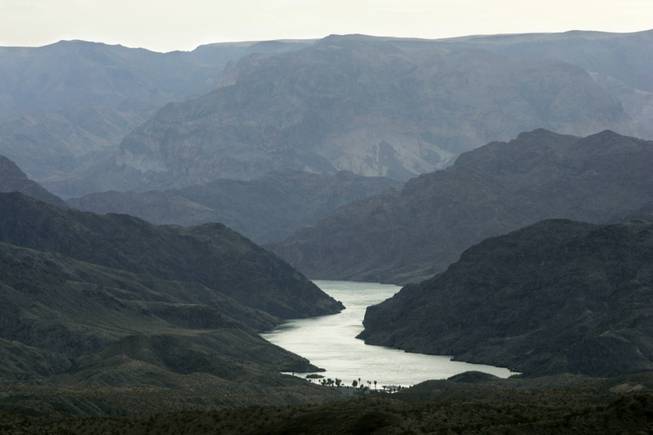
SAM MORRIS / LAS VEGAS SUN file
A seven-state agreement signed 80 years ago gives Nevada 300,000 acre-feet of water each year from the Colorado River.
Friday, Nov. 14, 2008 | 2 a.m.
Sun Topics
Nevada’s share of the Colorado River is so small that it seems only logical that a rewriting of the 80-year-old law that divvies up the river would go our way.
The Colorado River Compact, after all, allocates Nevada a paltry 300,000 acre-feet of the river’s water, by the far the smallest amount among the compact’s seven U.S. states.
Still, Southern Nevada Water Authority General Manager Pat Mulroy wants to leave the agreement alone.
At an Oct. 28 Brookings Institution event, Mulroy said she is going to make the case “whenever and wherever I can” that the key to the region’s water future can’t be found in any renegotiation of the compact.
The reason: Nevada is unlikely to benefit from any attempt to change it, according to Mulroy and Kay Brothers, the water authority’s deputy general manager.
“I don’t think we’d get any more water. In fact, I think we would lose water,” said Brothers, explaining that the law was written during a particularly wet period and that climate change has further sapped an over-allocated river. “When they allocated, they gave away 15 million acre-feet (a year). We know the flows are much less than that.”
With climate change affecting the snow pack that melts into the river, its flows in coming years are expected to decrease.
So, given that it is a shrinking water supply, Southern Nevada would have to fight just to keep its share of the river.
And here’s the clincher: All seven states would have to agree on the new allocations.
Although population growth in Southern Nevada over the past 100 years is a compelling argument for more water, states such as Utah, Colorado and California that have experienced and continue to experience their own population growth aren’t likely to give up water they might need one day, or in some cases already do.
So, if the compact were to be renegotiated, no state is likely to gain water.
“States would actually lose water ... or at the best stay the same,” Brothers said.
In fact, Sierra Club Southwest Regional Representative Rob Smith said that’s the reason the compact should be reopened — to carve into every state’s allocation to leave more water in the river for wildlife.
“The big question is not ‘Who gets what?’ but whether there is even enough to go around,” Smith said.
Smith, like Brothers, said all the states should fear that they would end up with less water.
Brothers said the water authority’s good working relationships with the other Colorado River Basin states, which have not always been so friendly, are more likely to bear fruit than a contentious renegotiation effort.
For two decades, the authority has drawn the same amount of water from the lake as it puts in from its wastewater treatment plant in addition to the 300,000 acre-foot allotment.
More recently the agency has negotiated plans to draw water from the Virgin and Muddy rivers through Lake Mead, to store water it doesn’t use in reservoirs in California and Arizona and to use water it saves by lining canals or fallowing fields.
So, yes, Southern Nevada got ripped off when the compact was signed in 1922. Which means its water managers will have to get creative to keep Las Vegas wet.
But perhaps the most compelling reason to give up on rewriting the agreement is a more philosophical one: It’s time for Southern Nevada to let go of its anger and come to terms with the reality of 300,000 acre-feet.



Be afraid. Be very afraid.
When will Lake Mead go dry?
Tim P. Barnett and David W. Pierce
Water Resources Research; published 29 March 2008.
[1] A water budget analysis shows that under current conditions there is a 10% chance that live storage in Lakes Mead and Powell will be gone by about 2013 and a 50% chance that it will be gone by 2021 if no changes in water allocation from the Colorado River system are made.
This startling result is driven by climate change associated with global warming, the effects of natural climate variability, and the current operating status of the reservoir system. Minimum power pool levels in both Lake Mead and Lake Powell will be reached under current conditions by 2017 with 50% probability. While these dates are subject to some uncertainty, they all point to a major and immediate water supply problem on the Colorado system. The solutions to this water shortage problem must be time-dependent to match the time-varying, human-induced decreases in future river flow.
Citation: Barnett, T. P., and D. W. Pierce (2008), When will Lake Mead go dry?, Water Resour. Res., 44, W03201,
doi:10.1029/2007WR006704.
Isn't it funny that a 2008 paper can be outdated. As KeepNVStrong pointed out the article said that if no changes in water allocation are made we would have little or no water in storage after 2021. But luckily in 2008 the states using the Colorado River came to an agreement to not let that happen including shortage guidelines. This was all spearheaded by the SNWA and the first time the seven states came to an agreement to change the policies of the river.
Unbelieveable...! Nevada, the SNWA and the Bureau of Reclamation have been offered a MILLION ACRE Feet of fresh water each year and they continue to proclaim that there is no solution to the drought dilemmas facing Nevada.
Maybe its time for the citizens of Nevada to ask the Bureau what it has done with the following offer to keep Lake Mead reasonably FULL:
August 19, 2008
TO: U.S. Bureau of Reclamation
FROM: Ray Walker, Retired Water Rights Analyst
waterrdw@yahoo.com
Subject: Lease of available space in Lake Mead
Attn: Robert Johnson, Commissioner
Robert Walsh, External Affairs Officer,Lower Colorado Region
I wish to deliver and properly measure up to ONE MILLION ACRE FEET of fresh water to the Colorado River which is absolutely non-tributary to the Colorado River.
In order to solve the water shortage dilemmas facing the region, I wish to store said non-tributary water in Lake Mead on a space available basis.
Evaporation losses will be paid by subtracting off for any increase in evaporation losses due to the increased surface area of Lake Mead that will result. Using existing capacity tables, this will be simple to calculate.
I propose to pay for the lease with some of the increase in power generation due to the increase in head pressure as the non-tributary water accumulates.
Lake Mead produces on average 1800 megawatts of renewable energy each year.
Releases of the non-tributary water will be utilized to solve the environmental problems associated with the Colorado River Delta and the endangered species in the Lower Colorado River.
The additional amount of non-tributary water will be utilized to solve the domestic and agricultural requirements of the region, as needed.
I fully understand that in the event Lake Mead eventually fills and spills, my non-tributary water will be the first to spill. The water quality of the delivered non-tributary water, at all times, will match or exceed the water quality of existing water in Lake Mead.
I agree to make no claim for any aspect of the stored non-tributary water as it applies to the recreational activities on the surface of Lake Mead, but I will in no way be held liable for such recreational activities.
The definition of non-tributary water to the Colorado River (non-tributary water) means water that under no circumstances is part of any tributary or groundwater that would drain into or possibly be connected to or eventually ever reach any part of the Colorado River or any of its tributaries in any state.
The million acre feet of fresh water was offered to the SNWA, Nevada and the Bureau for their independent investigations and verifications by their own attorneys.