
Duke Breuer, a former patient of the Endoscopy Center of Souther Nevada, is awaiting blood test results to see whether he contracted an infectious disease.
Sunday, March 9, 2008 | 3 a.m.
Endoscopy Patient Reacts
Arnold “Duke” Breuer of Las Vegas went to a Quest laboratory Monday to have a blood test, checking for hepatitis B, C or the HIV virus after he underwent not one but two procedures at the Endoscopy Clinic of Southern Nevada in December.
Beyond the Sun
If you want to get a sense of the rushed medical procedures that patients encountered inside the clinic that triggered the unprecedented hepatitis scare, consider Duke Breuer’s experience.
After undergoing a colonoscopy at the Endoscopy Center of Southern Nevada, Breuer asked a nurse what he should do about the bandage on his right forearm.
“Take it off when you get home,” the nurse said.
Later, when the 78-year-old Breuer pulled up the tape, he started gushing blood. The IV needle had been left in his arm and he had accidentally yanked it out.
Blood spurted with each beat of his heart — “Poom! Poom! Poom!” is how Breuer describes it. The darkest blood he’d ever seen, covering his pants and ruining his beloved Chinese silk rug.
So Breuer was none too happy when he returned to the facility a few days later for a second procedure.
“I ought to sue you for ruining my rug,” he told a nurse.
Her response stunned him.
“You ought to sue us for a lot of other things that go on here,” Breuer says the nurse replied. “You don’t know what goes on here. I hate my boss.”
He dismissed her as a disgruntled employee.
Then, 10 days ago, the Southern Nevada Health District announced that 40,000 people might have been infected with hepatitis B, hepatitis C or HIV because of dangerous injection practices at the downtown endoscopy center.
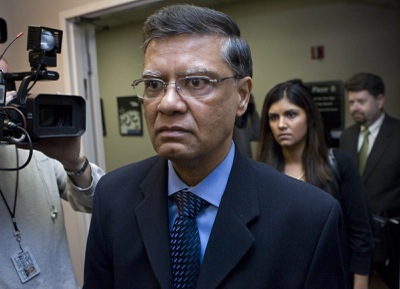
Dr. Dipak Desai, majority owner of the Endoscopy Center of Southern Nevada, leaves Las Vegas City Hall on March 3. Desai has surrendered his medical license pending the outcome of a state investigation.
Never, it seems, has the community been so collectively outraged as now, with the news that patients were put at risk of being infected with fatal diseases because of a doctor’s drumbeat to save money.
According to investigators, the nurses claimed that Dr. Dipak Desai, one of the state’s most powerful physicians and owner of the clinic, had ordered the dangerous practices. When patients needed more anesthetic, the nurses were using the same syringe to dip back into the vial. That tainted the medicine. Then, even though the vials were intended for single use, the nurses would reuse them on other patients. That passed along infection. Little money would be saved by reusing syringes, but reusing the medicine could save $5 to $10 per procedure, experts estimated.
Six people contracted acute hepatitis C because of the dangerous injection practices, health officials said, and now thousands more await the results of blood tests.
The clinic has been closed by the city.
Why did Desai apparently ignore established, fundamental medical safety?
Medicine is business. And in an era of rising health care costs and dropping insurance reimbursement rates, physicians balance the pursuit of profit with patient care. But those who know Desai and worked with him say his downfall was greed. Desai proudly proclaimed that he ran the most cost-effective clinic in the entire country.
A nurse who worked for Desai said his business plan called for extreme cost-cutting measures. A doctor who has worked with Desai said he was proud of churning through procedures at an impossibly fast pace. He said he witnessed Desai perform in a few minutes a colonoscopy that should have taken 15 minutes. And then brag about it.
“He’d say, ‘I’m the fastest endoscopist, the best endoscopist, in town,’ ” recalled the doctor, who like others asked for anonymity for fear of reprisals. “That was his pride and joy.”
In crude gastroenterology parlance, Desai would be known as a “jammer.”
Desai’s public relations consultant said the doctor would not consent to an interview for this story.
By many measures Desai is a success. He attended medical school in India and completed his residency and an internship in New York before he and his wife, Dr. Kusum Desai, a pulmonary specialist, were licensed to practice medicine in Nevada in 1980.
Desai has been chief of gastroenterology at University Medical Center and Valley Hospital & Medical Center, and a professor at the University of Nevada School of Medicine. The couple owns a $3.4 million, 8,700-square-foot home in Summerlin.
A friend credits him for helping to found the Hindu Temple of Nevada and donating $250,000 to it.
But the friend asked not to be identified because of what else he had to say about the doctor: that Desai is aggressive, intense and preoccupied with business.
“If he cannot achieve something with you he will forget you in a minute,” the friend said.
The Endoscopy Center of Southern Nevada opened in March 2004 in a medical building at 700 Shadow Lane, between two of the city’s largest hospitals — and across the street from the offices of the Southern Nevada Health District, which launched its surprise inspections of the facility in January.
The business complements Desai’s Gastroenterology Center of Nevada, which has six valley locations.
Although other doctors worked at the high-volume facility, it was Desai’s domain.
Appointments were frequently double-booked, leading to two-hour waits in a standing-room-only waiting room, said a nurse who worked there in 2007.
In assembly-line fashion, patients were hurried among nurses who would admit them, start an IV in their arm, take them to the room for the procedure, and then walk them to a recovery area before sending them out the door.
“He would always say, ‘Time is money,’ ” the nurse said of Desai. “The faster we would go, the happier he was.”
The flow of patients sounds impossibly fast, said Phyllis McGregor, a nurse who for 20 years directed the gastroenterology department at Centinela Hospital Medical Center in Inglewood, Calif.
She ran three rooms where a total of 30 procedures a day were done, at the most. Desai was doing 60 procedures in two rooms — a pace that McGregor said compromised patient safety.
The rush of procedures took its toll beyond the forgotten IV needle in Duke Breuer’s arm.
Carrol Lathrop, a 70-year-old from Pahrump, says Desai perforated her bowels during a colonoscopy, and she was forced to wear a colostomy bag for a year before having surgery to fix the problem.
Lathrop’s records from the clinic show Desai performed the procedure on Sept. 6, 2006. The notes are contradictory, observing on the one hand that she was in “discomfort,” “tolerated the procedure poorly” and that the “quality of the prep was inadequate,” while also saying “the colonoscopy was performed without difficulty” and she was discharged in “satisfactory” condition.
The next day, Lathrop was in such agony that she went to Desert View Regional Medical Center in Pahrump where, according to hospital records, she was diagnosed with an “acute perforation” of the sigmoid colon.
McGregor, the California nurse, says she has seen only two cases of perforated bowels in 25 years.
In addition to hurrying procedures, Desai was a miser with supplies, his clinic nurse said. In a finding unrelated to the hepatitis C outbreak, the state Licensure and Certification Bureau found that technicians were not adding the proper amount of detergent to remove the blood, tissue and other body fluids from the endoscopes, nor were they discarding cleaning solution after each use.
In addition, clinic staff was ordered to save money by cutting in half the disposable underpads that protect the beds, she said. The pads cost about 21 cents each.
Desai also saved money — and made money — by using certified nurse anesthetists rather than anesthesiologists, who are medical doctors. Because the certified nurse anesthetists were salaried employees, unlike anesthesiologists, who would have billed insurance companies and Medicare independently, Desai was able to submit his own billings for anesthesiology.
The nurse who worked in the clinic said keeping the anesthesia services in-house offered opportunities to overbill for services. For instance, she said the anesthesia for all procedures was billed at 30 minutes when none ever lasted more than 15.
The Nevada attorney general’s office is investigating whether Desai defrauded insurance companies or Medicaid, the government’s insurance program for the poor.
Using employee-nurses versus outside doctors to administer anesthetics may have contributed to a culture of compliance with Desai’s demands — including the unsanitary injection practices.
Dr. Chris Millson, a Las Vegas-based board member of the American Society of Anesthesiologists, said an independent anesthesiologist would have gone “toe to toe” with Desai and prohibited the dangerous injection practices.
“It’s not that a nurse anesthetist can’t argue with a physician,” Millson said. “But none did in this case.”
On Wednesday, five certified nurse anesthetists voluntarily surrendered their licenses to the Nevada State Board of Nursing pending the outcome of its investigation.
And on Friday Desai voluntarily agreed to cease practicing medicine pending the outcome of an investigation by the Nevada State Board of Medical Examiners.

Join the Discussion:
Check this out for a full explanation of our conversion to the LiveFyre commenting system and instructions on how to sign up for an account.
Full comments policy