Las Vegas Sun

October 11, 2008

Rush to judgment on Kucinich, debate

Short hearing led to quick decision that was roundly criticized, overturned

Image

Leila Navidi

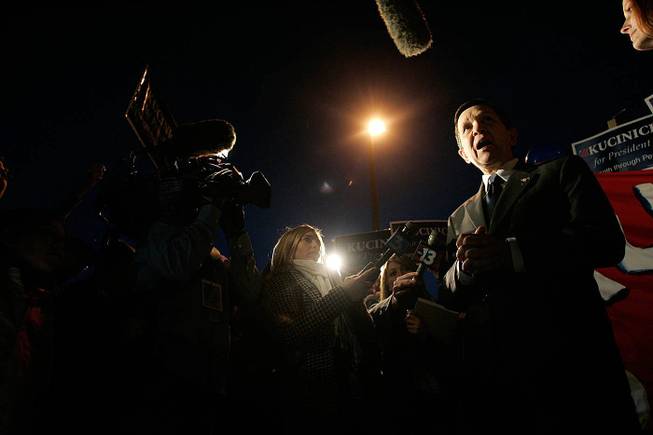
Presidential candidate Dennis Kucinich speaks to reporters outside Cashman Center after the state high court kept him out of the Democratic debate in Las Vegas.

Wed, Jan 23, 2008 (2 a.m.)

Outside Support

You need to upgrade your Flash Player

You Won't See This on TV

You need to upgrade your Flash Player
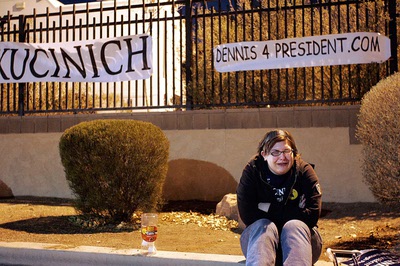
Briana Falb-Joslin of St. Paul, Minn., cries outside Cashman Center after hearing Dennis Kucinich was out of the debate in Las Vegas.

Briana Falb-Joslin of St. Paul, Minn., cries outside Cashman Center after hearing Dennis Kucinich was out of the debate in Las Vegas.

The loser of last week’s Democratic presidential debate in Las Vegas may not have been Hillary Clinton, John Edwards or Barack Obama. It appears to be Nevada’s courts.

A District Court judge last week issued a ruling about the debate that suggested the judiciary in Nevada isn’t terribly familiar with the First Amendment. The decision opened the possibility that long-shot presidential candidate Dennis Kucinich, an Ohio congressman, could pry his way into the Jan. 15 debate.

The Nevada Supreme Court ultimately settled the issue as NBC was going through final preparations, an hour before the debate. The high court saw the issue as a simple one -- ample First Amendment precedent gives NBC or any other news organization the right to invite anyone it wants to a debate.

But by then, Nevada had taken something of a beating for the original decision, which legal scholars immediately recognized as wrong.

The dispute began when NBC decided to limit the debate to the three leading candidates. NBC had invited Kucinich to participate, then withdrew the invitation. Kucinich barely registers in opinion polls and he showed poorly in early presidential contests.

The day before the debate, Kucinich filed a lawsuit. It landed in the District Court courtroom of Judge Elizabeth Halverson, who was suspended last summer over alleged ethical lapses. That sent the case to Senior Judge Charles Thompson, who had been assigned to Halverson’s courtroom that day.

But Thompson was in a rush to get to drug court, a conflict he explained to attorneys for both sides. The hearing lasted 20 minutes. Perhaps worse, it came just 90 minutes after the suit was filed, leaving little time for review.

During the hearing, Thompson denied the network’s request to have Chuck Todd, its political director, explain NBC’s decision to change the participation criteria.

Thompson surprised legal observers when he decided NBC’s cable news channel, MSNBC, which televised the debate, had to include Kucinich. Barring Kucinich, the judge said, would be unfair to the candidate and to Nevada voters.

According to the magazine The Nation, Thompson told NBC’s attorney: “I’m somewhat offended that a legitimate candidate was invited to a debate and then uninvited under circumstances that appear to be that they just decided to exclude him.”

The state Supreme Court overturned Thompson’s decision the next day.

Constitutional scholars said Thompson’s ruling ran counter to overwhelming precedent supporting NBC.

Disinviting a candidate “is arguably rude but it’s not legally actionable,” said Steven Lichtman, a professor at Shippensburg University in Pennsylvania.

“Judge Thompson essentially tried to substitute his vision for what is fair for the network’s vision of what is newsworthy, and he’s not allowed to do that” under the First Amendment, Lichtman said.

Thompson declined to comment to the Sun.

The reason his court had little time to consider the case is familiar to the short-handed Nevada court system.

Court Administrator Chuck Short said judges at the Regional Justice Center handle 1,500 to 2,500 cases a year -- indicative of swelling caseloads countywide. “You risk jeopardizing some fundamental constitutional rights when you have assembly-line justice rather than ensuring everyone has their day in court,” Short said.

But Presiding Judge Kathy Hardcastle told the Sun on Tuesday that she did not think time played a role. “I’m sure if he felt like he needed more time, he would’ve taken it,” Hardcastle said. “He’s a very experienced judge.”

Discussion: 10 comments so far…

  1. Wow. I hope a complaint will be filed with the Commission. After all Judge Thompson made a mistake. He is supposed to be a "SENIOR" seasoned judge. How could he makes such an ignorant decesion. Does he not know the law?

    I personally think he is a "Threat to the admisistration of Justice". I mean, how would such a seasoned judge not know the law.

    Hey Kathy Hardcastle... you going to take away his Civil cases now. Afterall a seasoned Judge should not make these sort of mistakes.

    Y'all worry about Halverson being an embrassement to the Judicary? LOL.. what a joke.

    The current Judges are what is making the Judiciary look bad. Especially the Leader ..Hardcastle.

    Had this been Halverson's decesion I am sure she would have been attacked and been set up on charges. Why the difference in attitude Hardcastle? Sounds like Court Administration and the Chief Judge protect those they like and sell the others down the river.

    You are all so transparent.

  2. Wow. Thank God we have NBC and the Nevada Supreme Court to keep us from hearing different viewpoints in the primaries.

    As far as this story is concerned, it's obvious that the reporter didn't do much research on the original case, because the original ruling didn't have anything to do with the First Amendment.

    The actual ruling was based on FCC rules, which state that a station must "operate in the public interest for the discussion of conflicting views of public interest". Because Kucinich is the only candidate offering to move troops out of Iraq within a year, he has a distinctly different view (which is actually more in-tune with the public) than the three candidates allowed in the debate.

    The other part of the initial lawsuit had to do with Breech of Contract- (the invitation and dis-invitation) which also wasn't addressed in this story.

    The bottom line is that a network's First Amendment rights should not allow them to go against FCC regulations which were set up to keep networks from excluding differing opinions in a political debate.

  3. I filed the complaint and represented Mr. Kucinich in Court. Normally, I would just read the comments, but the points made in the article deserve comment. It is an interesting reaction from some of the media, such as the LV Sun article, when there is question raised about the behavior of the media, itself. There tends to be the feel that some in media regards themselves with a religious reverence, and when someone does not pray at the foot of the alter, they just don't understand why. Mr. Eckhouse creates the impression that First Amendment law in this area is clear. Try reading the line of Forbes v. Arkansas cases, and see if anyone comes away with a clear understanding. The reality is there are various interests in conflict in this area of law.

    Mr. Eckhouse interviewed me yesterday and my comments were that the winner was the Court system and the citizens of Nevada. The entire process showed that the system is responsive, dealt with an important issue, and resolved the issue in a timely manner. While I was on the Kucinich side of the case, I told Eckhouse I thought the decision was judicious and fair, and well reasoned. I think there were arguments which were valid and favored Kucinich. The point of all this is that it was presented in Court, reviewed by the Supreme Court, and decided in a rational manner. What more do you want? The criticism of the system in this circumstance is not well thought out.

    Debate, and in this case, legal debate, of public policy issues is healthy. It allows us to understand why we do the things we do and provides a valid review of the law and how the media operates.

    The Court system exists so that issues like this can be resolved in a legal manner. The reporter should have understood that everyone took time to address the matter, and everyone responded appropriately. I get the sense of some sort of herd mentality from the article, as if everyone should just drone on and never question the position of the media. NBC's conduct here was not exemplary, it did invite Mr. Kucinich and then withdrew the invitation, after he agreed to be in Nevada for the debate. As far as I could see from research there was no other case like it in the First Amendment case law. The Supreme Court disagreed with that, but it was a valid question.

    One legal professor at UNLV law school noted the in the media the contract issue was reasonable. There are differing opinions, and there will always be differing opinion on the issue. But the concept of the article that the court system in Nevada was a loser because of this is simply a naive and superficial conclusion.

  4. As the constitutional expert consulted by Mr. Eckhouse, let me state that his research was indeed conscientious. It was certainly more impressive than the research done by the judges.

    My first question was whether Judge Thompson had ever read the case referenced above by Mr. McGaha. Arkansas Educational Television Commission v. Forbes, 523 US 666 (1997), is a Supreme Court case that is DIRECTLY on point. The Court, by 6-3 (Kennedy) stated that the decision of who to invite to participate in a candidates' debate is "an exercise of journalistic discretion". As long as a decision to exclude is not based on a media outlet's disagreement with the candidate's message, then the First Amendment mandates that the media gets to exercise discretion, and it is not for a judge - a governmental official - to countermand the editorial judgment of the press.

    Under the criteria that were laid out in Forbes, the decision to exclude Kucinich (and Mike Gravel) was completely reasonable. His support barely registered above the margin for error, he was wildly underfunded compared to other candidates, and major polling outlets were omitting him from their reports.

    Now, if you think that these criteria are a bad public policy, fine. It can be argued that these criteria prevent alternative views from being heard, or that they overstress the likelihood of electoral success while understressing having public debate be influenced.

    But that's not the issue Mr. Eckhouse raises. His contention is that Judge Thompson did not do his homework in issuing his ruling, and that contention is correct. Even a cursory amount of legal research - one small query on LEXIS - would have revealed the Forbes case, which gives clear guidance on how this dispute should have been resolved. Either Judge Thompson failed to do this research ... or (more worryingly), he did do it, discovered that the law mandated a result he personally disliked, and simply ignored the law.

    In fact, far from being "naive and superficial," I would suggest that Mr. Eckhouse's contention about the sloppy work of the Nevada courts is more spot-on than people realize ... because in their order invalidating Judge Thompson's ruling, the Nevada Supreme Court also failed to mention the Forbes case. For the Nevada courts - at all levels - to completely miss the one Supreme Court case that is directly relevant to a given legal question is totally mindboggling. It is the equivalent of deciding an abortion case and not knowing about Roe v. Wade.

    Again, you might think the legal precedents here are misguided. With all due respect to Mr. McGaha, I'm not sure I see the conflicts in the Forbes case and its progeny that he sees, but we'll agree to disagree on that; it's certainly an open question. What it not in question is that there was a Supreme Court decision that should have guided the result in this case, and the Nevada courts either disregarded it or were negligently unaware of its existence.

  5. My money s on "Negligently UNAWARE of its existence". The Nevada Courts do whatever they choose and make excuses and have vast cover-ups when they do not want to deal with what is right in front of their eyes.

    While I appreciate Mr. Williammcgaha's Switzerland type approach, this matter should never have had to go to the Supreme Court. Had SENIOR Judge Thompson paid attention and looked at what was presented(could he have fallen asleep??) there would not have been any need to use more tax payer money to go to a higher court.

    Again, I find it amusing how some Judges are protected and others are held up to criticism and trashed for the smallest mistakes.

    Good ole Nevada law.

  6. Mr. Lichtman's comments deserve a reply. Comments are good. Personalization of the argument, like Lichtman does, is a substitute for analysis. First, this was a real life case, not an academic exercise for a political science class. Practicing law and being a judge on a day to day basis requires constant decision making. Just by using the phrase "negligently unaware" flags the criticism by Lichtman as being outside valid legal critique. It may sound good, but it is not a legal standard and really is meaningless to judges and lawyers who do this stuff everyday.

    Second, the judges decision and comments were based upon the breach of contract issues. There was more to this than the First Amendment concerns of NBC. While not as sexy as First Amendment stuff, it is a valid argument and there were facts to support the claim. There was no contest from NBC on the issue it changed its corporate mind. The issue was the interpretation of those facts.

    Third, Lichtman refers to sloppy work of the courts in Nevada. This is the most confusing comment. The entire case was considered and resolved in a very compressed time frame. It is not like sitting in a chair at the Poli Sci Dept at Shippensburg U in Pennsylvania. Because of the timing, everything had to move very fast. So the sloppy criticism rings hollow, especially coming from an academic. While the academic has its place, it is still an ivory tower, and that is not an unfair criticism.

    The SC in Forbes noted that candidate debates are of "exceptional significance" to the electoral process. Should the Courts just sit around and ask for guidance from the law professor or decide the problem as best as they can under the circumstances. I think Judge Thompson and the justices at the Supreme Court all did a good job and the system worked as it should. It is easy to take pot shots, but do it on the merits.

    What was the harm here? That the issue got decided? Got decided quickly? Or is it just that neither court mentioned the Forbes case? The complaining by the reporter and the law professor is artificial and without substance.

    Go ahead and agree or disagree with NBC or Kucinich, but calling the work sloppy, under really difficult time pressures, shows the lack of knowledge of the professor about what happens in court. To use Lichtman's phrase, it is "mindboggling" that he would even make his comments about procedure.

    Finally, I read Lichtman's web site, and his creds, and I know judges on the Nevada Supreme Court and have tried cases in front of a number of them. While Mr. Lichtman holds himself out as a constitutional expert, which is really great for someone who teaches 20 year olds in a poli sci class, he has a long way to go before being as qualified as any of the judges in this matter.

  7. The story reads:
    "Kucinich barely registers in opinion polls and he showed poorly in early presidential contests"

    First off, why should this be a deciding factor in keeping someone out of the debates? The fact that certain candidates aren't given equal coverage might be a major reason for why they are polling low.

    Secondly, here's a link to a long list of polls including ones done by major networks that show Dennis Kucinich as actually scoring quite high in the polls.

    http://www.dennis4president.com/go/resou...

  8. Mr. McGaha has it exactly right on two fronts: First, the "harm" is indeed that the Nevada courts did not mention the Forbes decision. This dispute centers on whether a news outlet is free to decide what candidates can be invited to (and excluded from) a debate ... and sure enough, there is a US Supreme Court decision addressing THIS EXACT QUESTION. It's not an obscure decision. A judge simply has to find the main case and rely on it; that's the job. Failing to do so is an egregious professional error.

    Moreover, it is not a defense to say that this was a contract case, or that it was decided under time pressure. The Nevada Supremes did do the requisite First Amendment analysis, which demonstrates that they were appropriately focused on the issue, and that they had the time and inclination to do their research. They relied on other cases (Nebraska Press Association, e.g.), but somehow contrived to miss the most important case in this area. If a lawyer misses the main case, they will catch hell from the court (and from their superiors at their firm). Mr. McGaha knew about the Forbes case; why didn't the courts live up to the high standard he set?

    The second area Mr. McGaha has it right, if I'm reading his tone correctly (mea culpa if I am not), is that no real "harm" was done here. While the Nevada Supremes may have botched their research, they admirably arrived at the correct legal result. To that extent, this is much ado about nothing.

    However, Mr. Eckhouse has been criticized in this space for pointing out the flaws in the resolution of this matter, and my comments are simply designed to defend him from the accusation that his work is "not well thought out." Mr. Eckhouse's observation that the Nevada courts did not distinguish themselves here is a valid point, and one that is indeed well thought out. The lower court got the matter utterly wrong, and even as the Supreme Court was getting the matter right, their legal research contained a basic error that most first-year law students would not have committed. Mr. Eckhouse has merely identified these facts. Perhaps more credit should be extended to the Nevada Supremes for getting the right result, but when Mr. Eckhouse is critical of the path they took to get there, he has identified an important dimension of this story, and he does not at all deserve the criticism to which he has been subjected here.

    Finally, speaking as a former attorney (one who fled to the ivory tower, where the rent's much cheaper), I should caution Mr. McGaha about one thing. Although I have tremendous respect for members of the bar, my experience in both careers has demonstrated that the gap in intelligence between lawyers and the 20-year-olds that I teach is not as pronounced as Mr. McGaha thinks!

    Cheers, SBL

  9. Our democracy was founded on the principle of a free, open press that allowed citizens to make informed decisions. The media should have no say in what candidates are allowed to speak.

    It is important to hear candidates with different and opposing views.

    As a citizen, I am appalled and saddened that our ability, indeed our right, to make informed choices has been hijacked by Big Media.

    Thanks to the Las Vegas Sun for this new site. I hope more citizens participate in the important exchange of ideas that are now happening here.

  10. I would like to weigh in on this matter as a disinterested attorney. Although Mr. Lichtman may be correct that Forbes controls the First Amendment issue, Mr. McGaha appears to be correct in stating that this was not merely a First Amendment case. Both the trial court and the Supreme Court addressed breach of contract issues. Thus, even if NBC prevailed on their First Amendment argument, Kucinich could have prevailed in this case based on NBC’s purported breach of contract.

    It would not have been unreasonable for the trial court to infer that McGaha was asserting a promissory estoppel argument in support of his breach of contract claim. In paragraph 7 of the complaint, McGaha states that Kucinich met the criteria for participating in the debate by placing in the top four in Iowa. Although it may have been a bit of a stretch, I don’t believe that the trial court would have been completely unreasonable in interpreting this paragraph as a claim that, in reliance on NBC’s previous assertions regarding the eligibility of candidates to participate in the debate, Kucinich conducted his campaign in a manner to meet such criteria (every viable candidate needs such exposure and presumably conducts their campaigns accordingly). It was also not unreasonable for the Supreme Court to conclude that the promissory estoppel claim was not sufficiently asserted, as the trial court did not provide any such explanation in its order.

Post a comment

Commenting requires registration.

Comments are moderated by Las Vegas Sun editors. Our goal is not to limit the discussion, but rather to elevate it. Comments should be relevant and contain no abusive language. Full comments policy.

Username:
Password: (Forgotten your password?)

OR Create an account (It's free)

  • Most Read
  • Discussed
  • Most E-mailed

Calendar

Family, Fur & Fun Festival

Family, Fur & Fun Festival

(10 a.m. to 4 p.m. Summerlin Centre Community Park)