
STEVE MARCUS / LAS VEGAS SUN file
Thousands of homes in the Las Vegas Valley are in foreclosure, as was this one in Henderson, and growth has slowed considerably this year. Several policymakers are suggesting now is the time for Nevada to look for ways to diversify its economy outside of growth and gaming.
Saturday, Dec. 27, 2008 | 2 a.m.
Sun Archives
- Annual budget sessions to get look (12-26-2008)
- Nevada falls to No. 8 in population growth (12-22-2008)
- Vacant homes, fewer people. This is Vegas? (11-15-2008)
- Measuring population in moving boxes (8-4-2008)
That big sigh you hear is Nevada catching its breath.
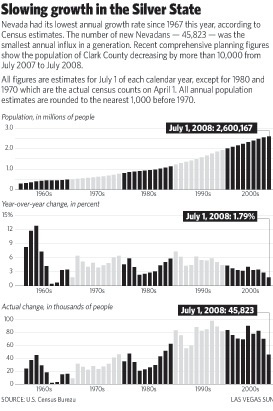
After an unprecedented 20-year-plus run, the state has recorded its slowest growth rate since 1967.
Although the recession-stricken state is reeling from record unemployment, thousands of foreclosures, less gambling revenue and tightened credit markets, Nevada policymakers say there may be a silver lining: a chance for the state to chart a course less reliant on growth as an economic engine.
Nevada added fewer than 46,000 residents from July 1, 2007, to this July 1, an increase of 1.8 percent, according to population estimates released by the U.S. Census Bureau this week. That is the smallest influx in a generation. Nevada now ranks eighth among the fastest-growing states, after spending the past 23 years in the top four, including 18 at No. 1.
At the same time, Clark County’s population has declined by about 10,000, an estimate based on the growing number of vacant residences.
“A brief timeout isn’t something we asked for,” said Clark County Commission Chairman Rory Reid, “but it’s something we should probably take advantage of.”
For decades, Nevada’s revenue has flowed from the tourism-dependent gaming industry and consumption-based taxes, such as sales, tying the state directly to the national economy. The state has no personal or corporate income tax.
Moreover, much of government fiscal health has been tied to continued growth. New growth was required to pay for the needs created by yesterday’s growth, including schools, roads and health care. This resembled a Ponzi scheme, in which there is a ceaseless need for new investors to pay off the old investors. Without growth, there are no new investors.
As UNLV economist Keith Schwer put it: “When the business cycle turns down, the public sector ends up in chaos.”
Nevada now faces a budget deficit of more than $1 billion over the next two budget years, and Gov. Jim Gibbons, vowing not to raise taxes or levy new ones, has indicated state government may have to cut as much as 34 percent of its budget. Lost in the debate is this sobering assessment from economists and analysts: Southern Nevada’s days of frenzied growth are likely gone, never to return.
To be sure, the state, like the Southwest, is still growing, and experts warn against using one year’s growth rate as an all-important indicator. But Nevada lost its status as the country’s fastest-growing state in 2006, and has slid further down the list ever since. In terms of population numbers, Nevada appears to be approaching maturity, economists say.
“What’s going on is transformational change, not just a small adjustment in a high growth period,” said John Restrepo, principal of Las Vegas-based Restrepo Consulting Group LLC.
Still, analysts, including Restrepo, were pushing much rosier forecasts as late as April, when the housing crisis was rocking the country — and Nevada in particular — and Congress was debating action. Most economic forecasts at the time said the year’s growth rate in the Las Vegas metropolitan area would be 3 percent to 4 percent.
Applied Analysis, for instance, in its annual study of Southern Nevada, said the region’s economy “remains sound” and that the level of investment on the Strip, with a bevy of resort projects, all but assured the area’s continued growth.
The Progressive Leadership Alliance of Nevada, a liberal advocacy group, now is urging policymakers to rethink basic assumptions. “Quite literally, we’ve been addicted to the short-term stimulus from growth for a long, long time,” spokesman Launce Rake said. “Now is the time to take a deep breath and reconsider where we have been going and what we can do better — our educational system, our social safety net, our physical infrastructure.”
UNLV economist Alan Schlottmann echoed the thought, citing the anticipated 2009 opening of MGM Mirage’s CityCenter, which will bring about 12,000 new jobs. “Every time we open a resort we get thousands of jobs, but that assumes people will have disposable income to maintain those jobs,” he said. “We should be asking the question, ‘If we build it, will they come?’ ”
The answer has not only been yes since the 1950s, but some analysts have said new resorts must continually be built to promote more tourism — otherwise the economy will stall. With new construction came new jobs, and newcomers to the state to fill them.
The gaming industry, however, is struggling to pay for new projects because of declining revenue and the stingy credit market, so the job market has collapsed, chilling population growth.
The states with the fastest rates of growth are Utah, Arizona, Texas, North Carolina and Colorado.
Nevada historian Michael Green said Las Vegas should take the time to redefine itself. Indeed, some policymakers, such as Commissioner Chris Giunchigliani, said such an assessment is long overdue.
“We should have been planning to prevent the bust,” Giunchigliani said. “But we treated gaming as if it were infallible. We bought the line that growth pays for growth — and growth absolutely does not pay for growth. We should start that conversation about doing things differently.”
At the top of the list, she said, should be economic diversification. The county should also undertake some public works projects to improve quality of life, she said. A light-rail system, for instance, should be revisited, Giunchigliani said.
Some economists said policymakers should consider broadening the tax base and reforming Nevada’s tax structure, which is overly reliant on gaming and sales taxes. Now, they said, is the time to make tough decisions.
“For a long time we thought we were young children,” Schwer said. “But we’ve grown up and we don’t know quite what we are.”
Sun reporter Alex Richards contributed to this story.

Join the Discussion:
Check this out for a full explanation of our conversion to the LiveFyre commenting system and instructions on how to sign up for an account.
Full comments policy