
Carissa Hurdstrom, 21, completed an associate of arts and is working toward a second degree in photography at the College of Southern Nevada. Hurdstrom, one of 47,000 Nevadans who have paid for at least part of their higher education using the state’s Millennium Scholarship, poses with images from her portfolio.
Sunday, Dec. 21, 2008 | 2 a.m.
Absent the Millennium Scholarship, Carissa Hurdstrom’s post-high school ambitions might have ended with a job as a waitress or concierge, her dreams of college deferred until the day — if one ever came — when she had squirreled away enough money to pay for classes.
Instead, Hurdstrom, the 21-year-old daughter of a parole officer and airport inspector, became the first in her family to attend college. The aspiring nature photographer and College of Southern Nevada graduate, is working toward her second associate degree, this one in commercial photography.
Hurdstrom is one of the more than 47,000 Nevadans who have used the scholarship since it debuted in 2000. The state award gives top high school graduates, rich or poor, as much as $10,000 to study at Nevada’s public higher education institutions or Sierra Nevada College in Incline Village.
In a state with one of the nation’s lowest percentages of high school students advancing to college, few public officials would openly advocate killing a program with such an impressive reach.
But funding problems and an erosion of the scholarship’s benefits threaten to make stories like Hurdstrom’s rarer.
Legislators took $12.6 million from Millennium funds this year to patch Nevada’s threadbare budget, and the state treasurer’s projections show the program becoming insolvent in fiscal 2016-17.
An even more immediate problem is the award’s diminishing value.
Daniel Coming, the first Millennium recipient to earn a bachelor’s degree, finished his studies at UNR in two years and remembers the scholarship covering all his tuition.
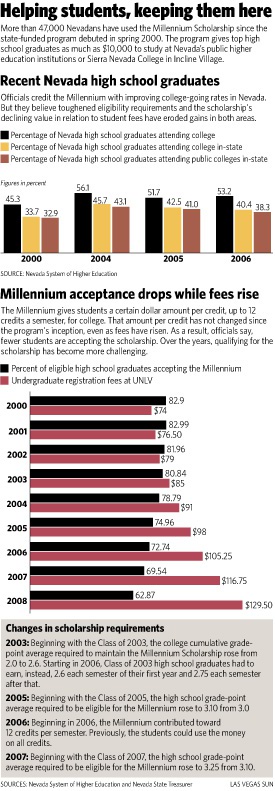
But even as those basic charges climbed from $74 a credit in fall 2000 to $129.50 a credit today at UNR and UNLV, Millennium grants for university students stagnated at $80 a credit. The same dynamic has eroded benefits for community and state college students.
New rules, meant to save the state money, cap the number of credits the award covers at 12 per semester.
“Although $10,000 sounds like a lot, as you go through, it’s not as generous as it was originally,” says Jane Nichols, vice chancellor of academic and student affairs for the Nevada System of Higher Education. “A student cannot finish in four years if they only take 12 credits.”
The changes have pressured young people such as Hurdstrom to temper their aspirations. She said she would have enrolled at UNR instead of community college had the Millennium Scholarship taken care of her tuition.
Juanita Fain, UNLV’s interim vice president for student affairs, says charting the scholarship’s future will require balancing competing goals — aiding as many students as possible while ensuring restrictions on how they use the money do not dilute the program’s benefits so much it is no longer effective nor attractive.
Asked whether scholarship money is spread too thinly, Fain responds, “It’s getting there.”
Data suggest she is right. The percentage of eligible students accepting the award plummeted from 83 percent for the Class of 2000 to 63 percent for the Class of 2008, a trend officials attribute to its dwindling value.
The proportion of high school graduates heading to college has fallen after peaking in 2004 at 56.1 percent.
In past years, legislators displayed an uncommon zeal for the scholarship, voting in 2005, for instance, to shovel $35 million into the Millennium account to keep it out of the red.
The number and diversity of families, and therefore constituents, who have shared in the riches help explain the award’s popularity in Carson City.
In the world of higher education, the scholarship is that rare success story that resonates with the public. Other expensive initiatives — such as sinking money into research or producing doctorates — can seem quixotic or nebulous to taxpayers, who often see no immediate benefits.
The Millennium’s contributions to society and regional economies seem obvious by contrast.
Zhiqi Feng, 22, an aspiring doctor in a state short on medical professionals, is using his scholarship to study biology at Nevada State College. His parents, a cook and hotel housekeeper who did not attend college, brought him from China to Nevada seven years ago because, he says, “it’s America.”
Mark Adams, 27, an electrical engineering student who graduated Tuesday from UNLV, has lined up a job at a local company. His near-perfect high school grades probably could have landed him a spot at a choice out-of-state college, but he stayed at home in part to cash in his Millennium award.
The total number of Millennium scholars is a figure equal to one in every 50 or so Nevadans.
The program’s popularity could be one reason the Legislature has not addressed what students identify as one of its greatest shortcomings — its failure to keep pace with rising fees.
Giving each Millennium scholar more money would require reducing the number of recipients — that bedeviling problem Fain laid out.
After raising eligibility requirements several times, some lawmakers are loath to do it again. High school students must earn a 3.25 — a B plus — grade point average to qualify for the scholarship, up from 3.0 when the program began.
“(Restrictions) are pretty tight now,” says Bonnie Parnell, D-Carson City, chairwoman of the Assembly Education Committee. “You really have to show that you’re a successful student and serious about your studies.”
The decision to limit Millennium spending to 12 credits per semester per student signals that legislators are willing to cut benefits today to preserve the program for future generations.
The changes, though painful, are necessary, says former Gov. Kenny Guinn, who masterminded the Millennium’s creation when he was in office.
“I’d rather have two kids getting 12 units’ help rather than one kid get the help on 17, 18 ... It’s more important to keep the program than to reduce (it) so that only a few can qualify,” he says.
That sentiment, paired with the state budget crisis, makes serious discussion about increasing the Millennium’s value unlikely in the immediate future.
Inevitably, though, the perpetual upward trajectory of student fees will leave legislators to grapple with a Sophie’s choice — cut the number of people receiving the scholarship, or risk letting the scholarship erode to the point where it loses relevance.
A Millennium scholar taking 15 credits a semester at UNLV gets stuck with an annual bill of at least $2,573 — $1,965 intuition, along with other expenses including a $4-per-credit technology fee and $173-per-semester “student life facilities” fee.
Undergraduate tuition at universities is set to rise 5 percent in the fall, and the chancellor of Nevada’s public higher education system has called for an additional increase of up to 25 percent. That would whittle the Millennium’s contribution to less than half of recipients’ university tuition.
Proposals to salvage the scholarship have included limiting eligibility to students in nursing, teaching and other fields the state deems crucial.
Assemblyman James Settelmeyer, R-Gardnerville, is submitting legislation that would require students to seek federal financial aid before tapping the Millennium.
An idea that has been floated often is disbursing Millennium money based on financial need. Proponents say that would make the program more effective, allowing more students who otherwise couldn’t afford college to attend. Opponents say that would go against one of the scholarship’s purposes — to keep the best students, including those from wealthier families, in Nevada.
To stretch out the program’s life, lawmakers will have to act soon. One of the scholarship’s main funding sources is annual revenue from a settlement Nevada and other states reached with tobacco companies in a case on health dangers of smoking.
Even accounting for an $18 million infusion of tobacco money expected in April, the state treasurer’s projections show the program ending the fiscal year with $17.5 million. More than $29 million remained at the end of each of the past three fiscal years.
The last year the state would be able to make annual scholarship payments is fiscal 2015-16, when disbursements are expected to top $32 million.
“I know people are aware of the issue,” regents Chairman Michael Wixom says. “I don’t know if anyone has any real solutions.”
The time to begin coming up with some is now, he adds.
Parnell thinks it unlikely the Legislature would be willing to divert general fund money to the scholarship on a regular basis. A more probable alternative, she says, is a new revenue stream. The only concrete suggestion she has heard is a state lottery, which she supports.
Legislators, however, have shot down a lottery more than once. The gaming industry opposes it as competition, and research shows the poor make up a disproportionately large number of ticket-buyers.
In Georgia, a lottery-funded scholarship offered since 1993 has encountered problems similar to those threatening the Millennium. Rising fees and growing numbers of students competing for money dragooned that state’s Legislature into tightening eligibility requirements and limiting payments.
The Georgia program, which used to pay all of qualifying scholars’ college fees, now covers only the amount schools charged in 2004.
In Nevada, many ideas for changing the Millennium program to extend its life go beyond fine-tuning, instead altering the award’s fundamental spirit and provisions.
The scholarship debuted eight years ago as a reward for promising high school graduates, with something close to a full ride. What remains is a shadow of that.
Although legislators seem keen on saving the scholarship, the program that emerges from their talks in coming years might bear little resemblance to the original Millennium Scholarship beyond the name.

Join the Discussion:
Check this out for a full explanation of our conversion to the LiveFyre commenting system and instructions on how to sign up for an account.
Full comments policy