Sunday, Dec. 21, 2008 | 2 a.m.
Television commercials now playing for the movie “Frost/Nixon” resurrect a famous post-Watergate retort by President Nixon: When the president does something, by definition it’s not illegal. As it happens, the statement is perfectly apt for this moment in history.
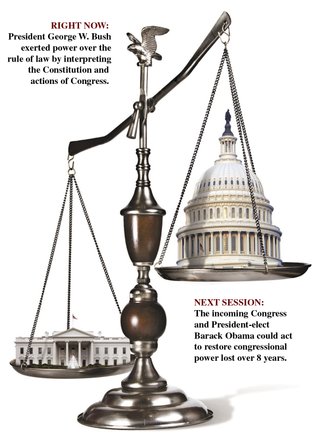
The nation is about to turn the page from an administration that seized unprecedented power at the expense of Congress and from a president who rewrote laws unilaterally, with the stroke of a pen.
In the final weeks before the new Congress begins work, the question being discussed on Capitol Hill and elsewhere is not whether it should reclaim constitutional powers usurped by President George W. Bush, but how — and how much.
Specifically, lawmakers, constitutional scholars, civil rights advocates and others are debating whether the power should be taken back ad hoc, a piece at a time as issues arise, or systematically — prosecuting members of the Bush administration who broke laws and appointing a special committee to delve into the many still unanswered questions.
Those urging the latter, systematic approach argue that the Bush administration leaves behind such an intricate maze of executive activity that Congress will have difficulty retaking its place as an equal branch unless it shines a bright light on what exactly happened these past years.
These voices argue that Congress should establish an independent congressional committee or create a 9/11-commission-style panel to deconstruct the White House’s ability to overreach — particularly in the national security arena, with its secret campaigns of spying on American citizens, suspension of habeas corpus, rendition of prisoners and harsh interrogation techniques.
The office of Senate Majority Leader Harry Reid confirmed last week that “conversations are taking place now to determine the best way” for Congress to proceed, according to spokesman Jon Summers. But no decisions have been made, including whether the Senate will take any systematic approach to reasserting its power, he said.
Lawmakers are hoping that whatever steps they take will be received well by the White House. After all, President-elect Barack Obama vowed on the campaign trail to “restore our Constitution and the rule of law.”
Historians caution, however, that saying and doing are often different things. If Obama does voluntarily yield powers that the office acquired over time, he will be the first president to do so to any significant degree.
Reid, in an interview in his Washington office, said he believes the relationship between the new White House and Congress will be different. Reid and Bush have famously clashed.
“Everyone who is a student of American government understands this unitary presidency is not appropriate,” Reid said. He includes Obama among the enlightened.
“He knows, and I know, he has to deal with Congress,” Reid said. “I believe in the Constitution — three separate but equal branches of government.”
Reid said he is confident Obama will relinquish some power. “He wants to,” Reid said.
The president-elect has vowed to undo executive orders that infringe on civil rights and to cut back on Bush’s unprecedented use of presidential “signing statements” to reinterpret laws approved by Congress.
Reid has taken one step to curtail the White House’s reach. He disclosed two weeks ago that Vice President-elect Joe Biden will be barred from the Democrats’ weekly internal policy lunch, redrawing a line that had been wiped away by Vice President Dick Cheney’s regular visits to Republican meetings. Biden has indicated he agrees with Reid’s decision.
“I, as a senator, work with the president, not for him,” Reid continued. “I don’t work for Barack Obama, I work with him. And as long as we understand each other, I think we’ll get along very well.”
•••
Rep. Mickey Edwards is a Republican who represented Oklahoma for 16 years and is now a lecturer at the Woodrow Wilson School of Public Policy at Princeton. At a fall congressional hearing looking at the relationship between the executive and legislation branches, Edwards testified about a telling moment in recent Washington history.
A majority of House Republicans walked out of the chamber to protest a vote on a bill to hold White House officials in contempt. The Bush administration was refusing to comply with a Judiciary Committee subpoena for aides to testify in the unusual firing of nine U.S. attorneys, including Nevada’s Daniel Bogden.
Edwards cited the walkout as an example of the Republican lawmakers essentially abandoning their responsibility to ensure oversight of the executive branch. (Outgoing Nevada Republican Rep. Jon Porter did not join the protest. Rep. Dean Heller declined to say where he was that day.)
“Every member of Congress takes an oath to uphold and defend the Constitution,” Edwards testified. “Once that oath is taken, loyalty to the Constitution takes primacy over loyalty to party or individual. That is not what has happened in recent years.”
Constitutional scholars have watched with alarm the ease with which the Bush administration made a play for power, and Congress gave it away.
Early in the administration, after the Sept. 11 terror attacks, Congress passed bills giving the president exceptional powers. The White House asserted that it had more powers still. Those actions seemed necessary to many in Washington because the president needed broad authority for the government to protect the nation.
Examples:
• Congress granted sweeping authority under the Patriot Act to allow the government to eavesdrop on suspected terrorists, while a clandestine program reached even farther to spy on American citizens, a felony punishable by fines or imprisonment.
• Congress passed a ban on the torture of war prisoners, but the president dashed off a signing statement that reinterpreted the legislation to allow harsh interrogation techniques to continue.
• Iraq and Afghanistan war prisoners were brought to the detention facility at Guantanamo Bay, yet others were being secretly ferried to undisclosed locations in foreign countries. The administration sought and Congress approved laws that suspended the centuries-old right to a speedy trial. The Supreme Court rejected the laws, and Congress passed them anew.
Now, viewed through the prism of time, those action amounts to what Bruce Fein, a former Reagan administration attorney and a constitutional scholar, calls Bush’s “grand slam in his war on the Constitution.”
“The untold story about the Bush presidency is that even though he has lost many battles, he’s won the constitutional war,” said Fein, author of recently published “The Life and Death Struggle for Our Constitution and Democracy.”
Even today, Democrats are reluctant to fully push back against an unpopular president, Fein said. Evidence of that is their willingness to grant judicial immunity to the telecom companies that engaged in the secret spying program, or to give broad authority for the $700 billion Wall Street bailout to the administration.
Congress similarly did not protest when the Clinton administration engaged in military action in Kosovo without full congressional approval required under the War Powers Act, Fein said.
“I don’t think this is a Democratic-Republican phenomenon,” Fein said. “This is an institutional phenomenon.
“By and large, Congress doesn’t want the power in national security and they don’t want it in financial security. They want the president to make the decision so if something goes awry they blame it on somebody else.”
•••
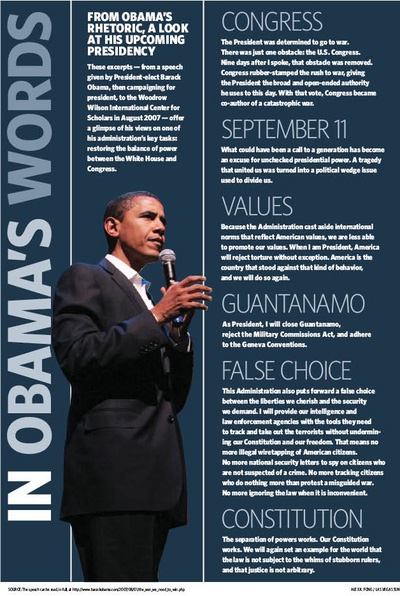
Early in his presidential campaign, when Obama was still a long-shot candidate in states like Nevada, he made a speech outlining the different approach he would take to these issues.
“Close Guantanamo.”
“Reject torture.”
“No more illegal wiretapping.”
“The separation of powers works.”
“Our Constitution works.”
In the speech, on Aug. 1, 2007, at a policy center in Washington, D.C., Obama promised: “We will again set an example for the world that the law is not subject to the whims of stubborn rulers.”
Democratic Sen. Russ Feingold of Wisconsin, one of the most progressive members of the Senate, has called on Obama to use his Jan. 20 inaugural address to depart boldly from the executive actions of the past.
Obama’s transition office is keeping the speech under wraps, but the president-elect’s speechwriter, Jon Favreau, was recently quoted saying the theme is “the idea that America was founded on certain ideals that we need to take back.”
Still, as a new era begins in Washington, observers caution Congress against trusting that the new president alone will reverse the excesses of the past.
“One of the things we’re encouraging is for Congress to flex its muscle a little bit, to reclaim its role as the legislative branch of government,” said Caroline Fredrickson, who directs the Washington legislative office of the ACLU, and is lobbying for an investigative committee. “Congress really needs to get a handle on the variety of powers that were handed over.”
Those pressing for congressional investigations point to the model of the Church Committee that reviewed the executive reaches of the Vietnam War era, or more recently the 9/11 Commission. After Watergate, the guilty parties faced jail time.
They also note that President Bill Clinton was impeached for lying about his liaison with a staff intern — an act they find trivial compared to the wrongdoing by Bush administration officials.
Edwards, the former congressman, testified that the question is not how the new president will act, but how the new Congress will.
“Do not let it be said that on your watch, the Constitution of the United States became not the law of the land but a suggestion,” he said.
But launching a systematic campaign to root out wrongdoing is politically dicey at a time when the country faces enormous economic and domestic concerns, and the continuing wars.
Democratic leaders have refrained from weighing in — much the way they declined to call impeachment hearings in early 2007 after becoming the majority in Congress. They fear alienating voters who may have more pressing concerns about jobs, health care and energy prices.
In the Senate, Judiciary Chairman Patrick Leahy is focused on swiftly confirming attorney general nominee Eric Holder so, as he explained on his home state Virginia Public Radio, “a fresh team, can come in and say, ‘OK. Justice is back.’ ”
Incoming Senate Intelligence Committee Chairman Dianne Feinstein of California plans to offer legislation on several fronts — to close Guantanamo and establish a single standard for interrogations that complies with the Geneva Conventions against torture.
The Armed Services Committee chaired by Sen. Carl Levin of Michigan just released an extensive report investigating abuses at Abu Ghraib prison in Iraq.
But will those individual steps eventually add up to reclaiming lost power?
“Now we’re kind of wondering — is this gong to be like the ’70s,” said Julian Zelizer, a congressional scholar at Princeton University, referring to the legislative pushback that grew out of Watergate and Vietnam. “Or are we going to see an acceleration of the trend where they cede power?”
“I’m dubious it will change much,” Zelizer said. “Presidents usually don’t give powers back ... if Congress doesn’t take them back, he’s going to keep them.”
•••
Republican Sen. John Warner of Virginia is a revered presence in Washington, a former Navy secretary and Armed Services chairman who challenged the Bush administration’s treatment of prisoners at Guantanamo, and was reportedly rebuked by his party for investigating Abu Ghraib.
He is retiring after 30 years in office. Two weeks ago, Warner was exiting the chamber after he cast his final vote — on the auto bailout. It was an hour before midnight, but he stopped to discuss the state of executive-legislative relations and the new era ahead.
“The wisdom of the Founding Fathers was a bold experiment and it was predicated on the concept of equal branches of government,” Warner said. “And certainly in this past administration, I’ve seen it go tilt with all power being brought unto itself by the executive branch, and that’s not good for the country.”
“Let’s hope that Sen. Obama, a scholar ... will see the need for having a balanced relationship,” he continued.
And Congress? What steps should his colleagues be taking to regain the power they have let slip away?
“I just cast my last vote,” Warner said as he walked toward the elevator doors. “I’m not giving them any advice for the future. They’re on their own.”

Join the Discussion:
Check this out for a full explanation of our conversion to the LiveFyre commenting system and instructions on how to sign up for an account.
Full comments policy