KEVIN CLIFFORD/SPECIAL TO THE SUN
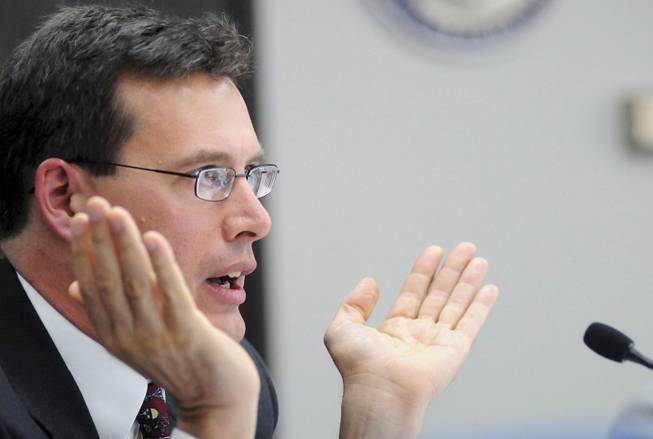
Louis Ling speaks during a Nevada State Board of Medical Examiners meeting in 2008 in Reno.
Saturday, Dec. 6, 2008 | 2 a.m.
When Louis Ling took administrative charge of the state’s medical board in September, he fretted that the process of investigating doctors and disciplining the bad ones could take two years or longer.
Sun Topics
Beyond the Sun
Ling, who is a lawyer, was bothered too that the disciplinary process seemed more concerned about watching out for the doctors than the patients. The process was “cloaked in confidentiality,” as he put it, and “a lack of transparency inevitably leads to accusations of favoritism and unaccountability.”
On Friday, he hoped the Nevada Medical Examiners Board would have the same concerns and agree to overhaul its disciplinary system.
He didn’t get exactly what he wanted, but he wasn’t disappointed. Medical board members concurred the process needs to be streamlined.
And as Ling sees it, better that the board address the problem than wait for legislators — wary of public outrage at the medical profession — to tee off on the issue when they meet in the spring.
At Friday’s medical board meeting in Reno, Ling introduced a plan that would remove much of the control from the hands of the board members, open more of the process to the public and resolve complaints in a timely manner.
The board’s discussion of the plan showed a willingness to go along with his ideas.
Ling said statutes that guide the current disciplinary process were created in 1977 — when “Saturday Night Fever” and “Laverne & Shirley” were popular. At that time the board licensed 820 active physicians. Today it licenses 4,400 active doctors, plus physician assistants and respiratory therapists.
The antiquated guidelines do not fit today’s medicine, he said. According to the process:
• Investigative committees made up of three board members each meet only quarterly. They review every complaint, and it can take more than two years to work through the entire disciplinary process.
• Patients have almost no voice. “Viewed objectively, our present process seems focused solely on physicians,” Ling wrote in his memo to the board. “The patient — the very center of medical practice and this board’s mission — often feels unnecessary and unimportant.”
• There is a lack of transparency and accountability. The medical board makes nothing public unless disciplinary action is taken.
• There is no option for requiring remediation of doctors who exhibit poor behavior that does not clearly reach the level of malpractice.
Ling said the system needs a “comprehensive and substantive” overhaul. He suggested replacing the investigative committees with a complaint management team — consisting of him, the investigative division chief, board attorneys, investigators and medical reviewers, but no board members — to take over the investigation and adjudication of complaints. The new team would review complaints; assign them to investigators; manage the investigation; and make determinations such as filing complaints, closing the case or negotiating disciplinary action.
Under the new proposal, patients — or whoever filed the complaint in cases where it was another party — would have a chance to tell the board how they were affected by the situation.
“What gets lost is the really human harm that’s been done in these matters,” Ling said in his critique of the current system. “We want to get patients back involved in your process so they’re part of your considerations.”
Ling proposed that in cases that result in hearings, a member or members of the board would hear the case with a hearing officer and determine issues of credibility and make factual findings.
The new system would resolve complaints within nine months and help the public see that the board cares about its interests, Ling said.
“At the very least, the board would be fairly criticized for what it actually did in public regarding such matters instead of being criticized for what it may or may not have done behind closed doors,” Ling wrote in his memo.
Under the new proposal, medical board members would be involved in a hearing, and then at the end of the process, only to approve any final disciplinary action.
The members of the medical board — six doctors and three members of the public — said they understood the need for reform. They had only one major disagreement with Ling’s proposal. They insisted that the investigative committees remain part of the process. People who complain to the medical board have a right to have board members consider their complaints, several of the doctors said.
But they suggested that the investigative committees could meet via a phone or video conference for two hours every other week instead of once every three months. That means one of the committees would be meeting on any week, which would also allow the board to be more responsive to emergency matters.
In the discussion, board members said it would be possible for a complaint management team to take some actions that do not require direct handling by an investigative committee, but that at least one board member should approve all actions.
Dr. S. Daniel McBride, a medical board member who was widely criticized for allegedly failing to take proper action following the hepatitis C outbreak, said after the meeting that the board is deeply concerned about protecting the public.
“If there are ways to get an immediate and responsive action, that’s our goal,” McBride said. “It’s never been a matter of protecting the physicians or the process.”
McBride said he hopes legislators will see that the medical board is moving in the right direction and that nothing is imposed through the political process that is not productive in practice.
Ling was thrilled by the outcome of the meeting. He said he was not married to his proposal, but that the priority was to spark a discussion about changing the cumbersome laws that guide the present process.
“The end result is still what we were hoping for — a more timely and responsive system,” Ling said.
The medical board will put the proposed changes into a bill draft request for February’s legislative session.

Join the Discussion:
Check this out for a full explanation of our conversion to the LiveFyre commenting system and instructions on how to sign up for an account.
Full comments policy