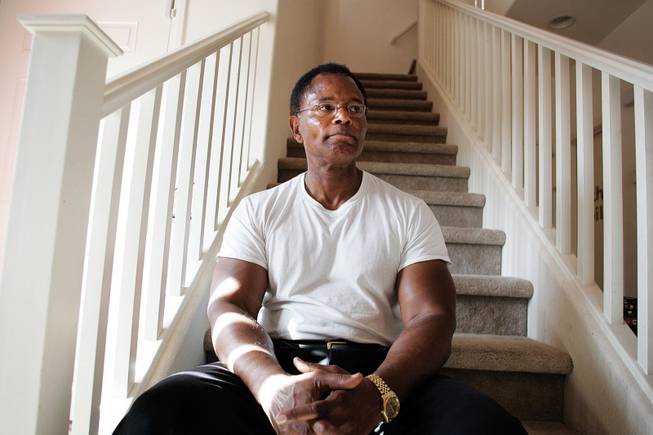
Buddy Yates sits in the North Las Vegas home he has been fighting to keep out of foreclosure. The pastor, 60, fears his efforts will have been wasted if he doesn’t receive help.
Wednesday, Aug. 13, 2008 | 2 a.m.
Sun Topics
Sun Archives
- Home sales up for 7th month; prices fall (8-6-2008)
- Measuring population in moving boxes (8-4-2008)
- Nevada leads nation in rate of foreclosures (7-25-2008)
- Housing affordability seen as long-term problem (7-22-2008)
Buddy Yates sits at a dining room table awash in paperwork. The bills, late notices and letters represent his nearly yearlong quest to keep his family in the three-bedroom North Las Vegas tract home he bought two years ago.
In December, when he could no longer afford the $2,365-a-month payments, much less the higher payments set to kick in within months, he dialed up his Texas-based lender, EMC.
Yates, a 60-year-old pastor who officiates at valley wedding chapels, wanted the company to restructure his loan by lowering his payments and spreading them over a longer term.
By Yates’ account, he ran into a thicket of red tape.
After seemingly endless waits on hold, he told his story over and over because the same staffer wasn’t available. Company representatives would then give contradictory advice, he said.
“When you talk to some of those people it’s like talking to this table,” Yates said.
Despite lenders’ promises to step up efforts to work with homeowners facing foreclosure, about half won’t reach a deal with their bank, according to recent figures.
As of the second quarter of this year, 12,000 Nevada homes went into foreclosure. Lenders were in negotiations with just more than half that number, according to Hope Now, a nationwide mortgage industry group that offers foreclosure counseling.
But the number of borrowers in need of assistance is expected to grow.
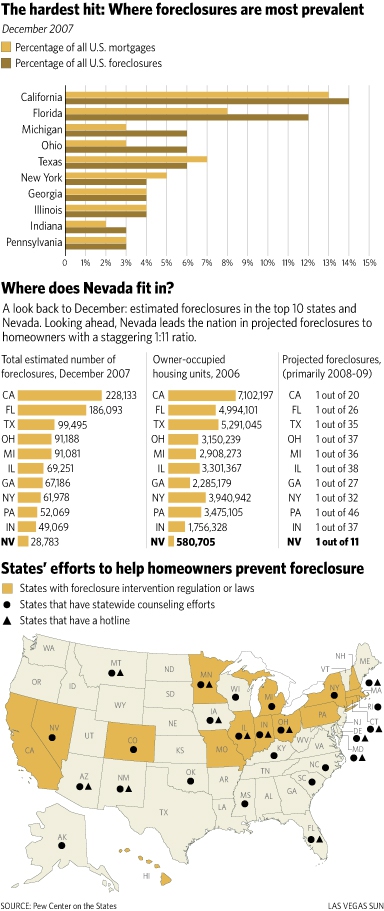
Nevada is expected to remain at the epicenter of the nation’s foreclosure crisis — the Pew Center on the States projects one in 11 homes in the state will enter foreclosure by 2010 — and Yates’ Sunrise Acres housing development seems to lie on a fault line.
Within one block of his home, more than a half-dozen residences are bank-owned or in some stage of the foreclosure process, according to Realty Trac, a Web site that maintains a nationwide database of foreclosed homes.
Like his neighbors, Yates was hit by a slumping economy and falling real estate values.
Last year, his income started to shrink as more couples skipped the trip to Las Vegas for their wedding and tied the knot at home. As it was getting harder for Yates to pay his $300,000 mortgage, the value of his home was dropping, and as a result he couldn’t refinance his loan.
Three weeks ago, Yates met his new neighbors, who had just purchased the house next door out of foreclosure for $167,000.
He figures his house isn’t worth much more. But it’s still home for him, his wife and their 4-year-old son.
Lenders have been deluged by borrowers seeking help.
“They just don’t have enough beating hearts to answer the phones,” said Kathleen Day at the Washington, D.C.-based Center for Responsible Lending.
Wells Fargo spokeswoman Natalie Brown said her company’s staff has grown fivefold to deal with delinquent loans than the bank had five years ago.
Debbie Krznarich of EMC, which holds Yates’ mortgage, would not discuss staffing levels at the company.
Even borrowers who reach their lender face obstacles.
Most loans have been sold to investors, who must approve deals with individual homeowners, Day said. Trustees who manage these loans are sometimes reluctant to modify them for fear of being sued by the investors.
What’s more, for borrowers who have second mortgages, both the first and second lien holders must agree to a deal before it can be offered to a homeowner.
Counselors who help troubled borrowers negotiate with their lenders are also swamped. Michelle Johnson, chief executive of Consumer Credit Counseling, reports that traffic at her agency is up 60 percent to 70 percent from last year.
Recent federal government initiatives to clean up the foreclosure mess have not helped Nevadans, Johnson said. An FHA program offers refinancing to homeowners with 3 percent equity in their homes, but few distressed homeowners in the state have any equity.
“The last I heard, there had not been a single (FHA refinance) loan made to anyone in Nevada,” she said.
The impact from the foreclosures extends beyond those who lose their homes.
The Pew Center predicts that in Nevada 77 percent of all homeowners, not just those in foreclosure, will feel the effects in the form of falling property values. That will have an impact on state and local tax revenue.
“It’s a concern for health, safety and economic viability,” said Lon DeWeese, chief financial officer of the Nevada Housing Division.
In June, Yates met face to face with an EMC representative.
EMC’s Krznarich said that Yates was offered a fair deal that would allow him to keep his home.
But Yates, who has missed more than one payment, said the repayment plan would put him only further behind. By the time he paid the arrears, he said, the interest rate on his adjustable-rate mortgage would go up, putting him back in the same predicament.
Yates has asked the Neighborhood Assistance Corporation of America, a nonprofit housing counseling group, for assistance. If he doesn’t get a reprieve, he said, he’s expecting a letter this month saying the company will foreclose on his home.
“When they sold you the home, they knew (with the adjustable interest rate), you weren’t going to be able to make the payment,” Yates said. “They don’t have compassion for the family who’s in the home.”


Explore Las Vegas’ past and present
Boomtown: The Story Behind Sin City
Neon Boneyard: A 360° look
Mob Ties: See the connections
Implosions: Classic casinos crumble
Maybe the 'pastor' needs to get a real job - people are getting smarter and not so apt to be conned by these men of 'god' who make a living off the wages of their 'faithful congregation'.
These government programs that are created to help people through this mess, rarely reach the guy who feels they needs it. Maybe this is just a way to appease the masses that there is help/hope while the red tape in the system flushes them out.
I hope so...we must take responsibility for our decisions and signatures!
And 100% of people who don't own homes will feel the effects of falling home prices...that is JOY now that homes are becoming more affordable to them!
THINK!!!
If Mr. Yates owes $300K for his house, and the one next door is only worth $167K, He is upside down to the tune of $133K. Maybe it's time to pass a law that would force the landers to re-figure a fair price that would reflect the current maket value of houses in the neighborhood. The property taxes would also need to be re-figured.
KDR,
The small problem with that is that the falling values are dragging down the rest of the ecomony. So that even though they didn't get directly whacked by the falling values, the ones that don't own are probably in a worse position to buy then they were before.
Anyone who is upside down in their mortgages needs to walk away from the house. Let the banks fail. Let the housing prices get back to realistic numbers. Last, but not least...RENT for a few years. You can save the difference between rent & a mortgage payment and still live quite comfortably while the housing mess sorts itself out.
The old rules of mortgages will be in full swing after this: Multiply your yearly income by a factor of 3. The result will be the total amount you can afford to borrow.
Where is the accountability for one's own decisions? This educated man bought more house than he could afford. The homeowner will take a loss, and the lender may take a loss, and the investor who bought the securitized mortgage may take a loss. And the voters who elected Bush and more than 40 Republican senators are taking losses. Unfortunately, the rest of us are suffering, too. So let's quit bellyaching and blaming everybody else, elect some smart people (not the guy who got into the Naval Academy because his father and his grandfather were admirals and was next to last in his class) and move on.
Boo Hoo. It's one thing to have empathy for the little old lady taht was swindled by some fast talking broker. Its quite another when those that fancy themselves as reasonablly intelligent rationalize that prices will always continue to climb astronomically and accepting high risk loans is a good idea. Caveat emptor, if it sound too good to be true then.. well you know the rest of this phrase. I too am suffering a huge decline in the value of my home. But really despite being a dye-in-the-wool Dem, this market and all the dupes who created it should be allowed to just wash out. The sooner we allow this to happen the sooner the correction, the sooner my and everyone's prop. values stabilizes and resumes it's measured increases. Oh yeah my utter lack of empathy also extends to the bank and investors that made these utterly stupid loans in the first place.
THE SKY IS FALLING, THE SKY IS FALLING! There is NO "HOUSING CRISIS". The prices of homes skyrocketed artificially based on ultra-easy credit, no downpayment loans and speculation. People like the pastor here thought they were economic gurus and would make a mint after 4 years.
Well guess what, prices go up and prices go down. It's natural. Bust follows boom.
If the price of gasoline was going down would people claim there is a "national gasoline crisis"? If the price of food or clothing was going down would they say there is a "food crisis" or a "clothing crisis"? NO! This is ridiculous. Low prices are a GOOD THING.
Housing is just becoming more affordable after years of being in unafordable bubble territory.
It's better this way. In the future hopefully, americans will have to pay a smaller percentage of their earnings on housing.
As long as energy takes the money out of Nevada visitors at home we will continue to drop long after the country starts to recover. We are a location for discretionary funds. When people put all their money in no jackpot slots at home called gas pumps, they wont be flying here to play. The airlines have already guarateed 20% less travelers with their reduction in flights. We need energy now. Contact Harry Reid and DEMAND he approve drilling in America for American jobs before we have to buy from Russia also.
email link
http://reid.senate.gov/contact/index.cfm...
Las Vegas
Lloyd D. George Building
333 Las Vegas Boulevard South, Suite 8016
Las Vegas, NV 89101
Phone: 702-388-5020 / Fax: 702-388-5030
"If everyone would stop making their mortgage payments for a few months the banks would really feel the crunch and do what they need to do--lower interest rates or restructure loans immediately--to keep people in their homes, property values, and the market moving again. It's very simple. Countrywide wouldn't lower my interest rate or restructure my loan, so now they're giving me time to try and sell the property via a short sale, which will take them many months to approve."
Wow. How irresponsible ARE you? Your bad decision should not become mine, or anyone else's. Suck it up and don't force your problem on anyone else. My three (FIXED RATE, FULL DOCUMENTATION) mortgages are doing fine, thank you.
I love people who blame the banks, brokers, etc for their problems. Sure there was mis-guidance, if not out outright fraud.
At the end of the day though....
YOU borrowed the mony
YOU should have understood the terms, and if not, hired someone who did to explain them to you
YOU should take accountability for your debts and not expect the government (read taxpayers lime me) to bail you out.
Yes, people will be affected by depreciating home values. They'll pay less property taxes,and it will cost them less to upgrade to a nicer home even though theirs has devalued. Sounds like a deal to me.
Their only loss is bragging rights and an inability to borrow against home equity. Too bad!
One reason why I still don't own a home is because when I had decided to buy a home the market was just in the process of going banana's and people were paying more than the asking price (which I equate to paying more than the house is worth) simply because 10 other people wanted to buy the same home. It was then that I stopped looking to buy a home because I refused to get sucked into that game...so today I still don't own a home but to me that is better than owing 300,000 on a home that's only worth 1/2 that price. I honestly believe that the people who are now suffering the repercusions of their actions have no one to blame but themselves - that is unless someone held a gun to their head and forced them to bid that extra 25,000 to ensure they'd get the house that 10 other people were vying for. People need to quit their bitchin' and take responsibility for the bad choices they themselves made.
"Maybe it's time to pass a law that would force the landers to re-figure a fair price that would reflect the current maket value of houses in the neighborhood."
So, let's say instead your home increased from $300k to $600k. Would this law also increase the amount you owe to $600k or is this a heads I win tails you lose scenario?
Who in their right mind would loan money under those circumstances? Do you want to see 15% interest again? If so, pass that law and you'll see lending dry up like the Sahara.
Mr. Yates stated that the lenders knew he could not make the adjusted payments. Well, then I ask, why did you, Mr. Yates, not know that as well? Could it be that both of you were counting on never ending continued appreciation?
So where are prices going to settle?
Home prices are re-aligning with the fundamentals.
Historically, home prices have been 2-4 times local income levels. This ratio makes sense when you realize that in normal times, sensible lenders will only allow a borrower to use a maximum of 28% of their income for mortgage payments and associated expenses. During the boom this ratio went up to 10 to 1 in some areas.
Now that lending standards have tightened, prices are being pushed down back to their historical ratio. What happens to prices? It depends on what the historical ratio was for the area before the bubble. There is a nifty tool at www.UsHousingMeltdown.org, the Ceiling tool,
where you can type in your zip-code and see the historical income to home price ratio and what happens prices when we return to the normal ratios. When prices go from 8 to 1 back to 3 to1 you're looking at a 60% price drop. Yikes!
To all those people out there who's opinions are "too bad" or "they got what they deserved", I feel the need to defend myself and thousands of others that are in the same situation. I went through a diverse in 05' resulting in the loss of my home, on the plus side the market was up, so my half of the equity was enough for a down payment on a modest home. I've lived here since 91', had been on my job for six years, and had a nearly perfect credit rating. At that time a 2 bedroom apartment was going for about 1,100/mo. I was fully aware that homes where overpriced, but between all the advice, "don’t worry you can only make money” and “ why through away money every month when you can own for a couple hundred more a month", and myself, being a single parent, and making a living as a bartender, having the opportunity to to be able to own a home for my son and myself, felt it was the right decision. Like I said I was a single parent bartending for a living, but because of my excellent credit my lender was able to get me the loan, only later to find out that he lied about my income. I feel like the lenders are partially responsible for this situation. In my case, I should not been given the loan according to the income I provided, but my lender was considerate enough to fix that without my knowledge, nice. Anyway, after 2 1/2 years of mortgage payments, not a single one late, and being upside down, I wasn’t able to refinance as planned. Then after eight years at the same job, suddenly found myself unemployed. When I finally got a hold of my mortgage company, hoping they would be willing to work with me, I was told that I was declined for the mortgage freeze because my home had lost too much value,??!!, and as far as the mortgage modification, was declined because I was unemployed. Now, after four months, not being able to find a job, have ruined my credit by using it to try to keep up with my mortgage, I have no choice but to accept the fact that foreclosure is in my immediate future. I consider myself to be a very responsible person, I considered my decions carefully, and did what I thought was best. The housing situation is not the result of a bunch of irresponsible people making stupid decisions. For those of you that were smart enough, or lucky enough to avoid all this, congratulations, but I don’t think the rest of us deserve to be judged by you for only trying to be responsible, hard working people trying to make a better life for ourselves. Obviously many factors led to this, but I feel like a large part of the blame lies with the lenders and mortgage companies who irresponsible approved these mortgages, and should be held accountable.
While I feel for Buddy, I believe he bought more house than he could afford. I live in San Jose, CA but just sold my mother's house in Las Vegas for $145 K. It was a perfect house, totally remodeled, wonderful neighborhood 89121, everything... Buddy overextended himself. Why does a paster need a $300 K home? The home needs to match the income.
For Thumbkin: You said "my lender was able to get me the loan, only later to find out that he lied about my income. I feel like the lenders are partially responsible for this situation. In my case, I should not been given the loan according to the income I provided, but my lender was considerate enough to fix that without my knowledge, nice." Your lender committed fraud. Send your story to the local district attorney. Your lender should go to jail.