
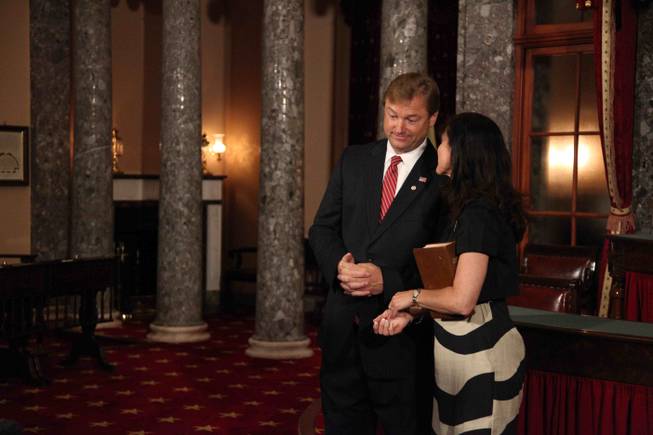
Sen. Dean Heller’s wife, Lynne, whispers to him as Vice President Joe Biden approaches the Old Senate Chamber in the Capitol to re-enact Heller’s official swearing-in for cameras on May 9, 2011. She is holding the Bible that he used for the re-enactment of the swearing in; Heller didn’t place his left hand on a Bible for his official swearing in on the Senate floor.
Sunday, Dec. 4, 2011 | 5 p.m.
The White House is turning up the pressure on Republican Senators in seven states, including Nevada, to press them to vote to confirm former Ohio attorney general Richard Cordray as director of the new Consumer Financial Protection Bureau when his nomination comes before the Senate this week.
They’ll be taking to airwaves with radio ads, local television interviews and public outreach campaigns between now and Thursday, the day Cordray’s confirmation vote is expected to take place, to send a message to Nevadans that approving his candidacy is vital to their financial security — and that the expected “no” votes of their Republican representatives will jeopardize that security.
“Without a Director, Americans will not be protected from falling prey to many of the harmful practices that contributed to the worst financial crisis since the Great Depression,” White House officials wrote in a report released Sunday night. “CFPB’s inability to exercise its full authority while it awaits a Director affects the lives and financial security of tens of millions of American families who rely on non‐bank financial institutions for their financial needs.”
On the one hand, it’s math. The 53 Democrats in the Senate need at least seven Republicans to vote with them in order to get around a filibuster threat of Cordray’s nomination.
But this is politics, too.
Republicans have not expressed as much distaste for Cordray’s nomination as they have for the agency he’s been tapped to lead: Republicans can’t stand the Dodd-Frank bill, and the CFPB is one of the products of it they object to most.
GOP presidential candidates have been calling for its repeal; and the Senate Republicans have picked up the refrain, not least because one of their own, Scott Brown of Massachusetts, is defending his Senate seat against the chief architect of the CFPB, Elizabeth Warren.
Back in the spring, 44 Senate Republicans sent a letter to President Barack Obama informing him that they would not vote to confirm a new director for the CFPB until Congress made some structural changes to the agency. Heller signed on to the letter as the 45th when he became a Senator.
Obama has said he would veto any changes to the Dodd-Frank bill.
But his new efforts to urge Cordray’s confirmation are sending an even stronger message: the public information campaign Obama administration officials outlined Sunday is the sort of effort usually reserved for selling sweeping policy initiatives, like an overhaul of the nation’s health care laws, or more recently, Obama’s jobs bill.
In fact, White House officials struggled Sunday to think of a case in which they’d staged a similar effort to get a nominee confirmed.
But there’s a reason for that, they argued.
“We are making a special effort in this handful of seven states because we believe, principally, that the citizens in these states have a lot to gain from the confirmation of Mr. Cordray,” said Josh Earnest, deputy press secretary to the president. “It sets up an important decision for the senators...side with the financial industry, or if they’re going to step up to the plate, side with middle class families.”
The bureau was created under the Dodd-Frank financial reform act that Congress passed last year to better police Wall Street and banks.
But Americans’ financial transactions don’t all take place within the confines of those institutions. According to the White House, 20 million Americans use payday lenders, 4 million rely on prepaid credit cards, 14 percent of Americans are in some stage of debt collection and 200 million rely on credit reporting agencies to rate their creditworthiness -- and none of those institutions are covered under the definition of “Wall Street” or “bank.”
That’s where the CFPB was supposed to come in. But it’s been rudderless since its inception.
“Without a director in place...the CFPB does not have the capacity to derive full oversight and full supervision (of those institutions),” Brian Deese, deputy director of the National Economic Council, said Sunday.
They’re taking the message to a total of seven states: Nevada, Alaska, Indiana, Iowa, Maine, Tennessee, and Utah.
The grand total of Republican Senators in those seven states: 11. Some are conservative, some are moderate, some are up for reelection.
Of those, Nevada’s Dean Heller is the the most vulnerable in an election, but he has no plans to be helping the president out on this vote.
“Senator Heller supports strong and effective consumer protection. However, this agency, which was created by Dodd-Frank, has no measure of accountability,” said Heller spokesman Stewart Bybee. “Senator Heller and a number of his colleagues reached out to the President in an effort to reform this agency, provide greater transparency, and work towards a compromise. Unfortunately, the White House decided they had no interest in working with Congress.”

Join the Discussion:
Check this out for a full explanation of our conversion to the LiveFyre commenting system and instructions on how to sign up for an account.
Full comments policy