
Monday, Nov. 19, 2012 | 3:05 p.m.
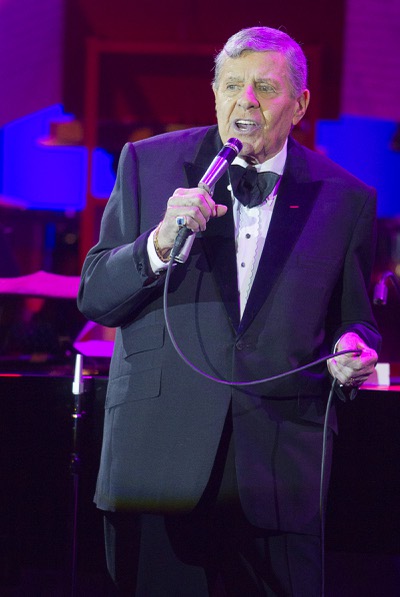
Entertainer Jerry Lewis performs at the Orleans Showroom Sunday, November 18, 2012.
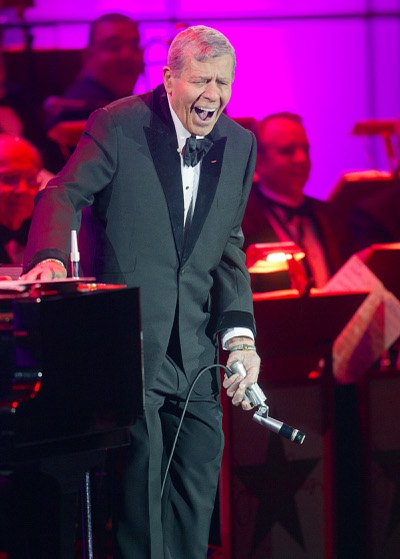
Entertainer Jerry Lewis performs at the Orleans Showroom Sunday, November 18, 2012.
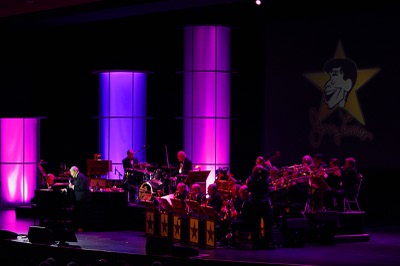
Entertainer Jerry Lewis, right, performs with an orchestra at the Orleans Showroom Sunday, November 18, 2012.
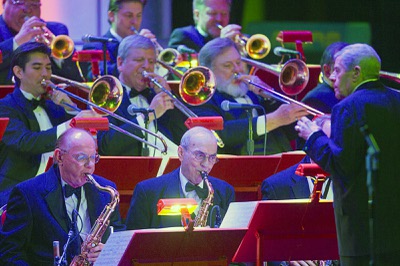
Entertainer Jerry Lewis, right, performs with an orchestra at the Orleans Showroom Sunday, November 18, 2012.
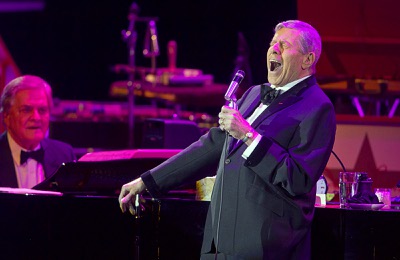
Entertainer Jerry Lewis sings during a performance at the Orleans Showroom Sunday, November 18, 2012.
The room dips into darkness, and there is a brief quiet. Then someone sitting deep in the audience cries out, “Hey laaaadyyyy!”
There is a chuckle at this inevitable calling call to tonight’s star of the show. Cameras are hoisted above the stage and at the back of the theater, ready to record the night’s performance for a PBS special to air in March.
The curtain is pulled away to reveal 17 musicians, which represent either a rather small orchestra or a rather large band. The man conducting the group stands slightly hunched over, waving and jabbing his wand to direct the players.
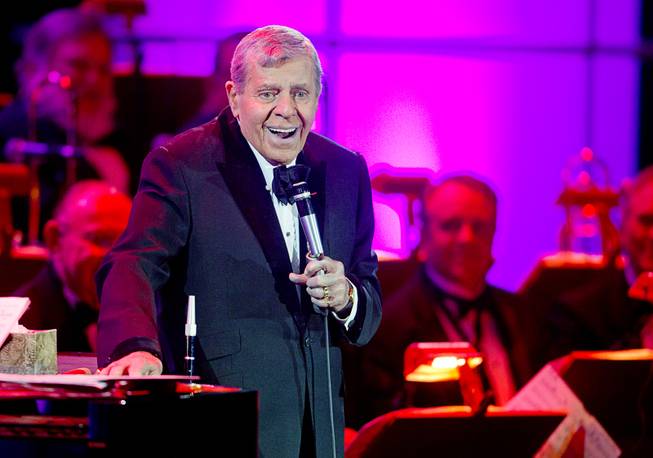
That’s how Jerry Lewis makes his entrance at Orleans Showroom on this Sunday night. Not as a comic performer, or even a singer. He is the star and the stage director of his own tribute performance, the airing of which is tied to his 87th birthday March 16.
Lewis is slim, though he is curved from chronic back pain -- falling off pianos and desks ladders and such for a half-century is not so good for the spine -- and hoofs ever-so-gingerly across the boards. He wears a coal-black tux and slip-on shoes that are reddish-brown and don’t at all match his formal suit. He finishes that opening number and leans heavily on the piano of Vincent Falcone, who has served as music director for just about every legendary singer in the history of contemporary music, including Frank Sinatra for a decade.
Lewis talks of old jokes and the youngsters who have just discovered them, kids who retell them with a childlike zeal. He exhumes a few. “Did you hear about the firefighter with twins? He named one Jose, and the other Hose-B.” He says he refuses to tell ethnic jokes but asks if we have heard of the Polish Olympic squad who won a gold medal and proudly “had it bronzed.”
Three brightly colored pillars flank the star onstage, and hanging high above in the middle is the familiar caricature, grinning in classic black and white. The musicians start in with “That Old Black Magic,” the soaring rendition Lewis uncorked as Mister Love in “The Nutty Professor.” At the end, he is fairly yelling the lyrics, “Darling, down and down I go! Round and round I go! In a spin, loving the spin that I'm in! Under that old black magic called looooove!”
Aged film clips are projected to the panels at the back of the stage. Many are familiar, some not so much, and many home movies have never been seen before. These priceless scenes show Lewis with the man he still calls “my partner,” and occasionally by his given middle name, “Paul,” Dean Martin. The two shadowbox and pull chairs from out beneath each other and generally goof off during breaks in filming on movie sets.
The unforgettable moment when Martin is summoned by Sinatra during the MDA Telethon in 1976 is replayed, as Lewis says, “We had not talked for 20 years before that night, and the stupidity of that is something I hope I will always forget,” and adds that the two spoke daily from that day until Martin’s death on Christmas Day 1995.
There are many clips unveiled outside that partnership, including a great segment in which Lewis -- with Norm Crosby on his left and Shecky Green on his right -- reel off one-liners in a tribute to Henny Youngman. A wild segment when Lewis, in a last-minute rush to the stage, joins the Valleyaires Barbershop Chorus singing on the MDA Telethon. His front teeth blacked out, Lewis mocks and teases those around him, repeatedly grabbing a smallish bald man to his right by the throat and shaking him energetically.
Lewis does not wholly depend upon clips to tell his story. He reprises his classic typewriter number (from the film “Who’s Minding the Store”), miming the performance in which he plays behind the orchestra and hitting the imaginary instrument’s keys and return to perfect time with the music. He recites, flawlessly, the complex “television announcer’s test” taught to him years ago by his late MDA sidekick Ed McMahon.
This is a recitation of 10 sentences, each increasing in length and verbal difficulty, called off entirely from memory. Lewis has performed this act innumerably over the years. But that he is able to deliver this set of impossible-to-pronounce sentences (topped by “ten lyrical, spherical diabolical denizens of the deep who haul stall around the corner of the quo of the quay of the quivery, all at the same time”) is astonishing.
He is from another time and place, but also in the here and now, in a spotlight performing for a few hundred friends, family and fans. In the row to the left is his wife, Sam. On the aisle, same row, is Oscar winner Cuba Gooding Jr. Steve Lawrence & Eydie Gorme are in the room. So is Tim Conway.
During the performance’s lengthy, but highly anticipated, Q&A, Gooding steps to the mic and thanks Lewis for inspiring all variety of actors and mentions that he started as an actor who also was a breakdancer. He asks Lewis to expound on how he incorporated physical comedy into his film and stage career, and Lewis says, “It would take me too long to talk about it now. Please meet me backstage after the show, and we’ll have a glass of wine and talk all about that.”
Lawrence moves to the front of the line and Lewis shoots out, “I thought you were here to plug the Stardust, but it’s not here anymore!” That prompts Lawrence to tick off a list of Las Vegas hotels and showrooms Eydie and he have closed, including the Desert Inn, Sands, Stardust and Circus Maximus at Caesars Palace.
“I walked into the Bellagio the other night, and the staff there were covering their faces!” Lawrence says. He asks Lewis to name his favorite singer, and Lewis grins and says, “Whenever Frank and I talked of our favorite vocalists, he always said Steve Lawrence. Whenever he said that, I tried to tell him about Jerry Vale.”
Conway moves into position and tells Lewis he is an inspiration to all comedians, including himself. Lewis quickly says that the sketch in which Conway played a dentist working with a tiny Hitler hand puppet to a defenseless patient portrayed by Harvey Korman on “The Carol Burnett Show” is one of the funniest scenes he has seen, ever.
Questioners ask the unexpected -- one wants to know about the meeting between Lewis and Charlie Chaplin, after which Chaplin sent a master copy of “Modern Times” to Lewis at his home in Bel Air, Calif. Lewis sent Chaplin a copy of Chaplin’s favorite Lewis film, “The Bellboy.” Lewis has never played his copy of the Chaplin film, which is still in its canister with the note, “To Jerry, from your pal, Charlie,” taped to its lid.
Some moments are jarring, which is a characteristic of any conversation with Lewis. A fan who speaks slowly and “in inches,” as Lewis notes, asks if the legend will sign a poster. Lewis says he doesn’t have time in the middle of a performance to sign memorabilia and says, “Sit down, ya putz!” There is nervous laughter. One fans asks for a positive anecdote about working with Dean Martin; no time for that, either. “It would take all night.” He describes John F. Kennedy as God’s “perfect specimen” and says forcefully that neither Jack nor Bobby Kennedy ever conducted a romantic affair with Marilyn Monroe. “You know how I know that? Because I was making it with her!”
Hey-oh!
Fans in the room are forgiving of Lewis’ verbal barbs, even as many of his detractors outside would find such shtick fairly offensive.
Lewis is pointedly asked by an audience member about “The Nutty Professor” musical and if it will ever be performed at the Smith Center for the Performing Arts; that the musical did not premiere here is one of this city’s greatest missed opportunities. He sidesteps to announce that the musical enjoyed a successful summer run in Nashville and is headed to Broadway, premiering at Marquis Theater on Feb. 25.
He notes his dedication to fighting Muscular Dystrophy, reminding that he has raised more than $2.6 billion for the cause over 61 years. He has long declined to specify exactly why he chose Muscular Dystrophy to fight “like an enemy,” but says that in 1950 he held a dystrophic child in his arms and vowed then that “I would do everything in my power to make it go away.” Nobody bothers to ask exactly why it was that Lewis’ affiliation with MDA ended soon after he last hosted the Labor Day Telethon in 2010.
After 45 minutes or so, the questioners having dissipated. Lewis is not finished, not quite, as he sings “Somebody” from “Cinderfella” for Sam, whom he says, “Has kept me alive.” His voice halts as he sings, “Everybody needs to care for somebody,” as the orchestra carries him to the end. He has a last quip: “A friend in need … is a pest. But you have been wonderful tonight. God bless you, and God bless America.” Then he steps away from the stage, bowing once more.
It might well be Jerry Lewis’ final performance on a Las Vegas stage. Maybe. No matter. He put on an unforgettable show. The man who stands alone as an entertainment legend made it count.
Follow John Katsilometes on Twitter at Twitter.com/JohnnyKats. Also, follow “Kats With the Dish” at Twitter.com/KatsWiththeDish.

Join the Discussion:
Check this out for a full explanation of our conversion to the LiveFyre commenting system and instructions on how to sign up for an account.
Full comments policy